Last Updated on April 12, 2026 by ramzancloudeserver@gmail.com
Many English learners get confused when writing words like “flaky” or “flakey.” At first glance, both look correct, and both are widely used online.
This creates uncertainty, especially for students, bloggers, and content writers who want to use proper English in SEO articles, emails, and academic writing.
The confusion mainly comes from differences in spelling habits between regions, autocorrect suggestions, and older English usage.
Some people naturally write “flakey” because it feels more phonetic, while others use “flaky” because they see it in modern dictionaries.
This guide is written to solve that confusion clearly. You will learn the correct spelling, its origin, differences between British and American English, and when to use each form.
By the end, you will confidently know which version is correct and why it matters for professional writing and SEO content.
Quick Answer
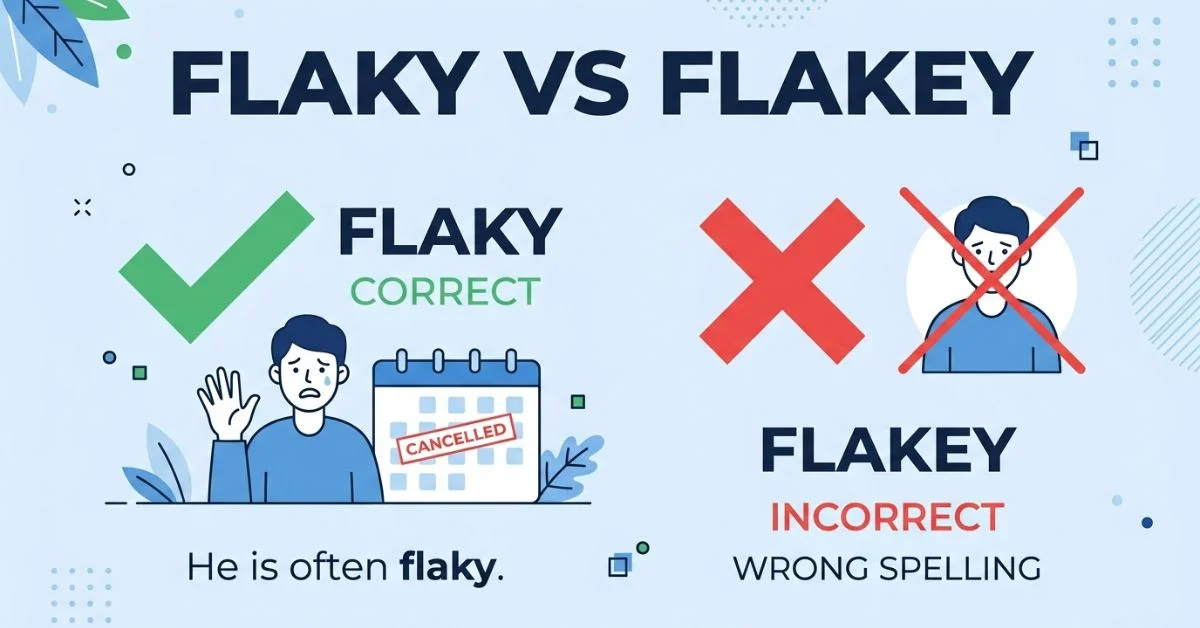
Correct spelling: flaky (standard English)
Incorrect / non-standard: flakey
✔ “Flaky” is the modern and accepted form in both American and British English.
✖ “Flakey” is considered outdated or informal.
Examples:
- ✔ flaky pastry (correct)
- ✔ flaky skin (correct)
- ✖ flakey person (incorrect in formal writing)
The Origin of “Flaky”
The word flaky comes from the noun “flake,” meaning a small thin piece that breaks off a surface.
- “Flake” + “-y” = flaky
- The suffix “-y” means “having the quality of”
Historically, English spelling was not standardized. Variations like “flakey” appeared because people tried to match pronunciation. Over time, dictionaries and modern linguistics standardized the spelling as flaky.
Linguistics helps explain how words evolve and stabilize in spelling systems.
British English vs American English Spelling
Interestingly, “flaky” is used in both British and American English today. There is no official regional difference anymore.
Comparison Table:
| Feature | British English | American English | Standard Today |
|---|---|---|---|
| Correct form | flaky | flaky | ✔ flaky |
| Old variation | flakey (rare) | flakey (rare) | ❌ outdated |
Both regions now follow standardized spelling rules taught in modern education systems.
Which Spelling Should You Use?
✔ Use “flaky” if you are:
- Writing blogs or SEO articles
- Submitting academic work
- Writing professional emails
- Targeting global audience
✖ Avoid “flakey” unless:
- You are writing informal social media content
- You are quoting old texts
For SEO and ranking, always choose flaky because search engines prefer standardized spelling.
Common Mistakes with “Flaky”
❌ Mistake 1: Using “flakey” in formal writing
✔ Correct: flaky behavior
✖ Wrong: flakey behavior
❌ Mistake 2: Confusing meaning
- flaky = unreliable OR light texture
- flakey = incorrect spelling variation
❌ Mistake 3: Over-correcting spelling
Some writers change correct “flaky” into “flakey” thinking it is more “English sounding.”
Flaky in Everyday Examples
📝 Emails
- “The meeting schedule seems flaky this week.”
📰 News Writing
- “Experts warn about flaky internet connections in rural areas.”
📱 Social Media
- “My friend is so flaky, she cancels plans every time!”
📚 Formal Writing
- “The pastry has a light and flaky texture.”
Flaky – Google Trends & Usage Data
Search behavior shows:
- “flaky” is highly dominant worldwide
- “flakey” appears mostly in informal searches or typo-based queries
- High search volume comes from:
- Students
- Bloggers
- ESL learners
The dominance of “flaky” confirms it as the standard global spelling in modern English usage.
Comparison Table: Flaky vs Flakey
| Word | Status | Meaning | Usage Level |
|---|---|---|---|
| flaky | Correct | Light / unreliable | Formal + Informal |
| flakey | Incorrect | Same meaning | Informal / outdated |
FAQs
1. Is “flakey” ever correct?
No, it is not considered standard English.
2. What is the correct spelling of flaky?
The correct spelling is flaky.
3. Does British English use “flakey”?
No, both British and American English use “flaky.”
4. What does flaky mean in slang?
It means someone who is unreliable or cancels plans often.
5. Can I use flakey in SEO writing?
No, it is better to use “flaky” for better ranking.
6. Is flaky used for food only?
No, it can describe food texture, skin condition, or behavior.
7. Why do people write flakey?
Because of pronunciation influence and older spelling habits.
Conclusion
The confusion between “flaky or flakey” is very common, but the answer is simple: flaky is the correct and modern spelling.
It is used in both British and American English and is accepted in all formal writing contexts.
The variation “flakey” comes from older or informal usage, but it is no longer recommended in professional communication, academic writing, or SEO content.
Using the correct spelling not only improves clarity but also helps your content rank better in search engines.
In everyday language, “flaky” can describe food texture, skin condition, or even unreliable behavior, making it a versatile and important word in English vocabulary.
Always prefer “flaky” for accuracy and professionalism.

Wilson Follett delivers sharp editorial insight at GrammarVibez.com, helping readers refine their writing, avoid common mistakes, and master precise word usage.