Last Updated on May 31, 2026 by ramzancloudeserver@gmail.com
If you have ever wondered whether math or maths is the correct spelling, you are not alone. Both words refer to the same subject: mathematics.
However, the preferred spelling depends largely on the country and type of English being used.
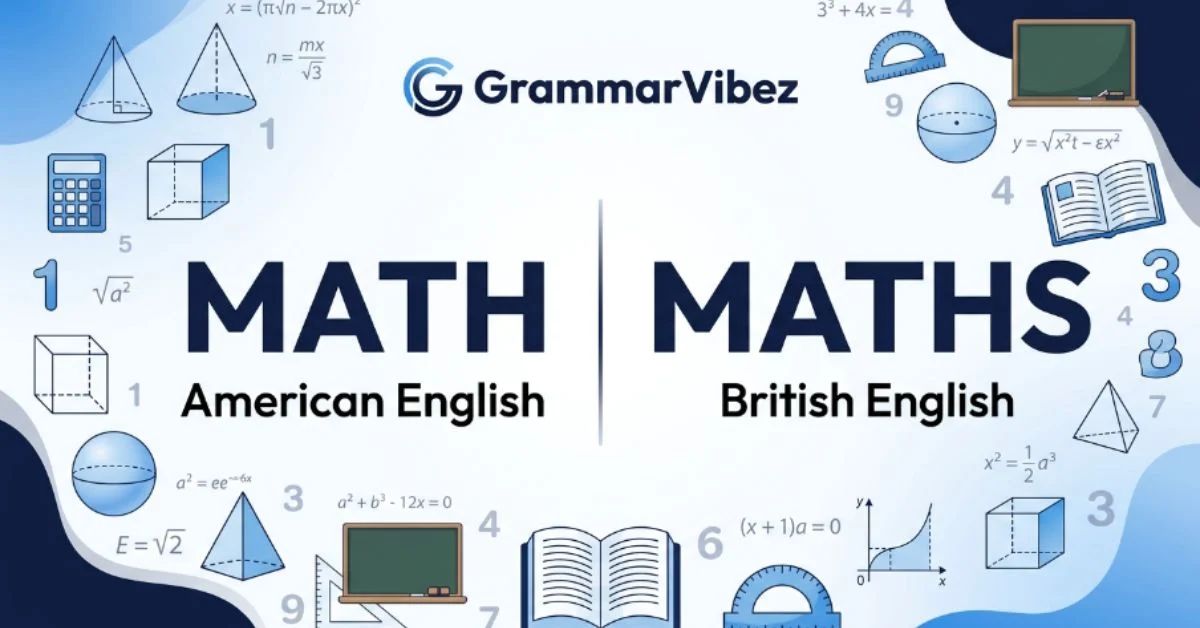
While American English favors math, British English, Australian English, and several other varieties prefer maths.
Therefore, understanding the difference can help you write more naturally for your audience.
This guide explains the meanings, history, usage, examples, and common mistakes related to these two spellings.
Quick Answer
Both math and maths are correct.
- Math is the standard abbreviation in American English.
- Maths is the standard abbreviation in British English and many Commonwealth countries.
The meaning is exactly the same in both cases.
Correct Example
- My favorite subject at school is math. (American English)
- She studies maths every evening. (British English)
Incorrect Example
- My favorite subject is maths. (If writing strictly for an American audience)
- He teaches math at a British school. (If following traditional British style)
These examples are not grammatically wrong, but they may sound unusual to local readers.
Meaning and Usage
Both spellings are shortened forms of mathematics, which is the academic discipline dealing with numbers, quantities, patterns, shapes, and logical reasoning.
Mathematics includes many branches, such as:
- Algebra
- Geometry
- Calculus
- Statistics
- Trigonometry
- Probability
- Number theory
For example, students use mathematics to solve equations, analyze data, and understand scientific concepts.
In everyday conversation, however, people often shorten the word:
- Americans usually say math.
- Britons usually say maths.
Meanwhile, the full word mathematics remains acceptable everywhere.
Origin and Spelling History
The word mathematics comes from the ancient Greek word mathema, meaning learning or knowledge.
The abbreviation developed differently across English-speaking countries.
In the United States, speakers shortened the word to math. Over time, this became the accepted standard in schools, universities, textbooks, and media.
In contrast, British English adopted maths. Many language historians believe the final “s” was retained because mathematics is treated as a plural-looking noun, similar to words like economics or physics.
Therefore, both spellings evolved naturally rather than one being more correct than the other.
British English vs American English
The biggest difference is regional preference.
| English Variety | Preferred Spelling |
|---|---|
| American English | Math |
| British English | Maths |
| Australian English | Maths |
| New Zealand English | Maths |
| South African English | Maths |
| Canadian English | Both, but Maths is common in some regions |
For example, a student in New York is likely to say “math class,” whereas a student in London is more likely to say “maths class.”
As a result, writers should match the spelling to their audience.
Spelling Comparison
| Feature | Math | Maths |
|---|---|---|
| Meaning | Mathematics | Mathematics |
| Correct? | Yes | Yes |
| American English | Preferred | Less common |
| British English | Less common | Preferred |
| Formal Writing | Acceptable | Acceptable |
| Academic Use | Common in US | Common in UK |
The key point is that the difference involves regional style, not meaning.
Which Spelling Should You Use?
The best spelling depends on your audience.
Use math if you are writing for:
- American readers
- US schools and universities
- American businesses
- US-based websites
Use maths if you are writing for:
- British readers
- Australian readers
- New Zealand readers
- International audiences following British English
However, once you choose a spelling, remain consistent throughout your content.
For example, do not switch between math and maths within the same article unless you are specifically discussing the difference.
Common Mistakes
Many writers make avoidable errors when using these spellings.
Mixing Regional Styles
Incorrect:
- I love maths, and my math teacher is great.
Correct:
- I love maths, and my maths teacher is great.
- I love math, and my math teacher is great.
Assuming One Is Wrong
Some people mistakenly believe that only one spelling is correct. In reality, both are accepted forms.
Ignoring Audience Expectations
Using the wrong regional spelling can make content feel less natural to readers. Therefore, always consider your target audience before publishing.
Real-Life Examples
Here are examples showing how each spelling appears in everyday English.
American English
- Math is my strongest subject.
- Our math teacher assigned homework.
- She earned a degree in math.
British English
- Maths is my strongest subject.
- Our maths teacher assigned homework.
- She earned a degree in maths.
Academic Context
- Mathematics plays a vital role in engineering.
- Mathematics helps scientists analyze complex data.
- Mathematics is essential in computer science.
Notice that the full term works universally.
Helpful Grammar Tips
When deciding between math and maths, keep these simple rules in mind.
- Use math for American English.
- Use maths for British English.
- Use mathematics when you want a formal or universal term.
- Stay consistent throughout your writing.
- Consider your audience before choosing a spelling.
Furthermore, remember that search engines recognize both forms as referring to the same subject. However, localized content often performs better when it matches regional language preferences.
FAQs
Is math or maths correct?
Both are correct. The choice depends on whether you are using American English or British English.
Why do Americans say math instead of maths?
American English adopted the shorter form math, and it became the standard abbreviation over time.
Why do British people say maths?
British English retained the final “s” from mathematics, leading to the abbreviation maths.
Is mathematics singular or plural?
Although mathematics ends with “s,” it is usually treated as a singular noun.
Example:
- Mathematics is an important subject.
Can I use mathematics instead of math or maths?
Yes. Mathematics is universally accepted and works in both American and British English.
Which spelling is better for SEO?
Neither spelling is inherently better. Instead, choose the version that matches your target audience and geographic market.
Conclusion
The debate between math and maths is not about right or wrong. Rather, it is a matter of regional language preference.
Americans typically use math, while British, Australian, and many other English speakers prefer maths.
The meaning remains exactly the same, and both abbreviations come from the word mathematics.
Therefore, the smartest approach is to choose the spelling that fits your audience and use it consistently.
Whether you write math, maths, or the full word mathematics, your readers will understand the subject you mean.

Lindley Murray brings classic grammar knowledge to GrammarVibez.com, guiding readers through tricky word choices and spelling rules with simple and timeless explanations.