Last Updated on June 12, 2026 by ramzancloudeserver@gmail.com
Many English learners get confused between “any time” and “anytime.” Both look similar, but they are used differently in grammar and writing.
Some people think they mean the same thing, while others are unsure which one is correct in formal or informal English.
In reality, both are correct, but their usage depends on context. One is mainly used as a phrase (two words), while the other is often used as an adverb (one word).
Understanding the difference helps you write better English, avoid common mistakes, and improve your communication in both academic and casual settings.
In this guide, we will explain the meaning, usage rules, differences, examples, and simple tricks to remember when to use any time or anytime correctly.
Quick Answer
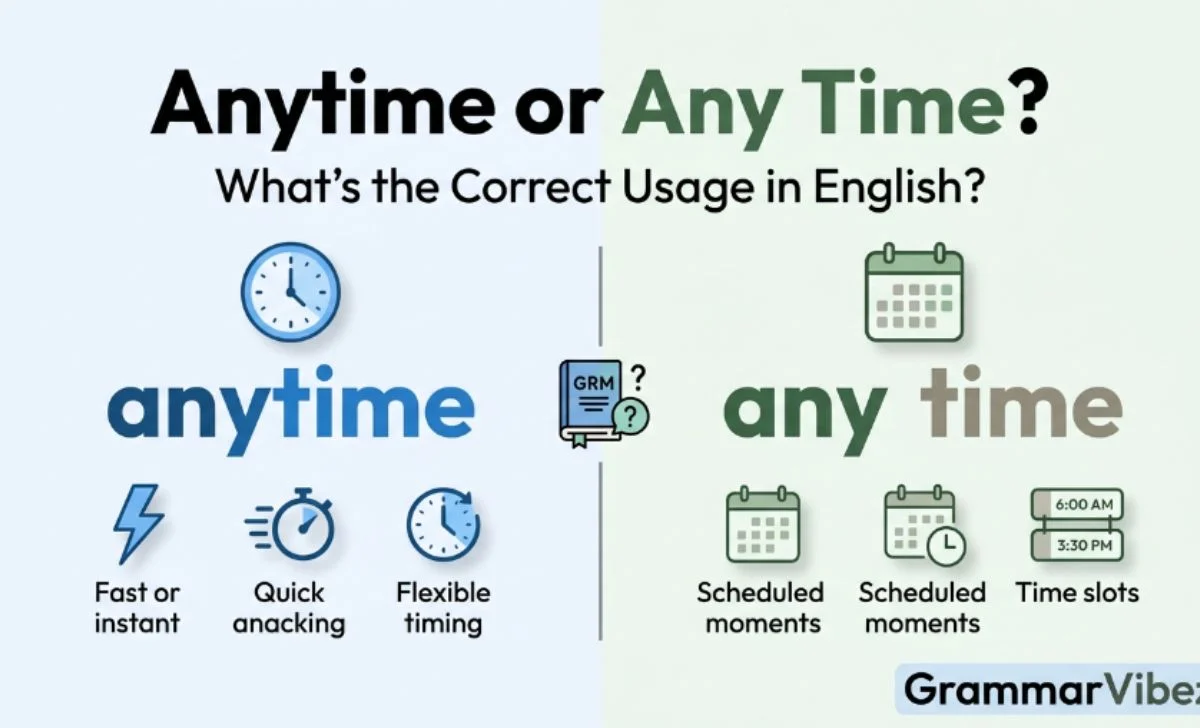
- Any time (two words) = refers to time or a specific moment
- Anytime (one word) = means “whenever” or “at any point”
👉 Both are correct, but usage depends on sentence structure.
Meaning and Usage of Any Time
“Any time” is a phrase made of two words. It is used when talking about time in a general or specific way.
Simple Meaning:
It refers to “any particular time” or “no fixed time.”
When to use “Any time”:
- When “time” is a noun
- When used after prepositions (like at, for, in)
Examples:
- You can call me at any time.
- I don’t have any time to waste.
- Is there any time left before the meeting?
👉 Here, “time” is a noun, so it stays separate.
Meaning and Usage of Anytime
“Anytime” is a single word and works as an adverb. It means “whenever” or “at any time you like.”
Simple Meaning:
It means something can happen at any moment or whenever needed.
Examples:
- You can visit me anytime.
- Anytime you need help, just call me.
- I am ready anytime.
👉 Here, it replaces phrases like “whenever.”
Any Time vs Anytime: Key Differences
| Feature | Any Time | Anytime |
|---|---|---|
| Type | Phrase (noun + adjective) | Adverb |
| Usage | Refers to time | Means “whenever” |
| Structure | Two words | One word |
| Formal writing | More preferred | Less formal but common |
| Example | Call me at any time | Call me anytime |
American vs British English Usage
Both forms are used in American and British English, but there is a slight preference difference.
| Region | Usage Style |
|---|---|
| American English | “Anytime” is very common in speech and writing |
| British English | “Any time” is preferred in formal writing |
However, both are widely accepted globally.
Common Mistakes
1. Using “anytime” in formal writing incorrectly
❌ I don’t have anytime for this meeting
✔ I don’t have any time for this meeting
2. Mixing meanings
❌ Call me any time (when meaning “whenever”)
✔ Call me anytime
3. Overthinking the difference
Both are correct—context matters more than spelling.
4. Wrong usage after prepositions
❌ I can meet you anytime at
✔ I can meet you at any time
Real-Life Examples
Daily Conversation:
- You can message me anytime.
- I don’t have any time today.
Work Context:
- We can schedule the meeting at any time tomorrow.
- Feel free to contact me anytime for support.
Education Context:
- You can ask questions anytime during class.
- There is no any time left for revision.
Helpful Tips to Remember
- If you can replace it with “whenever,” use anytime
- If “time” is a noun, use any time
- “At any time” is always two words
- “Anytime” sounds more casual and natural in speech
- Practice with examples to build confidence
FAQs
Is anytime one word or two words?
Both are correct. “Anytime” is one word, “any time” is two words.
When should I use any time?
Use it when referring to time as a noun or after prepositions.
Is anytime correct in formal writing?
It is acceptable but “any time” is often preferred in formal contexts.
What does anytime mean?
It means “whenever” or “at any moment.”
Can I say call me anytime?
Yes, it is correct and commonly used in spoken English.
Conclusion
The difference between any time and anytime is simple once you understand the rule. “Any time” is used when referring to time as a noun, especially in formal writing or after prepositions.
On the other hand, “anytime” is an adverb that means “whenever” and is commonly used in casual English.
Both forms are correct, and choosing the right one depends on context rather than strict grammar rules.
With practice, you will naturally understand when to use each form. This small grammar difference can improve your writing clarity and make your English sound more natural and confident in both spoken and written communication.

Wilson Follett delivers sharp editorial insight at GrammarVibez.com, helping readers refine their writing, avoid common mistakes, and master precise word usage.