Last Updated on June 12, 2026 by ramzancloudeserver@gmail.com
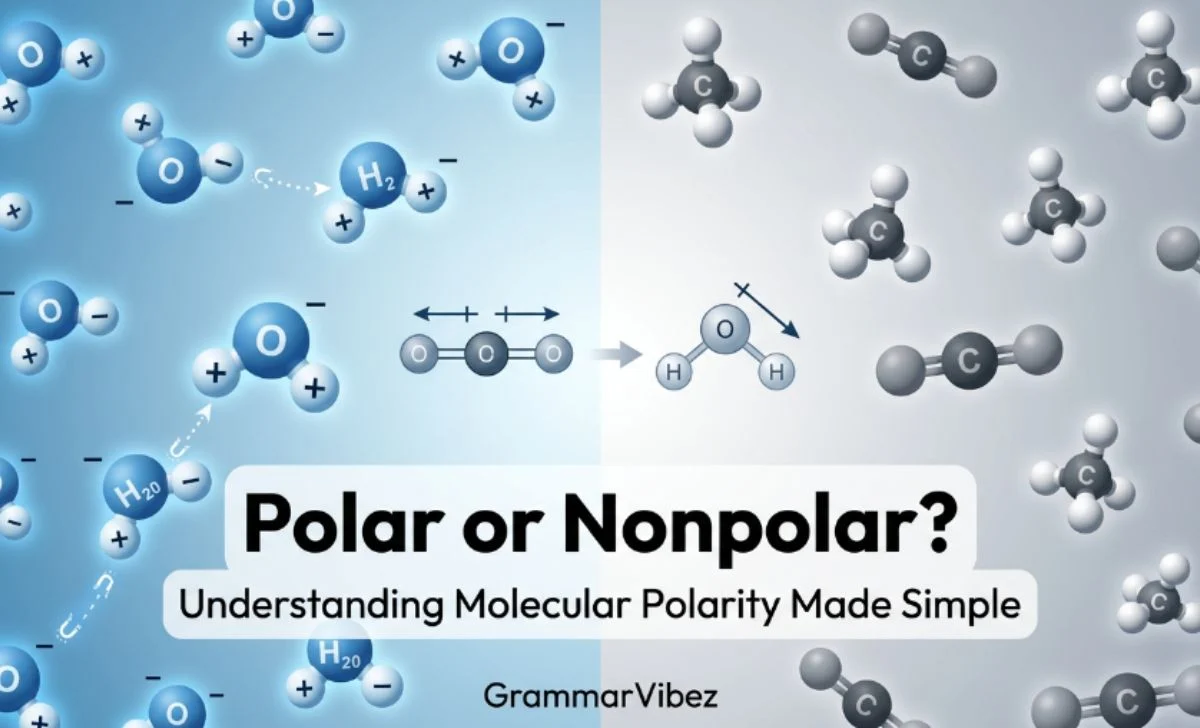
In chemistry, understanding whether a molecule is polar or nonpolar is very important. It helps explain how substances mix, react, and behave in different conditions.
For example, why oil does not mix with water or why some substances dissolve easily while others do not, all of this depends on polarity.
The terms polar and nonpolar describe how electrons are distributed in a molecule.
Some molecules have an uneven charge distribution, while others are completely balanced. This difference affects their physical and chemical properties.
In this guide, we will clearly explain what polar and nonpolar mean, how to identify them, real-life examples, differences, common mistakes, and simple tips to understand them easily, even if you are a beginner in chemistry.
Quick Answer
- Polar molecules = have uneven charge distribution (positive and negative ends)
- Nonpolar molecules = have equal charge distribution (no poles)
👉 Polar = uneven sharing of electrons
👉 Nonpolar = equal sharing of electrons
Meaning and Usage of Polar and Nonpolar
What is a Polar Molecule?
A polar molecule forms when electrons are shared unequally between atoms. This creates a slight positive charge on one side and a negative charge on the other.
Simple Meaning:
A molecule with two opposite charges (like tiny magnets).
Example:
- Water (H₂O) is a polar molecule
Why?
Oxygen pulls electrons more strongly than hydrogen, creating an uneven charge.
What is a Nonpolar Molecule?
A nonpolar molecule has electrons shared equally between atoms. As a result, there is no positive or negative side.
Simple Meaning:
A molecule with balanced charge.
Examples:
- Oxygen gas (O₂)
- Nitrogen gas (N₂)
- Methane (CH₄)
Key Difference Between Polar and Nonpolar
| Feature | Polar | Nonpolar |
|---|---|---|
| Electron sharing | Unequal | Equal |
| Charge | Positive & negative poles | No poles |
| Solubility | Dissolves in water | Does not dissolve in water |
| Example | Water (H₂O) | Oxygen (O₂) |
| Molecular shape | Asymmetrical | Symmetrical |
How to Identify Polar or Nonpolar Molecules
You can easily identify polarity using simple steps:
Step 1: Check Electronegativity
If atoms pull electrons differently → molecule is polar.
Step 2: Check Shape
- Symmetrical shape → usually nonpolar
- Asymmetrical shape → usually polar
Step 3: Look at Bond Type
- Polar bonds → may create polar molecules
- Nonpolar bonds → usually nonpolar molecules
Why Polarity is Important in Chemistry
Polarity affects many natural and chemical processes:
1. Solubility
- Polar dissolves polar (water + salt)
- Nonpolar dissolves nonpolar (oil + grease)
2. Biological systems
- Cell membranes depend on polar and nonpolar interactions
3. Chemical reactions
- Polarity controls how molecules interact
Real-Life Examples of Polar and Nonpolar
Polar Examples:
- Water (H₂O)
- Ammonia (NH₃)
- Alcohol (ethanol)
Nonpolar Examples:
- Oil
- Oxygen (O₂)
- Carbon dioxide (CO₂ – overall nonpolar due to symmetry)
Common Mistakes Students Make
1. Thinking all bonds make polar molecules
Not true. Even polar bonds can form nonpolar molecules if shape is symmetrical.
2. Confusing “bond polarity” with “molecule polarity”
A molecule depends on both bonds AND shape.
3. Assuming water is nonpolar
Water is always polar due to its bent shape.
4. Ignoring molecular geometry
Shape is just as important as electronegativity.
Helpful Tips to Remember Polar vs Nonpolar
- Think “polar = poles like a magnet”
- Think “nonpolar = balanced and equal”
- Water is always the best example of polar
- Oils are always nonpolar
- Symmetry usually means nonpolar
FAQs
What does polar mean in chemistry?
It means a molecule has uneven electron distribution with positive and negative ends.
What does nonpolar mean?
It means electrons are shared equally and there is no charge separation.
Is water polar or nonpolar?
Water is polar.
Is CO₂ polar or nonpolar?
CO₂ is nonpolar due to its symmetrical shape.
Why is oil nonpolar?
Because it has equal sharing of electrons and no charge separation.
Can polar and nonpolar mix?
Usually no, because they do not attract each other.
Conclusion
The concept of polar or nonpolar is one of the most important basics in chemistry. It explains how molecules behave, interact, and dissolve in different substances.
Polar molecules have an uneven charge distribution, while nonpolar molecules have balanced electrons.
This difference affects everything from water mixing with salt to oil separating from water.
Understanding polarity also helps in biology, medicine, and environmental science.
Although it may seem complex at first, simple rules like checking molecular shape and electron sharing make it easy to understand.
Once you master this concept, many chemistry topics become much easier to learn and remember.