Last Updated on June 11, 2026 by ramzancloudeserver@gmail.com
Many people struggle with your or you’re because both words sound exactly the same when spoken.
However, they have different meanings, different grammar rules, and different uses in a sentence.
If you use the wrong word, your writing can look unprofessional, whether you’re writing an email, school assignment, social media post, or business document.
The good news is that learning the difference is easy.
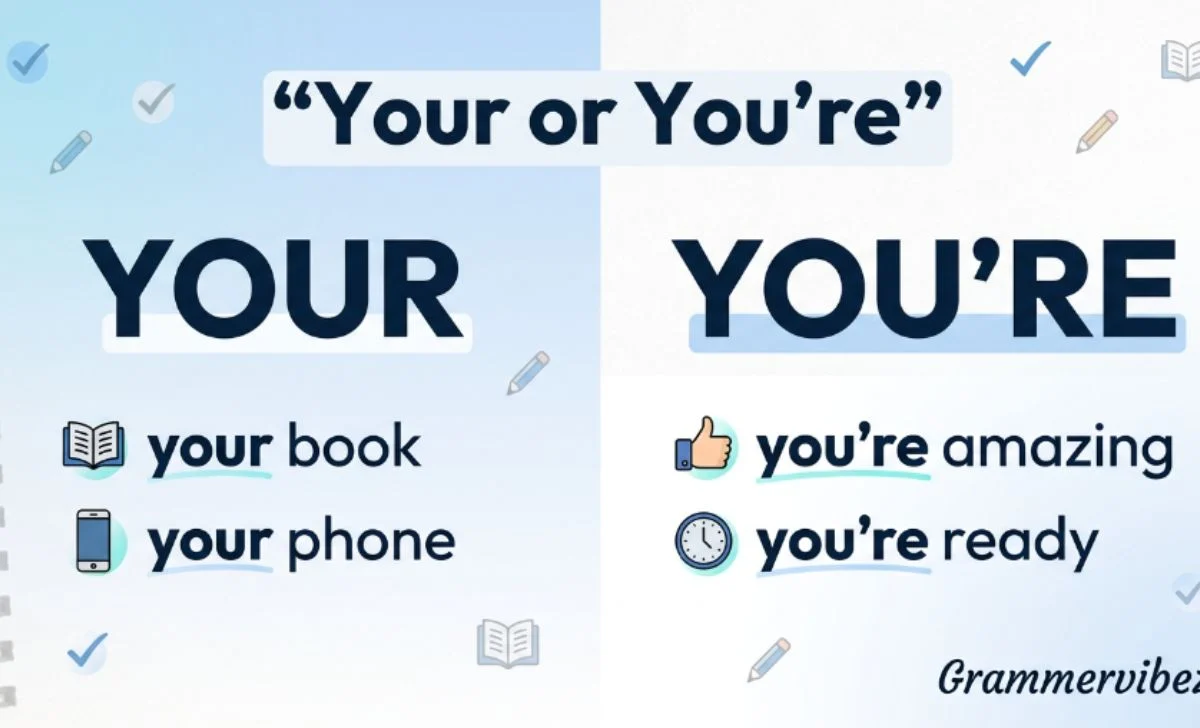
Your shows ownership or possession, while you’re is a contraction of you are. A simple trick is to replace the word with you are. If the sentence still makes sense, use you’re. If it doesn’t, use your.
In this guide, you’ll learn the meaning of both words, grammar rules, examples, common mistakes, exercises, quiz questions, and tips to remember the difference forever.
Quick Answer
The difference between your and you’re is simple:
- Your shows ownership.
- You’re means you are.
Examples
- Your phone is ringing.
- You’re answering the phone.
In the first sentence, the phone belongs to you.
In the second sentence, you’re means you are.
Your vs You’re Comparison Table
| Feature | Your | You’re |
|---|---|---|
| Meaning | Shows ownership | Means “you are” |
| Grammar Type | Possessive adjective | Contraction |
| Indicates | Possession | State of being |
| Can Replace with “You Are”? | No | Yes |
| Example | Your car is outside. | You’re driving the car. |
What Does Your Mean?
Your is a possessive adjective (sometimes called a possessive determiner). It shows that something belongs to the person being addressed.
Your Meaning
The word your expresses:
- Ownership
- Possession
- Relationship
- Association
Examples of Your
- Your laptop is on the desk.
- I like your idea.
- Your dog is very friendly.
- Your homework is complete.
- Your opinion matters.
In every example, something belongs to or is connected to the person being addressed.
When to Use Your
Use your whenever you want to show ownership.
Possession
- Is this your jacket?
- Where is your passport?
Relationships
- Your sister called earlier.
- I met your parents yesterday.
Responsibilities
- Finishing the report is your responsibility.
- Your task is due tomorrow.
Personal Characteristics
- Your creativity is impressive.
- Your sense of humor makes everyone laugh.
Whenever ownership is involved, your is usually the correct choice.
What Does You’re Mean?
You’re is a contraction of you are.
A contraction combines two words into one and uses an apostrophe to replace missing letters.
In you’re, the apostrophe replaces the letter a in the word are.
You’re Meaning
The word you’re simply means:
You are
Examples of You’re
- You’re very talented.
- You’re making excellent progress.
- You’re going to enjoy this book.
- You’re always welcome here.
- You’re working hard today.
When to Use You’re
Use you’re whenever you can replace it with you are.
Describing Someone
- You’re smart.
- You’re honest.
- You’re reliable.
Showing a State of Being
- You’re tired.
- You’re excited.
- You’re happy.
Talking About Actions
- You’re learning English.
- You’re improving every day.
- You’re doing great.
The Easy “You Are” Test
The easiest way to choose between your and you’re is the You Are Test.
Replace the word with you are.
If the sentence still makes sense, use you’re.
Example
You’re amazing.
Replace it:
You are amazing.
The sentence still makes sense.
Therefore, you’re is correct.
Example
Your amazing presentation impressed everyone.
Replace it:
You are amazing presentation impressed everyone.
The sentence becomes incorrect.
Therefore, your is correct.
Why Are Your and You’re Commonly Confused?
These words are often confused because they are homophones.
Homophones are words that:
- Sound the same
- Have different meanings
- Have different spellings
Other examples include:
- Their, There, and They’re
- Its and It’s
- To, Too, and Two
- Who’s and Whose
- Then and Than
Because your and you’re sound identical, writers sometimes choose the wrong spelling.
Your vs You’re Examples
Examples Using Your
- Your coffee is getting cold.
- Your car needs fuel.
- Your presentation was excellent.
- Your team won the competition.
- Your project looks professional.
- Your children are very polite.
- Your garden looks beautiful.
- Your phone battery is low.
- Your book is on the shelf.
- Your decision was correct.
Examples Using You’re
- You’re doing a fantastic job.
- You’re one of my best friends.
- You’re welcome to stay.
- You’re improving rapidly.
- You’re very thoughtful.
- You’re going to love this restaurant.
- You’re responsible for the presentation.
- You’re becoming more confident.
- You’re always helpful.
- You’re ready for the exam.
Your or You’re in a Sentence
Here are sentence pairs showing the difference clearly.
| Correct Usage of Your | Correct Usage of You’re |
|---|---|
| Your bag is missing. | You’re looking for your bag. |
| Your report is excellent. | You’re an excellent writer. |
| Your room is clean. | You’re very organized. |
| Your idea helped us. | You’re incredibly creative. |
| Your schedule is busy. | You’re working hard this week. |
Common Mistakes With Your and You’re
Incorrect
Your going to be late.
Correct
You’re going to be late.
Incorrect
I like you’re new shoes.
Correct
I like your new shoes.
Incorrect
Your the best employee here.
Correct
You’re the best employee here.
Incorrect
You’re homework is due tomorrow.
Correct
Your homework is due tomorrow.
These are among the most common grammar mistakes in English writing.
Is It Your Welcome or You’re Welcome?
Many people write:
❌ Your welcome
This is incorrect.
The correct phrase is:
✅ You’re welcome
Because the phrase means:
✅ You are welcome
Example
- Thank you for helping me.
- You’re welcome.
Is It Your Right or You’re Right?
The correct phrase is:
✅ You’re right
Because it means:
✅ You are right
Example
- I checked the answer.
- You’re right.
However, your right can be correct when discussing ownership.
Example
- It is your right to vote.
Your and You’re in Emails
Professional emails require proper grammar.
Correct Examples
- Thank you for your feedback.
- Your request has been approved.
- You’re receiving this email because you subscribed.
- You’re invited to attend the meeting.
Incorrect Examples
- Thank you for you’re feedback.
- Your invited to attend the meeting.
Your and You’re in Academic Writing
Grammar accuracy is important in school and university assignments.
Correct
- Your research supports the argument.
- You’re expected to cite your sources.
Incorrect
- You’re research supports the argument.
- Your expected to cite your sources.
Your and You’re in Business Writing
Businesses value clear communication.
Examples
- Your application has been reviewed.
- You’re eligible for the next stage.
- Your account has been updated.
- You’re approved for the program.
Using the correct word improves professionalism and credibility.
Your and You’re Exercises
Choose the correct answer.
- _____ going to enjoy the concert.
- I found _____ wallet.
- _____ one of the best students.
- What is _____ opinion?
- _____ welcome to join us.
- Where is _____ phone?
- _____ making great progress.
- I appreciate _____ support.
- _____ invited to the conference.
- Is this _____ backpack?
Answers
- You’re
- Your
- You’re
- Your
- You’re
- Your
- You’re
- Your
- You’re
- Your
Your and You’re Worksheet
Fill in the blanks.
- ______ car is parked outside.
- ______ always prepared for class.
- I admire ______ determination.
- ______ going to succeed.
- Is this ______ notebook?
- ______ one of the most reliable people I know.
- Thank you for ______ patience.
- ______ welcome anytime.
- Where is ______ ticket?
- ______ doing an excellent job.
Worksheet Answers
- Your
- You’re
- Your
- You’re
- Your
- You’re
- Your
- You’re
- Your
- You’re
Your and You’re Quiz
Question 1
_____ presentation was outstanding.
A. Your
B. You’re
Answer: A. Your
Question 2
_____ doing better than last week.
A. Your
B. You’re
Answer: B. You’re
Question 3
I appreciate _____ help.
A. Your
B. You’re
Answer: A. Your
Question 4
_____ one of our top performers.
A. Your
B. You’re
Answer: B. You’re
Question 5
_____ application has been accepted.
A. Your
B. You’re
Answer: A. Your
Related Grammar Mistakes
If you’re learning the difference between your and you’re, you may also find these grammar pairs confusing:
- Their vs They’re
- There vs Their vs They’re
- Its vs It’s
- Who’s vs Whose
- To vs Too vs Two
- Then vs Than
- Affect vs Effect
- Lose vs Loose
- Accept vs Except
Understanding these commonly confused words can improve your writing accuracy.
Tips to Remember the Difference
- Your = Ownership
- You’re = You Are
- Use the You Are Test
- Look for a noun after your
- Check whether you are fits naturally into the sentence
- Proofread before publishing or sending messages
These simple techniques help eliminate mistakes quickly.
FAQs
What is the difference between your and you’re?
Your shows possession, while you’re is a contraction of you are.
Is your a pronoun?
No. Your is a possessive adjective used before nouns.
Is you’re a contraction?
Yes. It combines you and are into one word.
Why do people confuse your and you’re?
Because they are homophones that sound identical when spoken.
Can your and you’re be used interchangeably?
No. They have different meanings and grammatical functions.
How do I know whether to use your or you’re?
Replace the word with you are. If the sentence still makes sense, use you’re.
Is “your welcome” correct?
No. The correct phrase is you’re welcome.
Is “your right” correct?
Usually, you’re right is correct. However, your right can be correct when referring to a legal or personal right.
Is your formal or informal?
Your can be used in both formal and informal writing.
Is you’re acceptable in formal writing?
Yes, although some highly formal documents may prefer you are instead.
Conclusion
Understanding the difference between your and you’re is one of the most important English grammar skills.
Your shows possession, ownership, or association, while you’re is simply a contraction of you are.
Whenever you’re unsure, use the You Are Test. If replacing the word with you are keeps the sentence correct, choose you’re. If it doesn’t, use your.
With enough practice, examples, quizzes, and exercises, you’ll never confuse your and you’re again.