Last Updated on June 2, 2026 by ramzancloudeserver@gmail.com
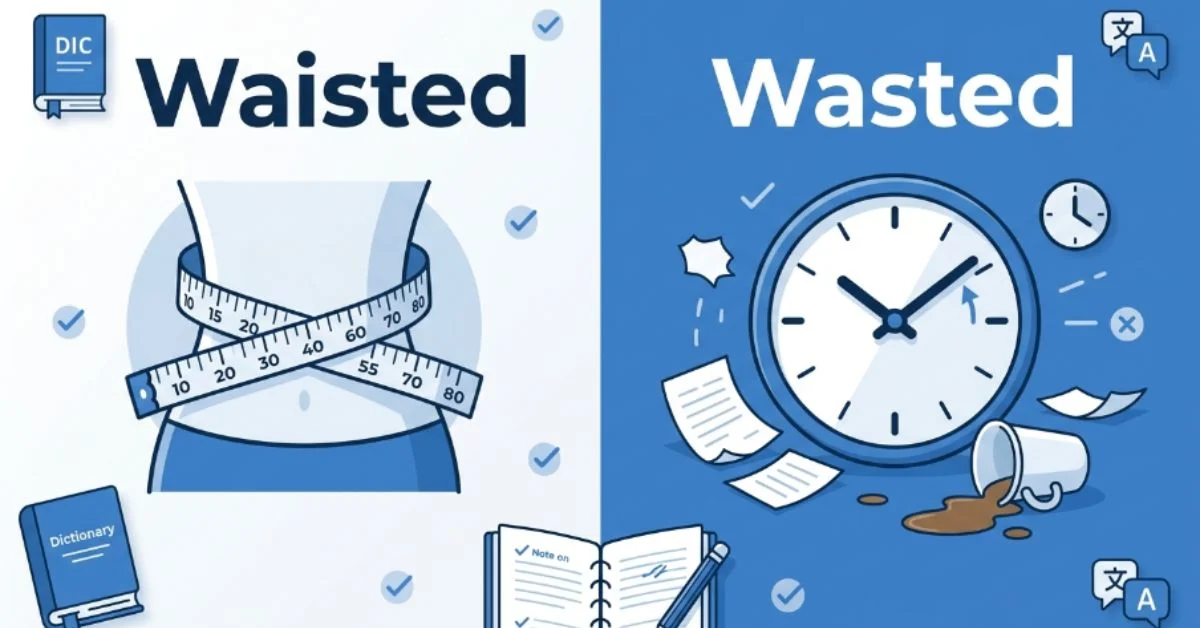
The confusion between waisted and wasted is more common than many people realize. Although these words look similar, they have very different meanings and uses.
In most everyday situations, people actually mean wasted, not waisted. However, because both words exist in English, it is easy to choose the wrong one when writing.
Therefore, understanding the distinction can help you communicate more clearly and avoid embarrassing mistakes.
This guide explains the meaning, history, usage, examples, and grammar rules behind waisted and wasted in simple, practical language.
Quick Answer
Wasted is the correct word in most situations when talking about something being used poorly, lost, ruined, or consumed unnecessarily.
Waisted is a real word, but it is much less common. It relates to having a waist or a particular waist shape in clothing and fashion descriptions.
Correct Example
- I wasted three hours scrolling through social media.
- She wore a high-waisted skirt to the event.
- Don’t waste your money on products you don’t need.
Incorrect Example
- I waisted my entire weekend watching television. ❌
- We waisted valuable resources on the failed project. ❌
In these sentences, wasted is the correct choice.
Meaning and Usage
The difference between waisted and wasted becomes clear when you look at their meanings.
Wasted
Wasted is the past tense and past participle of the verb waste.
It means:
- Used carelessly
- Lost unnecessarily
- Squandered
- Consumed without benefit
- Ruined or depleted
Examples:
- He wasted a great opportunity.
- The company wasted thousands of dollars.
- We wasted food by ordering too much.
Waisted
Waisted is an adjective used mainly in fashion and clothing.
It describes something related to the waist.
Examples:
- A high-waisted pair of jeans.
- A narrow-waisted dress design.
- A low-waisted skirt became popular in the early 2000s.
Because fashion discussions are less common than everyday conversations about wasting time or money, wasted appears far more frequently.
Origin and Spelling History
The word waste comes from Old French and Latin roots meaning “desolate,” “empty,” or “destroyed.”
Over time, English speakers developed the verb waste to describe the careless use of resources, opportunities, and time.
Meanwhile, waist originated from Middle English and referred to the middle section of the human body.
As fashion vocabulary expanded, terms like high-waisted and low-waisted became common.
Therefore, although the words look similar, they developed from entirely different origins.
British English vs American English
Unlike many spelling debates such as “recognize” versus “recognise,” there is no significant British or American English difference here.
| English Variant | Preferred Form |
|---|---|
| American English | Wasted / Waisted |
| British English | Wasted / Waisted |
| Canadian English | Wasted / Waisted |
| Australian English | Wasted / Waisted |
Both countries use the same spellings because these words have different meanings rather than regional spelling variations.
Spelling Comparison
| Feature | Waisted | Wasted |
|---|---|---|
| Part of Speech | Adjective | Verb/Adjective |
| Main Meaning | Related to the waist | Used poorly or lost |
| Common Usage | Fashion and clothing | Everyday language |
| Frequency | Rare | Very common |
| Example | High-waisted jeans | Wasted time |
As a result, most writers searching for “waisted or wasted” are usually looking for the word wasted.
Which Spelling Should You Use?
The correct choice depends entirely on your meaning.
Use wasted when discussing:
- Time
- Money
- Energy
- Resources
- Opportunities
- Effort
Examples:
- I wasted my afternoon.
- They wasted valuable resources.
- She felt her talent was wasted.
Use waisted when discussing:
- Clothing
- Fashion
- Garment design
- Body shape descriptions
Examples:
- The model wore a high-waisted dress.
- The designer created a narrow-waisted jacket.
Therefore, context determines the correct word.
Common Mistakes
Many English learners make predictable mistakes with these words.
Confusing Similar Spellings
Because the words differ by only one letter, writers often select the wrong option without noticing.
Assuming Waisted Is a Misspelling
Interestingly, waisted is a legitimate English word. However, it appears mainly in fashion-related contexts.
Using Waisted for Lost Time
This is perhaps the most common error.
Incorrect:
- I waisted my chance. ❌
Correct:
- I wasted my chance. ✅
Relying Only on Spell Check
Some spelling tools will not flag “waisted” because it is a valid word. Therefore, you must verify that it matches your intended meaning.
Real-Life Examples
Consider these practical examples.
School
- He wasted hours studying the wrong material.
- Students should avoid wasting valuable study time.
Business
- The company wasted resources on an unsuccessful campaign.
- Managers try to reduce wasted effort.
Daily Life
- I wasted money on items I never used.
- She regretted wasting her weekend indoors.
Fashion
- The store specializes in high-waisted jeans.
- Designers often feature fitted and narrow-waisted styles.
These examples show how the context changes the correct word.
Helpful Grammar Tips
Think About the Meaning First
Before choosing a word, ask yourself whether you are discussing loss or clothing.
Remember the Keyword
If the sentence involves:
- Time
- Effort
- Money
- Resources
Then use wasted.
Connect Waisted to Waist
The word waisted contains the word waist. Therefore, it should immediately remind you of clothing or body shape.
Read the Sentence Aloud
Often, reviewing the full sentence helps identify whether the chosen word makes logical sense.
FAQs
Is it waisted or wasted time?
Wasted time is correct. “Waisted time” is incorrect because time cannot relate to a waist.
Is waisted a real word?
Yes. Waisted is a legitimate adjective used mainly in fashion and clothing descriptions.
Why do people confuse waisted and wasted?
They look very similar in spelling. However, their meanings are completely different.
What does high-waisted mean?
High-waisted describes clothing that sits above the natural waistline, such as high-waisted jeans or trousers.
Which word is more common?
Wasted is significantly more common because it appears in everyday conversations, writing, business communication, and education.
Conclusion
Understanding the difference between waisted and wasted is simpler than it first appears.
In most situations, wasted is the correct choice because it refers to something lost, misused, or consumed without benefit.
Meanwhile, waisted is a specialized term used mainly in fashion to describe clothing that relates to the waist.
Therefore, the next time you write about wasted time, wasted money, or wasted opportunities, you can do so confidently.
By remembering that waisted connects to the waist, you can easily avoid one of English’s most common spelling mistakes.

Lindley Murray brings classic grammar knowledge to GrammarVibez.com, guiding readers through tricky word choices and spelling rules with simple and timeless explanations.