Last Updated on April 24, 2026 by ramzancloudeserver@gmail.com
Have you ever written “planing” and wondered if it should be “planning” instead?
This is a very common spelling confusion. Many learners and even professionals make this mistake. The words look almost the same. But they have very different meanings.
The confusion usually comes from English spelling rules. When we add -ing to verbs, sometimes we double the last letter. Sometimes we don’t. This makes it tricky.
If you use the wrong form, your sentence can become incorrect—or even change meaning completely.
In this guide, you will learn:
- The correct spelling
- The difference between planing and planning
- The grammar rule behind it
- Easy examples
- Common mistakes to avoid
Let’s make it simple and clear.
Quick Answer
✅ “Planning” is correct for most cases
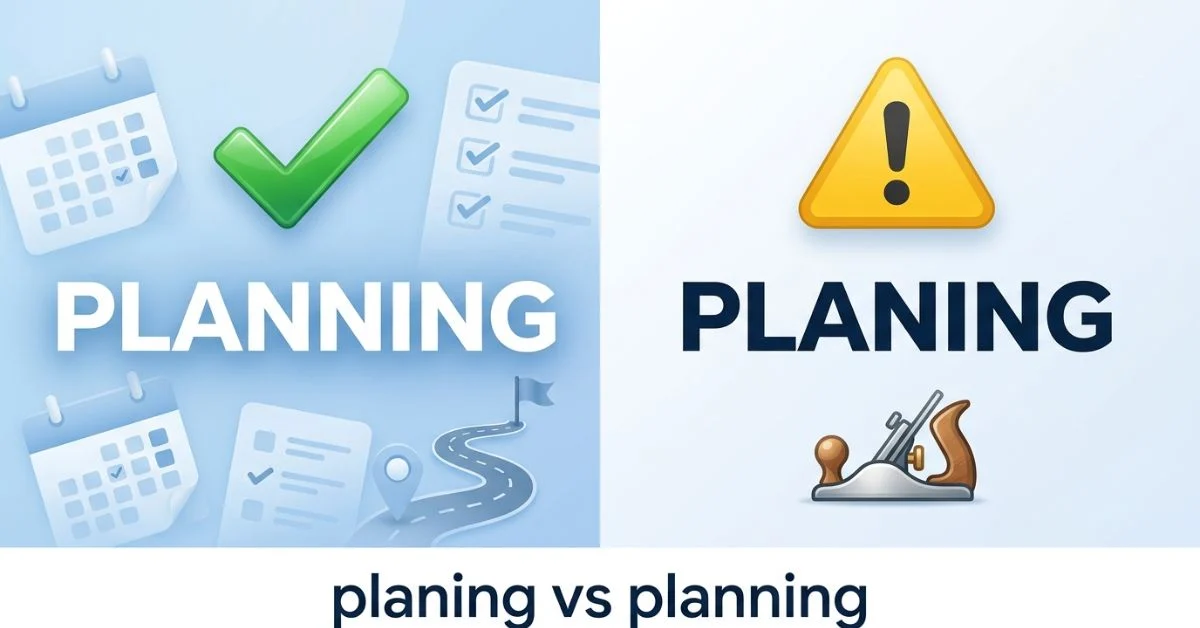
⚠️ “Planing” is a real word, but different meaning
👉 Use planning when talking about making plans
👉 Use planing only for a special technical meaning
Examples:
- ✔️ I am planning a trip
- ✔️ She is planning a project
👉 Simple rule:
Daily use = planning
The Origin of Planing or Planning
The word comes from the base verb “plan.”
When we add -ing, the spelling changes:
- plan → planning
Why double “n”?
Because of a common rule:
👉 Short vowel + consonant → double the consonant
So:
- plan → planning (correct)
What about “planing”?
- It comes from the word plane
- It means smoothing or shaping wood
👉 That’s why the meanings are different
British English vs American English Spelling
Here’s the good news:
👉 Both British English and American English use:
- planning (correct for plans)
Comparison Table
| Feature | Planning | Planing |
|---|---|---|
| Correct for “making plans” | ✔️ Yes | ❌ No |
| Technical meaning | ❌ No | ✔️ Yes |
| Used in UK | ✔️ Yes | Rare |
| Used in USA | ✔️ Yes | Rare |
| Everyday writing | ✔️ Yes | ❌ No |
👉 “Planning” is standard worldwide
Which Spelling Should You Use?
The answer is simple:
👉 Always use planning for normal writing
Use it in:
- Emails
- Business communication
- Travel plans
- Projects
- Daily conversation
When to use “planing”?
Only in technical context:
- Woodworking
- Shaping surfaces
👉 Most people will never need “planing”
Common Mistakes with Planing or Planning
Here are common errors:
❌ Mistake 1: Forgetting double “n”
❌ planing a trip
✔️ planning a trip
❌ Mistake 2: Not knowing the rule
- plan → planning (double n)
❌ Mistake 3: Confusing meanings
- planning = making plans
- planing = smoothing wood
👉 Always check your context
Planing or Planning in Everyday Examples
📧 Email:
- I am planning a meeting
🏢 Business:
- The team is planning a new strategy
✈️ Travel:
- We are planning a vacation
🛠️ Technical (rare):
- He is planing the wood surface
👉 Notice:
- Daily use → planning
- Technical use → planing
Planing or Planning – Google Trends & Usage Data
- “Planning” is used worldwide:
- USA
- UK
- Pakistan
- India
- “Planing”:
- Rare in general use
- Mostly technical term
Insight:
👉 “Planning” dominates search and usage
👉 “Planing” is niche and specialized
Grammar Rule for Adding -ING
This is the key rule:
👉 If a word ends in:
- Short vowel + consonant → double the consonant
Examples:
- run → running
- sit → sitting
- stop → stopping
- plan → planning
Exceptions:
- open → opening
- read → reading
- play → playing
👉 Learn this rule to avoid mistakes
Comparison Table (All Variations)
| Word | Meaning | Usage | Example |
|---|---|---|---|
| Plan | Base verb | Make plans | I plan ahead |
| Planning | Action | Making plans | Planning a trip |
| Planing | Technical | Smoothing wood | Planing wood |
| Planned | Past form | Completed action | Planned event |
FAQs
1. Is it planing or planning?
Use planning for normal meaning.
2. Why is planning spelled with double n?
Because of the short vowel + consonant rule.
3. Is planing a real word?
Yes, but it is used in woodworking.
4. Can I use planing in daily writing?
No. Use planning instead.
5. What does planning mean?
It means making plans.
6. Is this rule the same in UK and US English?
Yes. Both use planning.
7. Give a simple example
I am planning my future goals.
Conclusion
The confusion between planing and planning is very common, but easy to fix.
👉 “Planning” is the correct spelling for making plans
👉 It follows a simple grammar rule—double the “n”
While “planing” is a real word, it has a completely different meaning. It is used in technical fields like woodworking, not in daily conversation.
This mistake usually happens because of spelling rules in English. But once you understand the pattern, it becomes simple.
To avoid errors, remember this:
👉 plan → planning (double n)
Using the correct form will make your writing clear, correct, and professional.

Lindley Murray brings classic grammar knowledge to GrammarVibez.com, guiding readers through tricky word choices and spelling rules with simple and timeless explanations.