Last Updated on June 2, 2026 by ramzancloudeserver@gmail.com
If you have ever wondered whether recognize or recognise is the correct spelling, you are not alone.
Many English learners, writers, and professionals encounter this spelling difference regularly. The good news is that both words are correct.
However, the preferred spelling depends on whether you use American English or British English. Understanding the distinction can help you maintain consistency in your writing.
In this guide, you’ll learn the meaning, history, usage, and differences between recognize and recognise, along with practical examples and grammar tips.
Quick Answer
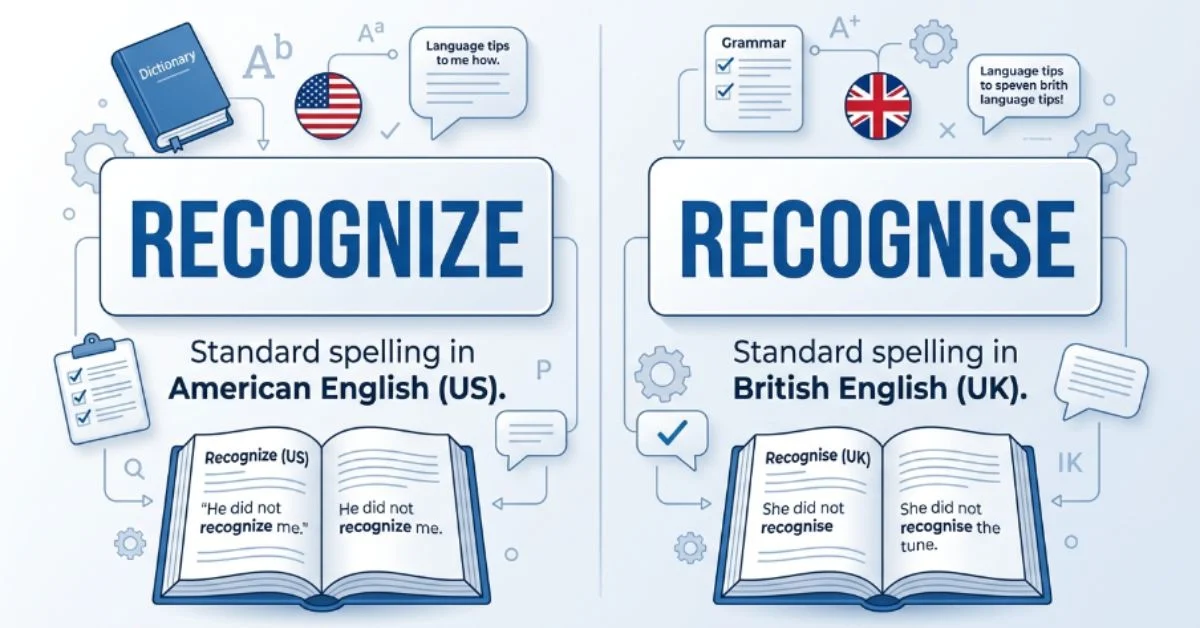
Both recognize and recognise are correct spellings of the same verb.
- Recognize is preferred in American English.
- Recognise is preferred in British English and many Commonwealth countries.
Correct Example
- I recognize her from school.
- The committee recognised his achievements.
- Most people recognize the importance of education.
Incorrect Example
- Using both spellings in the same document without following a specific style guide.
- The company recognizes its employees and also recognises customer loyalty. ❌ (inconsistent style)
Meaning and Usage
The words recognize and recognise have the same meaning. They are verbs used to identify, acknowledge, remember, or accept something as valid.
Common meanings include:
- Identifying someone or something seen before
- Acknowledging an achievement
- Accepting a fact or authority
- Realizing or understanding something
For example:
- I recognized his voice immediately.
- The organization recognized her contribution.
- Scientists recognize climate change as a major challenge.
Similarly, British writers would use recognised and recognise in the same contexts.
Synonyms
Depending on context, synonyms include:
- Identify
- Acknowledge
- Detect
- Notice
- Appreciate
- Realize
- Accept
- Observe
Origin and Spelling History
The word comes from the Latin term recognoscere, meaning “to know again” or “acknowledge.”
Over time, the word entered English through Old French influences. As English evolved, spelling variations developed between regions.
Interestingly, many people assume that words ending in -ise are always the original British forms. However, language historians note that the -ize ending has deep historical roots and has long existed in British English as well.
Therefore, both spellings have legitimate historical foundations.
British English vs American English
The primary difference is regional preference.
| English Variant | Preferred Spelling |
|---|---|
| American English | Recognize |
| British English | Recognise |
| Canadian English | Usually Recognize |
| Australian English | Usually Recognise |
| New Zealand English | Usually Recognise |
American publications, universities, and style guides almost always recommend recognize.
Meanwhile, many British newspapers, schools, and publishers prefer recognise.
However, some British authorities, including certain academic publishers, still accept recognize.
Spelling Comparison
| Feature | Recognize | Recognise |
|---|---|---|
| Meaning | Same | Same |
| Pronunciation | Same | Same |
| American English | Preferred | Rare |
| British English | Accepted | Preferred |
| Formal Writing | Accepted | Accepted |
| Grammar Difference | None | None |
The key point is that pronunciation and meaning do not change. Only the spelling varies.
Which Spelling Should You Use?
The best choice depends on your audience.
Use “Recognize” If:
- You write for an American audience.
- You follow American style guides.
- Your website targets readers in the United States.
- You use American spelling conventions like organize and realize.
Use “Recognise” If:
- You write for a British audience.
- You follow UK publishing standards.
- Your readers are mainly in Australia or New Zealand.
- You consistently use British spellings like organise and realise.
Most importantly, remain consistent throughout your content.
Common Mistakes
Many writers make avoidable errors when choosing between recognize and recognise.
Mixing Spellings
One of the most common mistakes is switching between spellings in the same article.
For example:
- The company recognizes excellence and recognises innovation. ❌
Choose one spelling style and use it throughout.
Assuming One Is Wrong
Some writers believe only one spelling is correct. However, both forms are accepted in standard English.
Ignoring Audience Expectations
Readers often expect spelling conventions that match their region. Therefore, choosing the appropriate version improves readability and professionalism.
Real-Life Examples
Here are examples from everyday situations.
Workplace
- The manager recognized outstanding performance.
- The company recognised employee dedication.
Education
- Teachers recognize student progress.
- Universities recognise academic achievement.
Technology
- Modern software can recognize speech patterns.
- Facial recognition systems recognize users instantly.
Everyday Conversation
- I recognized my old friend at the airport.
- She recognised the song after hearing the first few notes.
These examples show that the meaning remains identical regardless of spelling.
Helpful Grammar Tips
Stay Consistent
First, select either American or British English before you begin writing.
Follow Your Style Guide
If you work with a publication, company, or academic institution, follow its preferred spelling rules.
Use Spell Check Carefully
Many writing tools automatically switch between British and American English. Therefore, check your language settings before publishing.
Match Related Words
If you use:
- Organize → Recognize
- Realize → Recognize
Then maintain the same American pattern.
Similarly:
- Organise → Recognise
- Realise → Recognise
This creates consistency and professionalism.
FAQs
Is recognize or recognise correct?
Both are correct. Recognize is preferred in American English, while recognise is preferred in British English.
Which spelling is more common worldwide?
Recognize often appears more frequently online because American English has a large global influence. However, recognise remains standard in many English-speaking countries.
Do recognize and recognise have different meanings?
No. They have identical meanings, pronunciation, and grammar.
Is recognize accepted in Britain?
Yes. Although recognise is more common in British English, recognize is also accepted by some British publishers and organizations.
Which spelling should I use for SEO?
Use the version that matches your target audience. For international content, either can work, but consistency is essential.
Conclusion
The debate between recognize and recognise is not about right versus wrong. Instead, it is about regional spelling preferences.
Recognize is the standard form in American English, whereas recognise is more common in British English and several Commonwealth countries.
Since both spellings share the same meaning, pronunciation, and grammatical function, your choice should depend on your audience and writing style.
Most importantly, remain consistent throughout your document.
By doing so, your writing will appear polished, professional, and easier for readers to follow.

John E. Warriner shares clear and practical grammar insights at GrammarVibez.com, helping readers understand confusing words and spelling differences with ease and confidence.