Last Updated on May 1, 2026 by ramzancloudeserver@gmail.com
Many English learners get confused between “shrank” and “shrunk.” They both come from the same verb “shrink,” but they are used in different grammar situations.
This small difference often causes mistakes in writing, exams, and even professional communication.
People search for “shrank or shrunk” because they want to know which form is correct in sentences like “The shirt ___ after washing” or “It has ___ in the dryer.”
Using the wrong form can make your English sound incorrect or unclear.
In this guide, you will learn the simple difference between shrank and shrunk, when to use each one, and how to avoid common grammar mistakes with easy examples.
Quick Answer
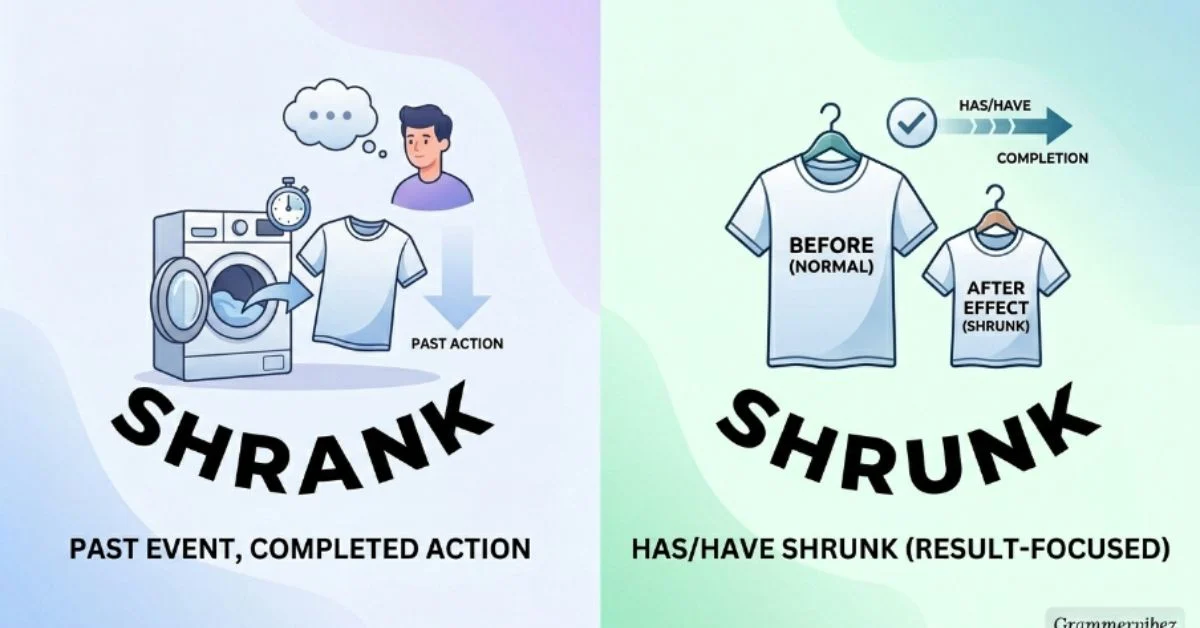
- Shrank → simple past tense
- Shrunk → past participle
Examples
- The shirt shrank after washing.
- The shirt has shrunk in the dryer.
👉 Simple rule:
- Use shrank for past actions
- Use shrunk with has/have/had
The Origin of Shrank or Shrunk
Both words come from the verb “shrink,” which means “to become smaller.”
Over time, English developed different verb forms as part of irregular grammar rules studied in English Language and Irregular Verb.
- Old English form evolved into: shrink → shrank → shrunk
- These forms are still used today in modern English
Past Tense vs Past Participle Rule
\text{shrink} \rightarrow \text{shrank (past tense)} \rightarrow \text{shrunk (past participle)}
Simple Rule
- Shank (wrong) ❌
- Shrank (correct past) ✔
- Shrunk (correct with has/have/had) ✔
Which One Should You Use?
Use SHRANK when:
- Talking about a finished action
- No helping verb used
👉 Example: The sweater shrank yesterday.
Use SHRUNK when:
- Using has/have/had
- Talking about result or experience
👉 Example: The sweater has shrunk over time.
Common Mistakes with Shrank or Shrunk
❌ Wrong:
- The shirt has shrank
✅ Correct:
- The shirt has shrunk
❌ Wrong:
- It shrunk yesterday (when focusing on simple past rule confusion)
✅ Correct:
- It shrank yesterday
Shrank or Shrunk in Everyday Examples
Daily Life
- My clothes shrank after washing.
- The fabric has shrunk in size.
Business Writing
- The market shrank last year.
- Sales have shrunk due to inflation.
Academic Context
- Data values shrank during analysis.
- The sample size has shrunk over time.
Shrank or Shrunk – Usage Overview
| Form | Type | Usage | Example |
|---|---|---|---|
| Shrink | Base verb | Present | Clothes shrink in hot water |
| Shrank | Past tense | Completed action | Shirt shrank yesterday |
| Shrunk | Past participle | Perfect tense | Shirt has shrunk |
FAQs
1. Is it shrank or shrunk?
Both are correct but used in different grammar situations.
2. What is the past tense of shrink?
Shrank.
3. What is the past participle of shrink?
Shrunk.
4. Can I say “has shrank”?
No, correct form is “has shrunk.”
5. What is a simple example?
The shirt shrank after washing.
6. Why are both forms different?
Because “shrink” is an irregular verb.
7. Which one is more common?
Both are common depending on sentence structure.
Conclusion
The difference between shrank and shrunk is simple once you understand grammar rules. Shank is the past tense used for completed actions, while shrunk is the past participle used with helping verbs like has, have, or had.
This confusion is common because English has many irregular verbs. However, once you learn the pattern, it becomes easy to remember.
A simple trick is: “has/have = shrunk, past action = shrank.” With this rule, you can avoid mistakes in writing, exams, and professional communication.
Always check the sentence structure before choosing the word. Practice a few examples, and soon this difference will feel natural.

John E. Warriner shares clear and practical grammar insights at GrammarVibez.com, helping readers understand confusing words and spelling differences with ease and confidence.