Last Updated on May 1, 2026 by ramzancloudeserver@gmail.com
Many people confuse discreet and discrete. They look almost the same. But their meanings are very different. This small spelling change can lead to big mistakes in writing.
People search for “discreet or discrete” because they want to use the correct word in emails, essays, or professional work.
A wrong choice can change the meaning of a sentence. For example, calling someone “discrete” instead of “discreet” may sound strange or even incorrect.
This confusion is common in English. Even advanced learners mix them up. Dictionaries like Merriam-Webster and Oxford English Dictionary clearly define both words, but remembering the difference is still tricky.
This guide solves that problem. You will learn the quick difference, origin, usage rules, and real-life examples. By the end, you will never confuse these two words again.
Quick Answer
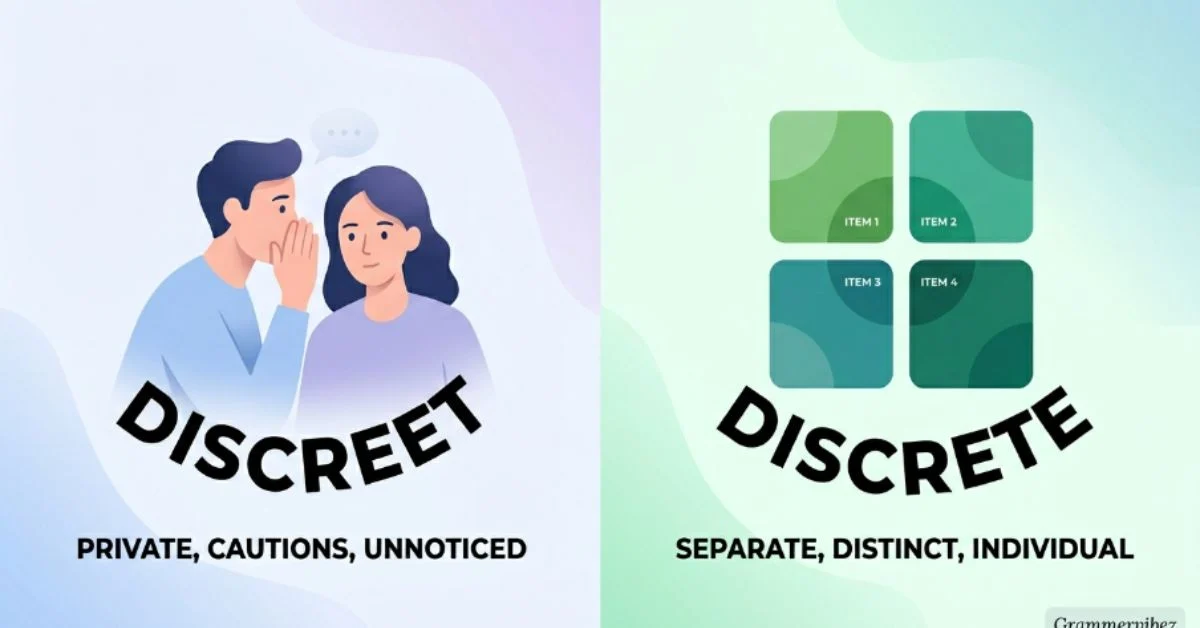
- Discreet = careful, private, not attracting attention
- Discrete = separate, distinct, individual
Examples
- She was discreet about the secret.
- The data is divided into discrete sections.
👉 Simple trick:
- Discreet = secret (both have “ee”)
- Discrete = separate
The Origin of Discreet or Discrete
Both words come from the Latin word “discretus”, meaning “separated” or “distinguished.”
Over time, English split the meaning into two:
- Discreet → focused on behavior (careful, polite, private)
- Discrete → focused on things (separate, distinct parts)
This change happened as English evolved through the study of Linguistics. Writers needed two forms to express different ideas clearly.
British English vs American English Spelling
Good news:
There is no spelling difference between British and American English for these words.
| Word | British English | American English | Meaning |
|---|---|---|---|
| Discreet | Discreet | Discreet | Careful, private |
| Discrete | Discrete | Discrete | Separate, distinct |
Unlike other words, both forms stay the same worldwide.
Which Spelling Should You Use?
Choose based on meaning, not location:
- Use discreet when talking about behavior
👉 Example: Be discreet in meetings - Use discrete when talking about separate items
👉 Example: The system has discrete parts
Audience Tip
- USA, UK, Pakistan, global use → same rule applies
- Always check meaning, not region
Common Mistakes with Discreet or Discrete
❌ Wrong:
- He gave a discrete reply (if you mean careful)
✅ Correct:
- He gave a discreet reply
❌ Wrong:
- The project has discreet stages
✅ Correct:
- The project has discrete stages
Top Mistake
People use discrete when they mean “secret.”
This is incorrect in most cases.
Discreet or Discrete in Everyday Examples
Emails
- Please be discreet with this information.
Business Writing
- The system works in discrete modules.
Social Media
- She stayed discreet about her plans.
News Style
- Data is shown in discrete categories.
Discreet or Discrete – Google Trends & Usage Data
Search data shows:
- “Discreet” is popular in communication and behavior topics
- “Discrete” is common in science and Mathematics
Also, discrete is widely used in Discrete Mathematics, where values are separate, not continuous.
Usage by Context
- USA & UK → both words used equally
- Academic fields → prefer discrete
- Daily communication → prefer discreet
Comparison Table
| Feature | Discreet | Discrete |
|---|---|---|
| Meaning | Careful, private | Separate, distinct |
| Usage | People, behavior | Data, objects |
| Memory Trick | Secret = “ee” | Separate |
| Example | Discreet conversation | Discrete values |
FAQs
1. Is discreet the same as discrete?
No. Discreet means private. Discrete means separate.
2. How do I remember the difference?
Discreet = secret (both have “ee”).
3. Can discreet mean separate?
No. That meaning belongs to discrete.
4. What is a discrete example?
Numbers like 1, 2, 3 are discrete values.
5. What is discreet behavior?
Being careful and not drawing attention.
6. Which word is more common?
Both are common, but in different contexts.
7. Is this mistake serious in writing?
Yes. It can change the meaning completely.
Conclusion
The difference between discreet and discrete is simple once you understand it. Discreet relates to behavior.
It means being careful, private, and respectful. Discrete refers to things. It means separate, distinct, and not connected.
This confusion happens because both words look almost the same and share the same origin.
However, their meanings have changed over time. That is why using the correct word is important, especially in professional writing.
A simple memory trick can help you forever. Discreet has “ee,” just like “secret.” Discrete means separate. Keep this in mind, and you will avoid mistakes.
In daily use, choose the word based on context. If you talk about people or actions, use discreet.
If you talk about data or objects, use discrete. With practice, the difference becomes natural.

John E. Warriner shares clear and practical grammar insights at GrammarVibez.com, helping readers understand confusing words and spelling differences with ease and confidence.