Last Updated on June 9, 2026 by ramzancloudeserver@gmail.com
The words “on to” and “onto” often confuse English learners because they look almost identical but carry different meanings.
Therefore, many people mistakenly use them interchangeably in writing and speech. However, understanding the difference is important for clear and accurate communication.
In addition, both forms are commonly used in academic writing, exams, business communication, and everyday conversations.
Meanwhile, incorrect usage can change the meaning of a sentence completely.
Moreover, this small grammar distinction is frequently tested in English exams and appears in professional editing standards.
In this article, you will learn the exact meaning, rules, real-life examples, and practical tips to never confuse “on to” and “onto” again in any situation.
Quick Answer
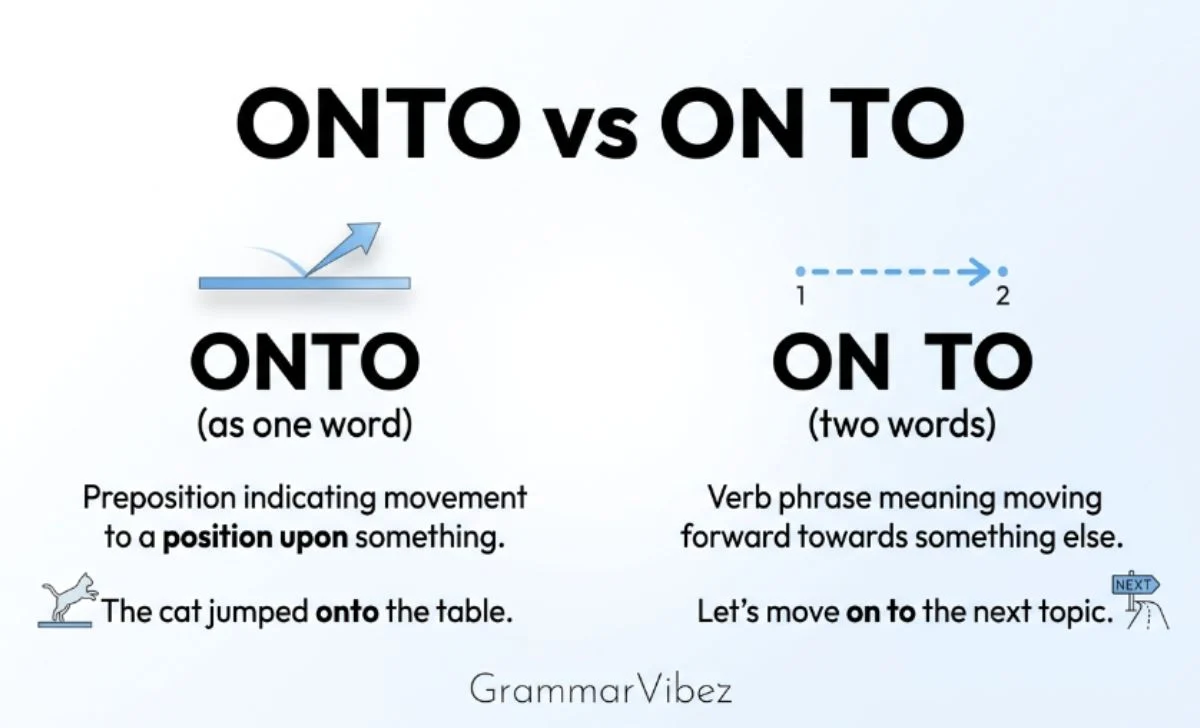
“Onto” is a preposition that shows movement to a surface or position. However, “on to” is used when “on” is part of a verb phrase and “to” belongs to the next idea.
Correct Example
She jumped onto the table.
Correct Example
He moved on to the next chapter.
Incorrect Example
She jumped on to the table. ❌ (wrong in this meaning)
Meaning and Usage
The word “onto” is used when someone or something moves from one place to another and ends up on a surface.
Therefore, it indicates physical movement or placement. For example, climbing onto a roof, stepping onto a stage, or placing a book onto a desk.
On the other hand, “on to” is used when “on” belongs to a verb phrase like “move on,” “go on,” or “carry on,” and “to” connects the next action or object. Therefore, it usually refers to progress or continuation rather than physical movement.
Moreover, the confusion happens because spoken English does not clearly separate them. However, written English strictly follows this distinction for clarity and correctness.
Origin and Spelling History
The word “onto” developed as a combined form over time in English grammar to clearly show directional movement.
Historically, it evolved from phrases like “on to the surface,” which gradually became “onto” for simplicity.
Meanwhile, “on to” remained unchanged because it belongs to phrasal verbs and expressions where “on” and “to” serve different grammatical purposes. Therefore, both forms exist independently in modern English.
Furthermore, English language evolution often merges or separates words based on usage frequency.
As a result, “onto” became standard for physical movement, while “on to” remained functional for abstract or verbal transitions.
British English vs American English
Interestingly, both British and American English use “onto” and “on to” in exactly the same way. Therefore, there is no regional difference in meaning or grammar rules.
However, style guides in formal writing, journalism, and academic English strongly emphasize correct usage. For example, newspapers like The Guardian or The New York Times follow strict grammar rules to avoid confusion.
Moreover, learners across all English-speaking regions are taught the same rule: use “onto” for movement and “on to” for continuation. Therefore, this distinction is universal, not regional.
Spelling Comparison
Here is a simple breakdown for better understanding:
| Form | Type | Meaning | Example |
|---|---|---|---|
| Onto | Preposition | Movement to a surface or place | She climbed onto the roof |
| On to | Phrase | Continuation or progress | He moved on to the next task |
Moreover, understanding whether you are describing movement or progress is the key to choosing the correct form.
Which Spelling Should You Use?
You should use “onto” when describing physical movement toward a surface or position. For example, jumping onto a bed or stepping onto a platform.
However, you should use “on to” when describing progress in tasks, ideas, or actions. For example, moving on to another topic or going on to the next step.
Furthermore, a simple test can help: if you can replace it with “on top of,” then use “onto.” If not, then “on to” is likely correct.
Therefore, context is the most important factor in choosing the correct form.
Common Mistakes
Many learners confuse these two forms because they sound the same in spoken English. First, they use “on to” when describing physical movement, which is incorrect. Second, they fail to separate phrasal verbs from prepositions. Third, they rely on guessing instead of understanding grammar rules.
❌ She jumped on to the chair.
✔ She jumped onto the chair.
❌ He stepped on to the stage (movement meaning).
✔ He stepped onto the stage.
Moreover, another common mistake is overthinking simple sentences, which leads to inconsistent writing. Therefore, practice and repetition are essential for mastery.
Real-Life Examples
Here are practical examples to understand usage clearly:
- The cat jumped onto the sofa.
- She moved on to the next question.
- He climbed onto the roof carefully.
- We moved on to the final topic in the meeting.
- The book fell onto the floor.
Moreover, these examples show how meaning changes based on small grammatical differences. Similarly, correct usage improves clarity in both academic and professional communication.
Helpful Grammar Tips
To avoid confusion between “onto” and “on to,” follow these simple strategies.
First, always check whether the sentence describes physical movement. If yes, then use “onto.” Next, check whether the sentence describes progress or continuation. If yes, then use “on to.”
In addition, try the substitution trick: replace the word with “on top of.” If the sentence still makes sense, then “onto” is correct.
Furthermore, reading sentences aloud can help identify natural meaning. Therefore, practicing with examples is one of the best ways to improve accuracy.
Finally, consistency in writing is more important than memorizing rules.
FAQs
What is the difference between onto and on to?
“Onto” shows movement to a surface, while “on to” shows continuation or progress.
Is it correct to say “move onto the next topic”?
No, the correct form is “move on to the next topic.”
Is “onto” a preposition?
Yes, “onto” is a preposition.
Can “on to” be replaced with “onto”?
No, because both have different meanings.
Why do people confuse onto and on to?
Because they sound identical in speech but have different grammar roles.
Conclusion
In conclusion, understanding the difference between “onto” and “on to” is essential for clear and accurate English writing.
Although they sound similar, their meanings are completely different and depend on context. Therefore, “onto” is used for physical movement toward a surface, while “on to” is used for progression or continuation of an action.
Moreover, using them correctly improves grammar accuracy, writing clarity, and professional communication.
In addition, mastering this small rule can significantly reduce common English mistakes.
Overall, consistent practice and attention to context will help you confidently use both forms correctly in exams, writing tasks, and everyday communication without confusion or errors.

I am Mignon Fogarty, a grammar expert dedicated to making English simple, clear, and easy to learn.I write for Grammervibez, helping people improve their grammar, writing skills, and confidence in English.