Last Updated on June 9, 2026 by ramzancloudeserver@gmail.com
“In regard or in regards” is a very common English grammar confusion that appears in emails, blogs, academic writing, and daily communication.
Many learners use both phrases without knowing which one is actually correct. However, this small mistake can affect the clarity and professionalism of your writing.
Therefore, it is important to understand the correct usage in a simple way.
Moreover, this topic is widely searched on Google, which shows how often people struggle with it.
In this guide, you will learn the exact difference, correct rule, real examples, and common mistakes so you can use it confidently in any situation.
Quick Answer
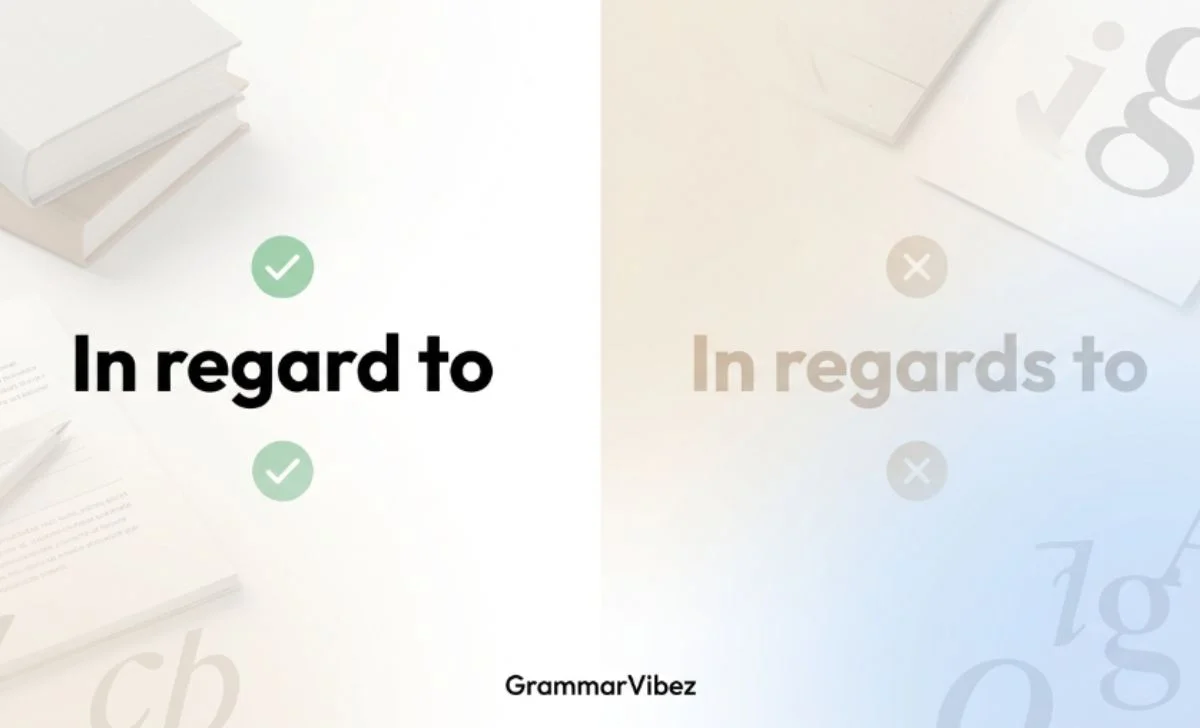
The correct formal phrase is “in regard to.”
“In regards to” is informal and generally considered incorrect in standard English grammar.
Correct Example
- I am writing in regard to your request.
Incorrect Example
- I am writing in regards to your request. ❌
👉 Therefore, always use “in regard to” in formal writing.
Meaning and Usage
“In regard to” means about, concerning, or related to something specific. It is used to introduce a topic in formal communication.
For example:
- In regard to your email = about your email
- In regard to the report = concerning the report
Moreover, it is widely used in business emails, legal writing, and academic communication. However, in spoken English, people often say “in regards to,” but it is not grammatically standard.
In addition, dictionaries like the Merriam-Webster Dictionary confirm that “regard” is used in singular form in this structure.
Origin and Spelling History
The word “regard” originally comes from Old French, meaning attention or consideration. Over time, English adopted it as a formal expression for referencing a topic.
Historically, the correct phrase was always “in regard to.” However, in informal spoken English, people started adding an “s,” creating “in regards to.” This variation became common in speech but never became grammatically standard.
Moreover, this shift shows how spoken language often changes faster than written grammar rules. Therefore, formal English still preserves the original structure.
British English vs American English
Both British and American English follow the same rule for this phrase.
- British English → in regard to ✔
- American English → in regard to ✔
However, in casual American speech, “in regards to” is sometimes heard. Meanwhile, British English tends to avoid it more strictly.
Furthermore, in professional writing across both regions, only “in regard to” is accepted. As a result, global English standards remain consistent.
Spelling Comparison
| Phrase | Status | Usage Type | Example |
|---|---|---|---|
| in regard to | Correct | Formal writing | In regard to your request… |
| in regards to | Incorrect | Informal speech | ❌ In regards to your request… |
Therefore, the difference is not meaning but grammar correctness and formality.
Which Spelling Should You Use?
You should always use “in regard to” in professional and academic writing.
For example:
- Emails ✔
- Reports ✔
- Blogs ✔
- Business communication ✔
Moreover, using the correct form improves clarity, professionalism, and SEO performance. Therefore, it is the safer and more trusted option for all formal content.
In addition, search engines and NLP systems often favor grammatically correct structures, which makes this choice even more important for online content.
Common Mistakes
Many learners mistakenly add “s” to “regard” because of spoken English habits.
Here are common errors:
- ❌ In regards to your email, we responded.
- ❌ I am calling in regards to the issue.
- ❌ This is in regards to payment.
Correct versions:
- ✔ In regard to your email, we responded.
- ✔ I am calling in regard to the issue.
- ✔ This is in regard to payment.
Moreover, autocorrect tools do not always fix this mistake, so careful proofreading is necessary.
Real-Life Examples
Here are practical real-world uses:
- In regard to your application, we have approved it.
- I am writing in regard to your inquiry.
- In regard to the meeting schedule, it has been updated.
- She contacted us in regard to the project changes.
- In regard to your request, we will respond soon.
Furthermore, this phrase is commonly used in corporate emails and formal documentation.
Helpful Grammar Tips
To avoid confusion, use this simple rule:
👉 “regard” = formal reference
👉 “regards” = email closing (not this phrase)
Quick test:
- If it means “about” → use in regard to ✔
- If it feels casual → avoid ❌
For example:
- In regard to your order = about your order ✔
- In regards to your order = incorrect ❌
Therefore, this simple logic helps eliminate mistakes instantly.
FAQs
Is “in regards to” correct?
No, it is not correct in formal English.
What is the correct form?
“In regard to” is the correct phrase.
Can I use it in emails?
Yes, but only the correct form.
Why do people use “in regards to”?
Because of spoken English influence and habit.
Is there a difference in UK and US English?
No, both prefer “in regard to.”
What does it mean?
It means “about” or “concerning something.”
Conclusion
“In regard to” is the correct and standard English phrase used in formal communication, while “in regards to” is an informal and incorrect variation.
However, many learners still use both due to spoken language influence and confusion with similar expressions.
Therefore, it is important to remember a simple rule: always use “in regard to” when writing emails, blogs, academic content, or professional documents.
Moreover, correct usage improves clarity, credibility, and overall writing quality. In addition, it helps your content perform better in SEO and professional environments.
Finally, mastering this small grammar rule will make your English more accurate, natural, and confident in real-life communication.

Wilson Follett delivers sharp editorial insight at GrammarVibez.com, helping readers refine their writing, avoid common mistakes, and master precise word usage.