Last Updated on June 9, 2026 by ramzancloudeserver@gmail.com
The words “loose” and “lose” are two of the most commonly confused terms in English writing and speaking.
Although they look similar, their meanings are completely different, which often leads to spelling mistakes in exams, emails, and online content.
Therefore, understanding the difference is essential for clear communication.
In addition, these words frequently appear in academic tests, competitive exams, and daily conversations, making them highly important for learners.
Meanwhile, many people also struggle with pronunciation, which adds to the confusion.
Moreover, mastering this difference improves both writing accuracy and professional credibility.
In this article, you will learn meanings, usage rules, examples, grammar tips, and common mistakes in a very simple and practical way.
Quick Answer
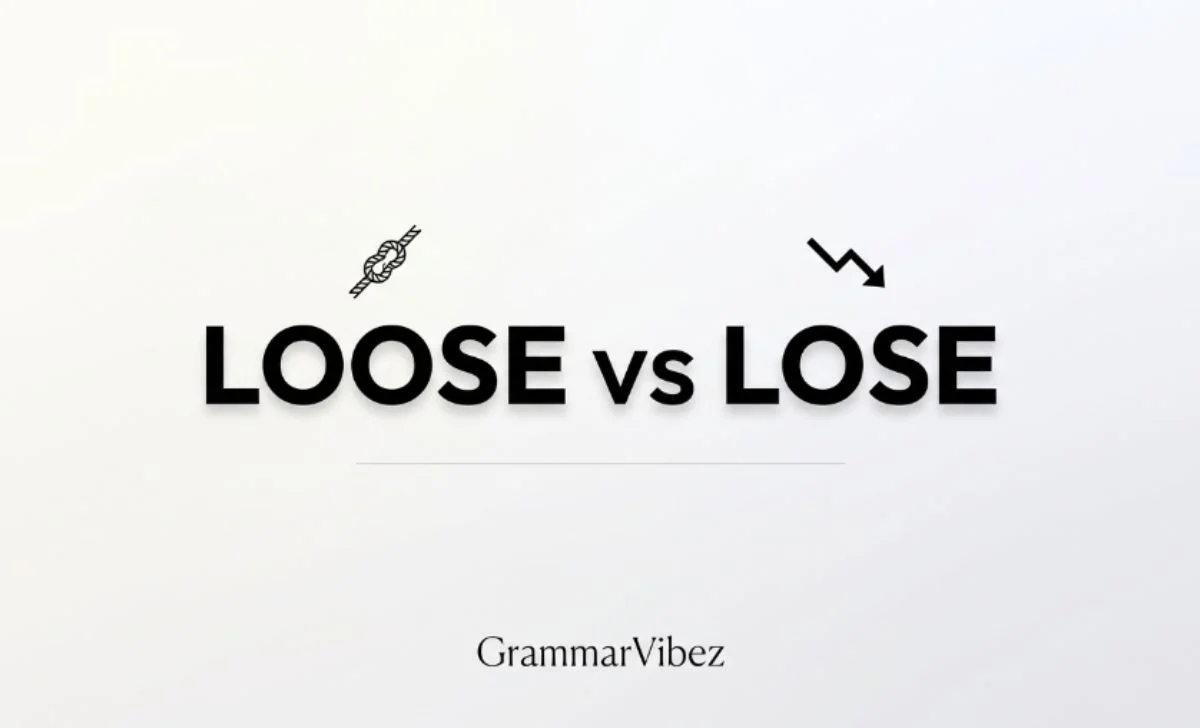
“Loose” and “lose” are not the same words. However, they are often confused because of similar spelling.
- Loose = not tight or free
- Lose = to fail to keep something or to not win
Correct Example
My shirt is loose on me.
Correct Example
I don’t want to lose my phone.
Incorrect Example
I don’t want to loose my phone. ❌
Meaning and Usage
The word “loose” is an adjective that describes something not tightly fixed or secured. For example, a loose button, loose clothing, or loose hair.
Therefore, it usually refers to physical condition or lack of tightness.
On the other hand, “lose” is a verb that means to fail to keep something, misplace something, or not win a competition. For instance, losing a game, losing money, or losing keys. Moreover, it is often used in emotional and practical contexts.
Furthermore, the confusion happens because both words sound almost identical in spoken English.
However, their grammar roles are completely different, which makes understanding essential.
Origin and Spelling History
The word “loose” comes from Old Norse and Middle English roots where it originally meant “free” or “not bound.” Over time, it became widely used in English to describe physical objects that are not tight or fixed.
Meanwhile, “lose” comes from Old English “losian,” meaning to perish, destroy, or fail to keep something. Therefore, both words developed independently but later became confusing due to pronunciation similarity.
Moreover, English language evolution reduced pronunciation differences, which increased spelling mistakes. As a result, modern learners often mix them up in writing and speech.
British English vs American English
Interestingly, both British and American English use “loose” and “lose” in the same way. Therefore, the confusion is not regional but global.
However, pronunciation clarity may vary slightly. In some accents, “lose” sounds softer, while “loose” has a longer “oo” sound. Despite this, spelling rules remain identical across all English variations.
Furthermore, both forms are equally important in exams like IELTS, TOEFL, and academic writing. Therefore, learners must focus on grammar rather than regional differences.
Spelling Comparison
Here is a simple comparison to make the difference clear:
| Word | Type | Meaning | Example |
|---|---|---|---|
| Loose | Adjective | Not tight or fixed | My jeans are loose |
| Lose | Verb | To misplace or fail to win | Don’t lose your keys |
Moreover, understanding the part of speech helps avoid mistakes. Therefore, always check whether you need a verb or adjective in your sentence.
Which Spelling Should You Use?
You should use “loose” when describing something not tight, and “lose” when talking about failure or misplacement.
For example:
- Use loose for clothes, objects, or conditions
- Use lose for games, money, items, or opportunities
Furthermore, context is the key factor. If you can replace the word with “not tight,” then “loose” is correct. However, if the meaning involves loss, then “lose” is correct.
In addition, practicing sentence examples helps improve long-term accuracy.
Common Mistakes
Many learners make predictable mistakes with these words. First, they use “loose” instead of “lose” in sentences about failure. Second, they confuse pronunciation and spelling. Third, they overthink grammar rules and end up making errors.
❌ I don’t want to loose my job.
✔ I don’t want to lose my job.
❌ My phone is lose in my pocket.
✔ My phone is loose in my pocket.
Moreover, another common mistake is not checking the verb vs adjective role. Therefore, always analyze sentence structure before choosing the word.
Real-Life Examples
Here are practical examples to help you understand usage clearly:
- The screw is loose and needs tightening.
- If you don’t study, you will lose marks.
- Her hair was loose during the windstorm.
- He doesn’t want to lose his opportunity.
- The shirt is too loose for me.
Furthermore, these examples show that context changes meaning completely. Similarly, correct usage improves clarity and professionalism in writing.
Helpful Grammar Tips
To avoid confusion between “loose” and “lose,” follow these simple tips.
First, remember that “loose” has two “o’s,” just like the word “too much space,” which connects to the idea of something not tight. Next, “lose” has one “o,” which can remind you of losing one thing.
Moreover, always identify the sentence type. If it describes condition, use “loose.” If it describes action, use “lose.”
In addition, reading sentences out loud helps identify errors. Therefore, practice regularly to build confidence.
Finally, avoid rushing when writing, because most mistakes happen due to speed, not lack of knowledge.
FAQs
What is the difference between loose and lose?
Loose means not tight, while lose means to fail to keep or win something.
Why do people confuse loose and lose?
Because they sound similar in pronunciation but have different meanings.
Is it “loose weight” or “lose weight”?
The correct phrase is “lose weight.”
Can loose be used as a verb?
No, loose is mainly an adjective, not a verb.
Is lose always negative?
Not always, but it usually refers to loss or failure.
Conclusion
In conclusion, “loose” and “lose” are two different English words that often confuse learners due to their similar spelling and pronunciation.
However, their meanings are completely different, and understanding them is essential for accurate communication.
Therefore, “loose” is used for something not tight, while “lose” refers to failure or misplacement.
Moreover, mastering this difference improves writing clarity, exam performance, and professional communication skills. In addition, practicing real-life examples helps strengthen long-term understanding.
Overall, careful attention to context and grammar rules ensures correct usage.
Finally, with regular practice, you can easily avoid this common mistake and write more confidently in English.

Lindley Murray brings classic grammar knowledge to GrammarVibez.com, guiding readers through tricky word choices and spelling rules with simple and timeless explanations.