Last Updated on May 18, 2026 by ramzancloudeserver@gmail.com
Many English learners and writers get confused between “independant” and “independent.” The words look similar, so the mistake is easy to make.
However, only one spelling is correct in English grammar.
This confusion appears in emails, social media posts, school assignments, and even business writing. That is why many people search for the right spelling online.
In this guide, you will learn the correct usage, meaning, history, grammar rules, and examples of “independent” so you can avoid common spelling mistakes and write with confidence.
Quick Answer
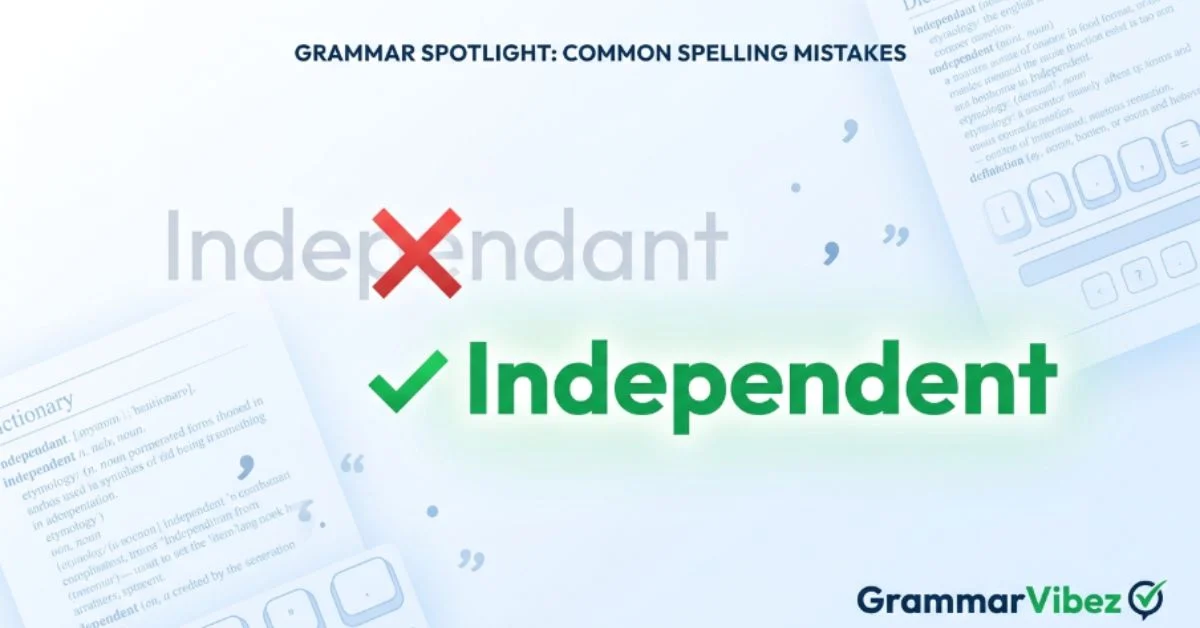
The correct spelling is independent. The word “independant” is incorrect and considered a spelling mistake in both British English and American English.
\text{Correct: Independent \qquad Incorrect: Independant}
“Independent” means free, self-reliant, or not controlled by others.
Example:
- She is an independent woman.
- The country became independent in 1947.
Correct Example
- He works as an independent journalist.
- Children should learn to become independent.
Incorrect Example
- He is an independant worker.
- She became independant after college.
What Does Independent Mean?
The word “independent” describes someone or something that is free from outside control or support.
Common Meanings
| Meaning | Explanation |
|---|---|
| Self-reliant | Able to manage without help |
| Free | Not controlled by others |
| Separate | Not connected to another group |
| Confident | Able to make personal decisions |
Simple Usage Examples
- My sister is financially independent.
- The company operates independently.
- India became an independent nation.
- Teenagers often want more independent choices.
The Origin of Independent
The word “independent” comes from Latin and later entered Middle English through French influence.
Word History
“Independent” developed from the Latin word dependere, meaning “to hang from” or “to rely on.” The prefix “in-” changed the meaning to “not dependent.”
Over time, English spelling standardized the word as “independent.”
Why the Confusion Happens
People often write “independant” because many English words end with “-ant.” Also, pronunciation can sound similar in fast speech. However, dictionaries and grammar guides confirm that “independent” is always correct.
British English vs American English
Unlike some English words, “independent” has the same spelling in both British and American English.
Comparison Table
| Version | Correct Spelling | Region |
|---|---|---|
| British English | Independent | United Kingdom |
| American English | Independent | United States |
| Canadian English | Independent | Canada |
| Australian English | Independent | Australia |
Independant vs Other Variations
Several spelling mistakes appear online because people confuse vowels and endings.
Spelling Comparison Table
| Word | Correct or Incorrect | Usage | Region |
|---|---|---|---|
| Independent | Correct | Standard English | Worldwide |
| Independant | Incorrect | Spelling mistake | None |
| Independantly | Incorrect | Misspelled adverb | None |
| Independently | Correct | Adverb form | Worldwide |
Which Spelling Should You Use?
You should always use “independent” in formal and informal writing.
US Audience
American English uses “independent.”
UK Audience
British English also uses “independent.”
International Writing
Global English writing follows the same spelling.
Academic Writing
Schools, universities, and research papers require the correct spelling “independent.”
Social Media Usage
Many users type “independant” online by mistake, but “independent” remains the correct form.
Common Mistakes with Independent
Spelling mistakes happen often because English pronunciation can confuse learners.
Frequent Errors
| Incorrect Form | Correct Form |
|---|---|
| Independant | Independent |
| Independance | Independence |
| Independantly | Independently |
Corrected Examples
- Incorrect: She is very independant.
- Correct: She is very independent.
- Incorrect: They want independance.
- Correct: They want independence.
Independent in Everyday Examples
The word appears in daily communication, education, journalism, and business English.
Emails
- I am working as an independent consultant.
Social Media
- She became financially independent at 25.
News Writing
- The nation celebrated its independent status.
School Writing
- Students should develop independent thinking.
Business Writing
- Our company remains fully independent.
Google Trends & Usage Data
“Independent” receives high search volume because many people want spelling help and grammar clarification.
Popular Countries
People commonly search this keyword in:
- United States
- United Kingdom
- Canada
- Australia
- India
Why People Search This Keyword
Users search this term because:
- They see different spellings online.
- They want correct grammar.
- They need help with academic writing.
- They want professional English communication.
Related Grammar Rules
Learning similar spelling rules can improve your English writing skills.
Similar Spelling Mistakes
- Definately or Definitely
- Seperate or Separate
- Occured or Occurred
- Grammer or Grammar
- Publically or Publicly
Helpful Grammar Tips
- Use spell-check tools while writing.
- Read dictionary examples regularly.
- Learn common suffix patterns.
- Practice writing difficult words daily.
FAQs
Is independant a real word?
No. “Independant” is an incorrect spelling.
How do you spell independent correctly?
The correct spelling is “independent.”
Is independent used in British English?
Yes. British English uses “independent.”
Is independent used in American English?
Yes. American English also uses “independent.”
Why do people write independant?
People confuse the ending because of pronunciation and spelling habits.
What does independent mean?
It means free, self-reliant, or not controlled by others.
Can independent describe a person?
Yes. It can describe a confident and self-reliant person.
What is the noun form of independent?
The noun form is “independence.”
Conclusion
The correct spelling is always “independent,” while “independant” is a common spelling mistake. Both British and American English use the same correct form.
The word describes someone or something that is free, self-reliant, or not controlled by others. Because the spelling sounds tricky, many people type it incorrectly online.
Still, using the correct version is important for school writing, business communication, and professional English.
To avoid mistakes, practice the spelling regularly, use grammar tools, and read trusted dictionary examples whenever you write in English.

John E. Warriner shares clear and practical grammar insights at GrammarVibez.com, helping readers understand confusing words and spelling differences with ease and confidence.