Last Updated on June 10, 2026 by ramzancloudeserver@gmail.com
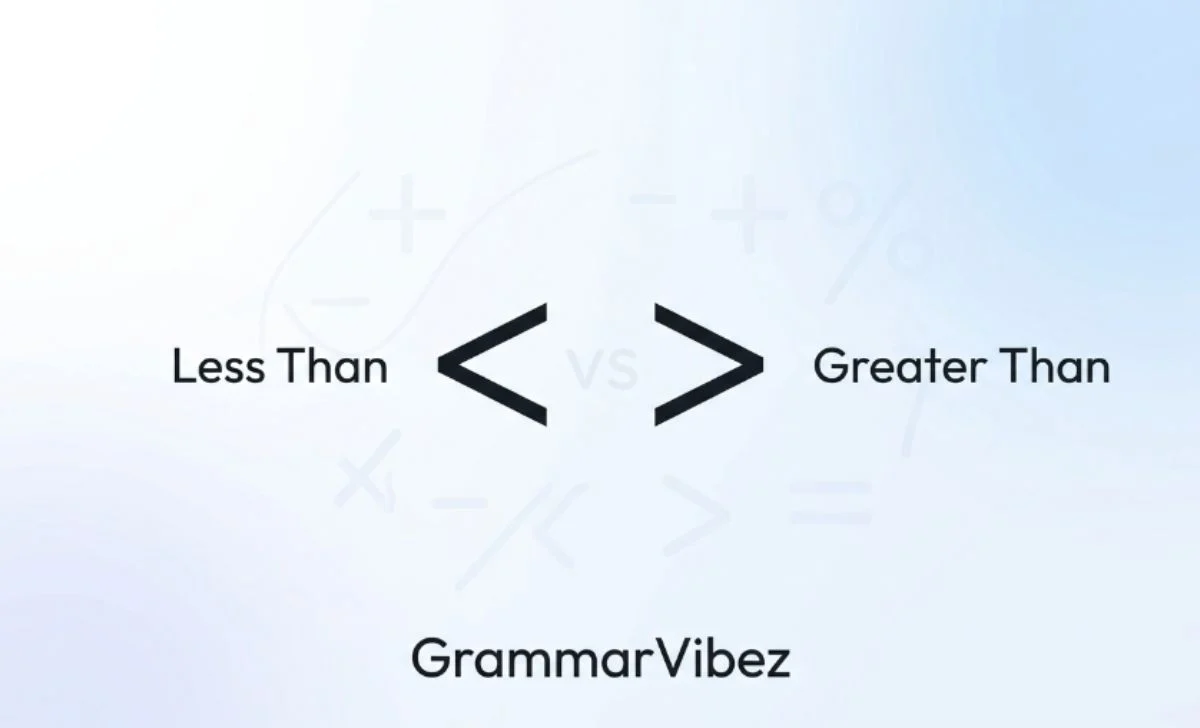
The symbols less than (<) and greater than (>) are very common in mathematics and everyday problem-solving.
However, many students still get confused about which symbol means what and when to use them.
These signs are used to compare numbers, values, and expressions, and they play an important role in basic arithmetic and algebra.
Therefore, understanding them clearly is essential for strong math skills.
In this guide, you will learn the meaning of both symbols in a very simple way, along with real-life examples, differences, and memory tricks so you never get confused again.
Quick Answer
The less than sign (<) means that the number on the left is smaller than the number on the right.
The greater than sign (>) means that the number on the left is bigger than the number on the right.
For example:
- 3 < 5 means 3 is less than 5
- 7 > 2 means 7 is greater than 2
Simply put, the open side always faces the bigger number.
Meaning of Less Than (<)
The less than sign (<) is used when one value is smaller than another value. It helps us compare numbers easily in mathematics.
For example:
- 4 < 9 (4 is smaller than 9)
- 10 < 15 (10 is less than 15)
In real life, this is used when comparing prices, ages, scores, or quantities. For instance, if Ali has 5 candies and Sara has 10 candies, we can write:
- 5 < 10
This clearly shows that Ali has fewer candies than Sara.
Meaning of Greater Than (>)
The greater than sign (>) shows that one number is larger than another number. It is the opposite of the less than sign.
For example:
- 8 > 3 (8 is greater than 3)
- 20 > 12 (20 is bigger than 12)
In daily life, we use this comparison when talking about money, height, marks, or quantities. For example, if John has $50 and Mike has $30:
- 50 > 30
This means John has more money than Mike.
Key Differences Between Less Than and Greater Than
| Feature | Less Than (<) | Greater Than (>) |
|---|---|---|
| Meaning | Smaller value | Larger value |
| Symbol shape | Open side faces right | Open side faces left |
| Example | 2 < 5 | 5 > 2 |
| Usage | Shows decrease or lower value | Shows increase or higher value |
| Common use | Comparing smaller numbers | Comparing bigger numbers |
Therefore, both symbols are opposites but used for the same purpose: comparison.
Common Mistakes Students Make
Many learners get confused between these two symbols because they look similar but point in different directions. However, the most common mistakes include:
- Reversing the symbol (writing 5 < 3 instead of 5 > 3)
- Forgetting which side is bigger
- Mixing up direction in word problems
- Not reading the sentence properly before writing the symbol
Moreover, students often rush during exams, which leads to simple errors. Therefore, slow reading and practice are very important.
Real-Life Examples
These symbols are not only used in math but also in real-life situations.
- Age comparison:
- 12 < 18 (a child is younger than an adult)
- Money comparison:
- $100 > $50 (100 dollars is more than 50 dollars)
- Height comparison:
- 150 cm < 170 cm (150 cm is shorter than 170 cm)
- Exam scores:
- 80 > 60 (80 marks are higher than 60 marks)
Furthermore, these comparisons help in decision-making and understanding differences quickly.
Easy Trick to Remember
A very simple trick helps many students remember the symbols:
👉 The open side of the symbol always faces the bigger number.
Also, think of it like a crocodile mouth 🐊:
- The crocodile always eats the bigger number.
So:
- 7 > 2 (crocodile eats 7 because it is bigger)
- 2 < 7 (same idea from opposite side)
This trick is very effective and easy to remember during exams.
FAQs
What is the difference between less than and greater than?
Less than means a smaller value, while greater than means a larger value.
How do I remember < and > symbols?
Remember that the open side always faces the bigger number.
Is 5 < 10 correct?
Yes, because 5 is smaller than 10.
Is 9 > 3 correct?
Yes, because 9 is greater than 3.
Why are these symbols important?
They help compare values in math, science, and daily life situations.
Conclusion
The concepts of less than and greater than are simple but very important in mathematics.
Once you understand the basic idea that one symbol shows a smaller value and the other shows a larger value, everything becomes easier.
Moreover, remembering the direction rule or the crocodile trick makes it even simpler. These symbols are used in exams, daily life comparisons, and logical reasoning.
Therefore, regular practice will help you master them quickly and avoid confusion.
Overall, learning these symbols builds a strong foundation for future math topics like algebra and equations.

Lindley Murray brings classic grammar knowledge to GrammarVibez.com, guiding readers through tricky word choices and spelling rules with simple and timeless explanations.