Last Updated on April 19, 2026 by ramzancloudeserver@gmail.com
You may have seen both “icy” and “icey” online and felt confused. Which one is right? Many people search this because both look correct at first glance.
Social media, chats, and even captions often use “icey,” while school and formal writing prefer “icy.”
This confusion happens because English spelling rules are not always simple. Some words change when we add “-y.”
Others do not. So people guess, and sometimes guess wrong.
This guide solves that confusion in a clear way. You will learn the correct spelling, why the mistake happens, and when to use each form.
You will also see real examples, common errors, and simple tips. By the end, you will feel confident using the right word in both casual and formal writing.
Quick Answer
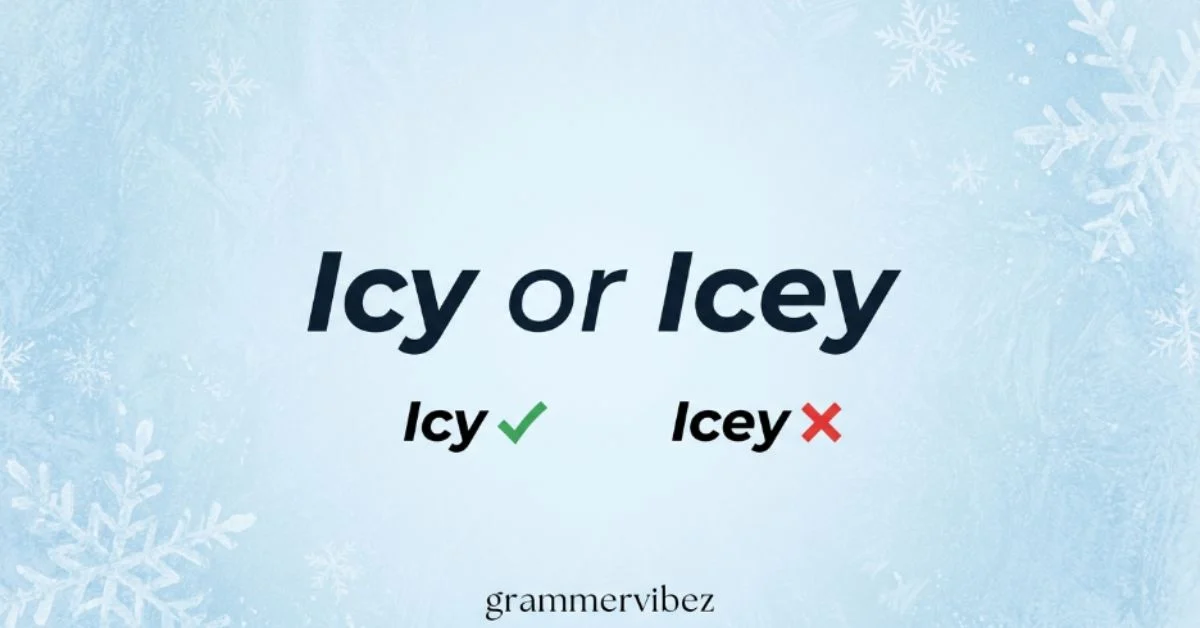
Correct spelling: “icy”
Incorrect spelling: “icey”
“Icy” means very cold or covered with ice.
Examples:
- The road is icy today.
- She gave me an icy look.
“Icey” is a common spelling mistake and is not standard English.
The Origin of Icy or Icey
The word “icy” comes from the noun “ice.” When we add “-y,” the spelling changes slightly.
Rule:
If a word ends in “e,” we often drop the “e” before adding “-y.”
- ice + y → icy (correct)
- NOT ice + y → icey (wrong)
This rule also applies to other words:
- shine → shiny
- spice → spicy
So “icey” looks logical, but it breaks the spelling rule.
British English vs American English Spelling
There is no difference between British and American English for this word.
| Version | Correct Spelling | Example |
|---|---|---|
| American English | icy | The lake is icy |
| British English | icy | The path is icy |
| Incorrect form | icey | ❌ Not accepted |
Both regions use “icy” only.
Which Spelling Should You Use?
Always use “icy.”
- USA: icy
- UK & Commonwealth: icy
- Global writing: icy
Avoid “icey” in:
- Emails
- Blogs
- School work
- Professional writing
You may see “icey” in casual posts, but it is still incorrect.
Common Mistakes with Icy or Icey
1. Writing “icey” instead of “icy”
❌ The road is icey
✅ The road is icy
2. Thinking both are correct
Only “icy” is correct.
3. Ignoring spelling rules
Remember: drop the “e” before adding “-y.”
Icy or Icey in Everyday Examples
Emails:
- Please drive carefully. The roads are icy.
News:
- The city reported icy conditions after snowfall.
Social Media:
- That was an icy response 😅
Formal Writing:
- The surface became icy, increasing risk.
Icy or Icey – Google Trends & Usage Data
Search data shows that “icy” is far more popular worldwide.
- High usage in the US, UK, Canada, and Australia
- “Icey” appears in low-volume searches, mostly as a mistake
- Social media sometimes boosts “icey,” but not in formal writing
Conclusion:
“Icy” dominates in correct usage and search rankings.
Comparison Table
| Word | Status | Meaning | Correct Usage |
|---|---|---|---|
| icy | ✅ Correct | Covered with ice / cold | Yes |
| icey | ❌ Incorrect | Same intended meaning | No |
FAQs
1. Is “icey” ever correct?
No, it is always incorrect.
2. Why do people write “icey”?
Because it looks logical, but it breaks spelling rules.
3. Is “icy” used in formal writing?
Yes, it is the correct and accepted form.
4. Does “icy” have other meanings?
Yes, it can mean cold behavior, not just temperature.
5. Is there a US vs UK difference?
No, both use “icy.”
6. Can I use “icey” in social media?
You can, but it is still wrong.
7. What is an easy way to remember?
Drop the “e” → ice → icy.
Conclusion
The difference between “icy” and “icey” is simple once you know the rule. “Icy” is the correct spelling and works in all types of writing.
“Icey” is a common mistake that comes from misunderstanding how English forms words.
The key rule is easy: when a word ends in “e,” drop the “e” before adding “-y.” This is why we write “icy,” not “icey.”
This same pattern appears in many English words, so learning it helps beyond just this example.
In real life, you should always use “icy” in emails, blogs, school work, and professional writing. While “icey” may appear on social media, it is not standard English.
Now you can write with confidence. Next time you describe cold weather or a cold attitude, you know the correct word is icy.

Wilson Follett delivers sharp editorial insight at GrammarVibez.com, helping readers refine their writing, avoid common mistakes, and master precise word usage.