Last Updated on May 8, 2026 by ramzancloudeserver@gmail.com
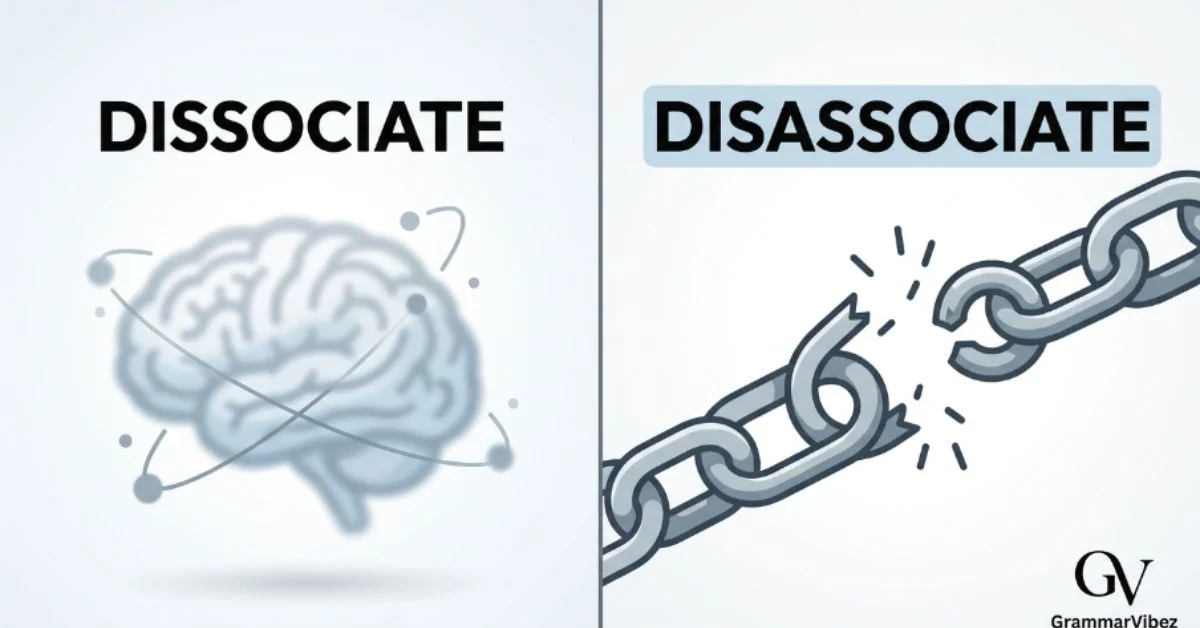
Many English learners get confused between “dissociate” and “disassociate.” Both words look similar and even feel like they mean the same thing, but there is a small difference in how they are used.
This confusion often appears in academic writing, psychology topics, emails, and everyday communication.
People search for “dissociate or disassociate” because they want to know which word is correct and whether both can be used interchangeably.
The problem becomes more confusing because both words exist in dictionaries and are considered correct in English.
In simple terms, “dissociate” is more formal and often used in scientific or psychological contexts.
“Disassociate” is more common in everyday English when talking about separating from something or breaking a connection.
This guide will clearly explain both words, their meanings, usage differences, origins, examples, and common mistakes so you can use them correctly and confidently.
Quick Answer
Both words are correct, but usage depends on context.
- Dissociate → formal, scientific, psychological separation
- Disassociate → general English, breaking connection or relation
Examples
- She began to dissociate during stress.
- He wants to disassociate from that company.
Simple Rule
- Use dissociate in academic or medical writing
- Use disassociate in everyday conversation
The Origin of Dissociate or Disassociate
Both words come from the Latin root socius, meaning “ally” or “partner.”
- Dissociate = dis + associate → to separate mentally or structurally
- Disassociate = dis + associate → to break connection
Over time, English developed both forms. “Dissociate” became more technical, while “disassociate” became more general in usage.
British English vs American English Spelling
There is no strict regional spelling difference, but usage patterns vary.
| Word | Usage Style | Example |
|---|---|---|
| Dissociate | Formal / Academic | Patients may dissociate under stress |
| Disassociate | General English | He disassociated from the group |
Both are accepted in UK and US English.
Which Spelling Should You Use?
Use “Dissociate” when:
- Writing psychology or science content
- Referring to mental or chemical separation
- Using formal academic tone
Use “Disassociate” when:
- Talking about breaking relationships
- Writing casual or business English
- Describing social or organizational separation
Best Practice
For professional writing, “dissociate” is preferred. For everyday English, “disassociate” feels more natural.
Common Mistakes with Dissociate or Disassociate
| Incorrect | Correct |
|---|---|
| He dissociated from the company (casual context) | He disassociated from the company |
| She disassociated during therapy (formal context) | She dissociated during therapy |
| Both words mean exactly the same always | Meaning depends on context |
Why confusion happens
- Both words are in dictionaries
- Both come from same root
- Similar pronunciation
Dissociate or Disassociate in Everyday Examples
Emails
- We need to disassociate from that vendor.
Psychology
- Patients may dissociate during trauma.
News Writing
- The company tried to disassociate from the scandal.
Social Media
- I want to disassociate from negativity.
Academic Writing
- Subjects may dissociate under stress conditions.
Dissociate or Disassociate – Google Trends & Usage Data
Usage Insights
- “Disassociate” is more common in everyday searches
- “Dissociate” is more common in psychology and science content
Regional Pattern
- USA: Both used, “disassociate” more casual
- UK: “Dissociate” preferred in formal writing
- Global: Mixed usage depending on context
Comparison Table
| Feature | Dissociate | Disassociate |
|---|---|---|
| Style | Formal | General |
| Field | Psychology, Science | Everyday English |
| Meaning | Mental/structural separation | Breaking connection |
| Usage Frequency | Medium | High |
FAQs
Are dissociate and disassociate the same?
They are similar but used in different contexts.
Which word is more formal?
“Dissociate” is more formal.
Which word is more common?
“Disassociate” is more common in daily English.
Can I use both words interchangeably?
Sometimes, but context matters.
Is dissociate used in psychology?
Yes, very commonly.
Is disassociate wrong?
No, it is a correct English word.
Which should I use in academic writing?
“Dissociate” is preferred.
Conclusion
“Dissociate” and “disassociate” are both correct English words, but they are not always used in the same way.
“Dissociate” is more formal and widely used in psychology, science, and academic writing. “Disassociate” is more common in everyday English when describing separation or breaking connections.
The key difference is context. If you are writing professionally or academically, “dissociate” is safer. If you are speaking or writing casually, “disassociate” feels more natural.
Understanding this difference helps you avoid confusion and improves your writing accuracy in English.

Lindley Murray brings classic grammar knowledge to GrammarVibez.com, guiding readers through tricky word choices and spelling rules with simple and timeless explanations.