Last Updated on May 9, 2026 by ramzancloudeserver@gmail.com
Have you ever seen the words “boney” and “bony” and wondered which one is correct? Many people get confused because both words look similar and sound almost the same.
This spelling confusion is common in everyday English, especially in social media posts, casual writing, and online conversations.
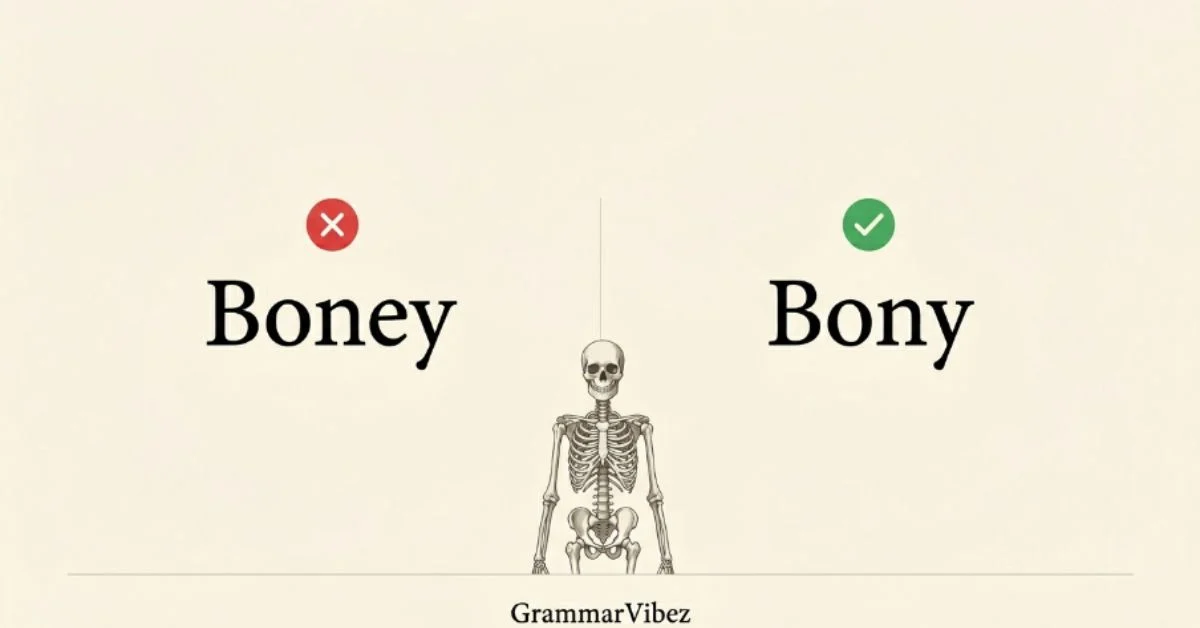
The correct standard spelling is bony. The word boney is considered an alternative spelling, but it is far less common and usually appears in informal writing.
Most dictionaries, teachers, editors, and professional writers prefer bony.
People search for “boney or bony” because they want to avoid spelling mistakes in school work, emails, blogs, or formal documents.
Using the correct spelling helps writing look cleaner and more professional.
In this article, you will learn the difference between boney and bony, their origins, spelling rules in British and American English, common mistakes, real-world examples, and which spelling you should use for different audiences.
Quick Answer
The correct and preferred spelling is bony.
❌ Boney
✅ Bony
The word bony describes someone or something with visible bones or very little flesh.
Examples
- The dog looked very bony after being lost for weeks.
- She has long, bony fingers.
- The fish had a bony structure.
The spelling boney is sometimes used informally, but it is not the standard choice.
The Origin of Boney or Bony
The word bony comes from the noun bone. English speakers added the suffix “-y” to describe something that has the qualities of bones.
Over time, the spelling became standardized as bony in dictionaries and formal English writing.
Why Does “Boney” Exist?
Some people spell it as boney because:
- It follows the pattern of words like “stoney.”
- The pronunciation sounds similar.
- Informal writing often ignores standard spelling rules.
However, modern English style guides strongly prefer bony.
British English vs American English Spelling
Both British and American English use bony as the standard spelling.
Comparison Table
| Style | Preferred Spelling | Less Common Variant |
|---|---|---|
| British English | Bony | Boney |
| American English | Bony | Boney |
| Canadian English | Bony | Boney |
| Australian English | Bony | Boney |
Examples
- UK: The bird had a thin, bony neck.
- US: He looked weak and bony after the illness.
There is no major regional spelling difference for this word.
Which Spelling Should You Use?
You should use bony in almost every situation.
Best for:
- School assignments
- Business writing
- Articles and blogs
- Academic papers
- Professional emails
- News writing
When “Boney” Appears
- Casual online comments
- Creative writing
- Personal style choices
If your audience is global or professional, always choose bony.
Common Mistakes with Boney or Bony
Writers often confuse these spellings because they sound alike.
Common Errors
| Incorrect | Correct |
|---|---|
| Boney | Bony |
| Boney | Bony |
| Bonie | Bony |
| Bonny | Bony |
Why These Mistakes Happen
- Pronunciation confusion
- Informal internet writing
- Typing habits
- Lack of proofreading
Easy Memory Trick
Think of:
- Bone + y = Bony
There is no need for the extra “e.”
Boney or Bony in Everyday Examples
Here are common ways people use bony in daily writing.
In Emails
- The rescued animal looked very bony and weak.
In News Articles
- Doctors treated the patient’s severely bony arms.
On Social Media
- My cat gets so bony when she skips meals.
In Formal Writing
- The scientist studied the animal’s bony skeleton.
In Conversations
- He was tall and bony as a teenager.
Boney or Bony – Google Trends & Usage Data
Online search data shows that bony is searched and used far more often than boney.
Usage Trends
- Bony appears in dictionaries, books, schools, and professional writing.
- Boney mostly appears in casual writing and typo-based searches.
Countries Searching This Keyword
- United States
- United Kingdom
- Canada
- Australia
- India
- Pakistan
Most users searching this term want grammar help, spelling correction, or writing advice.
Comparison Table
| Word | Correct? | Usage |
|---|---|---|
| Bony | ✅ Yes | Standard English spelling |
| Boney | ⚠️ Less Common | Informal or alternative spelling |
FAQs
Is it boney or bony?
The standard and correct spelling is bony.
Is boney a real word?
Yes, but it is considered a less common alternative spelling.
Which spelling do dictionaries prefer?
Most dictionaries prefer bony.
Is bony used in British and American English?
Yes. Both forms of English mainly use bony.
Why do people spell it as boney?
People add the extra “e” because of pronunciation habits or informal writing styles.
Can I use boney in formal writing?
It is better to avoid it in formal or professional writing.
What does bony mean?
It describes a person, animal, or object with noticeable bones or little flesh.
Conclusion
The confusion between boney and bony is common, but the standard and widely accepted spelling is bony.
While “boney” may appear in informal writing or creative styles, it is not the preferred choice in professional English.
Whether you are writing a school assignment, email, article, or social media caption, using bony will make your writing look more accurate and polished.
The good news is that both British and American English follow the same rule, so you do not need to learn different spellings for different audiences.
A simple way to remember the correct spelling is to think of the base word “bone” and simply add “-y.
” There is no need for an extra “e.” Avoiding small spelling mistakes like this can improve your grammar, clarity, and confidence as a writer.
Now you can confidently choose bony whenever you write.

Lindley Murray brings classic grammar knowledge to GrammarVibez.com, guiding readers through tricky word choices and spelling rules with simple and timeless explanations.