Last Updated on April 12, 2026 by ramzancloudeserver@gmail.com
Have you ever wondered whether you should write “among” or “amongst” in your sentence? Many English learners and even native speakers get confused because both words look correct and sound similar.
This confusion often appears in school writing, professional emails, blog posts, and even exams.
People search this keyword because they want a clear, simple rule that tells them which word is right and when to use it.
The truth is, both words mean the same thing, but they are used in slightly different styles of English.
One is more modern and common, while the other feels older and more formal. Understanding this difference helps you write more confidently and avoid small but noticeable mistakes in English writing.
In this guide, you will learn the exact meaning of among vs amongst, their origin, differences in British and American English, common mistakes, real-life examples, and usage trends.
By the end, you will know exactly which one to use in any situation without confusion.
Quick Answer
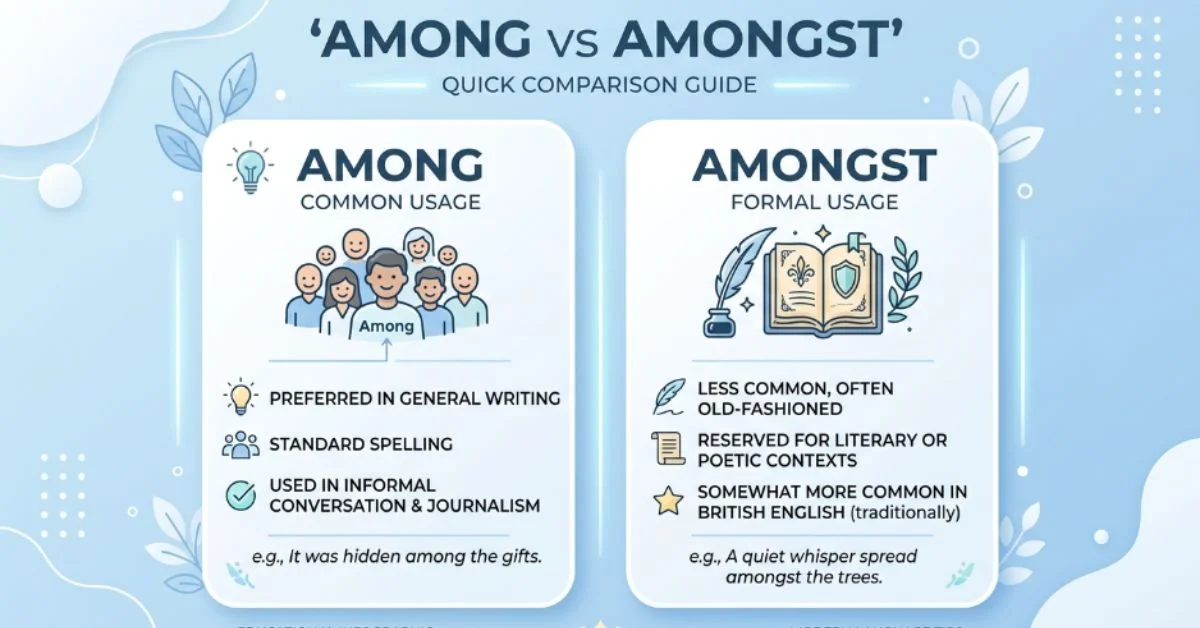
Among and amongst both mean “in the middle of” or “surrounded by a group.”
✔ Among = modern, standard English
✔ Amongst = formal, older, or literary style
Examples:
- She is sitting among her friends.
- He found peace amongst nature.
👉 Both are correct. Only style changes.
The Origin of Among vs Amongst
The word comes from Old English:
- “on gemang” → meaning “in a crowd” or “in a group”
Over time:
- Among became the simplified modern form
- Amongst developed as an extended form with “-st” ending for sound and emphasis
Historically, English used many “-st” endings (like whilst, amidst), but modern English gradually simplified them.
British English vs American English Spelling
English Grammar
| Feature | Among | Amongst |
|---|---|---|
| Usage | Global standard | Mostly British style |
| Tone | Neutral | Formal / poetic |
| Frequency | Very common | Less common |
| Modern use | Preferred | Limited use |
👉 American English strongly prefers among
👉 British English sometimes uses amongst for style
Which Spelling Should You Use?
✔ Use among if you are:
- Writing blogs or SEO content
- Sending business emails
- Taking exams
- Writing academic papers
✔ Use amongst if you want:
- A poetic tone
- A storytelling style
- Formal or classical writing
👉 Safe rule: Always choose “among” unless style demands otherwise.
Common Mistakes with Among vs Amongst
❌ Using both randomly in the same paragraph
❌ Thinking they have different meanings
❌ Overusing “amongst” in modern writing
❌ Using “amongst” in formal business documents
✔ Correct usage:
- The secret was shared among the team.
- The secret was shared amongst ancient warriors (literary style only).
Among in Everyday Examples
📧 Email:
- Your file is shared among the department members.
📰 News:
- The policy is popular among citizens.
📱 Social Media:
- Happiness is found among friends and family.
📄 Formal Writing:
- The task was divided among all participants.
Among vs Amongst – Google Trends & Usage
In modern usage:
- Among → highly dominant worldwide
- Amongst → declining usage, mainly literary or regional
Countries like the US, Canada, and Australia mostly use among, while the UK still occasionally uses amongst in formal or poetic writing.
Comparison Table: Among vs Amongst
| Feature | Among | Amongst |
|---|---|---|
| Meaning | Same | Same |
| Style | Modern | Old / formal |
| Usage frequency | High | Low |
| Region | Global | UK literary use |
| Writing type | Academic, business | Poetry, storytelling |
| Recommendation | Always preferred | Optional stylistic use |
FAQs
1. Are among and amongst the same?
Yes, both have the same meaning. Only style is different.
2. Is amongst wrong English?
No, it is correct but less common in modern writing.
3. Which is more professional?
“Among” is more professional and widely accepted.
4. Can I use amongst in exams?
Yes, but “among” is safer and preferred.
5. Why does amongst exist?
It comes from older English forms with “-st” endings.
6. Is amongst British English?
It is more common in British English, but still not frequently used today.
7. Which should I learn first?
Always learn among first because it is standard global English.
Conclusion
Both among and amongst are correct English words that share the same meaning, but their usage depends on tone and style.
In modern communication, among is the clear winner because it is simple, natural, and widely accepted across all forms of writing.
It fits perfectly in academic, professional, and everyday English.
On the other hand, amongst still exists as a stylistic choice. It is often used in poetry, storytelling, or formal writing where a more traditional or emotional tone is needed.
However, using it in business or SEO content is usually unnecessary and may even feel outdated.
If you are learning English or writing for a global audience, always prefer among. It keeps your writing clean, modern, and easy to understand.
Once you master this simple rule, you will avoid one of the most common confusion points in English grammar.

John E. Warriner shares clear and practical grammar insights at GrammarVibez.com, helping readers understand confusing words and spelling differences with ease and confidence.