Last Updated on June 7, 2026 by ramzancloudeserver@gmail.com
The words “woman” and “women” are often confused by English learners because they look similar but have very different meanings and usage.
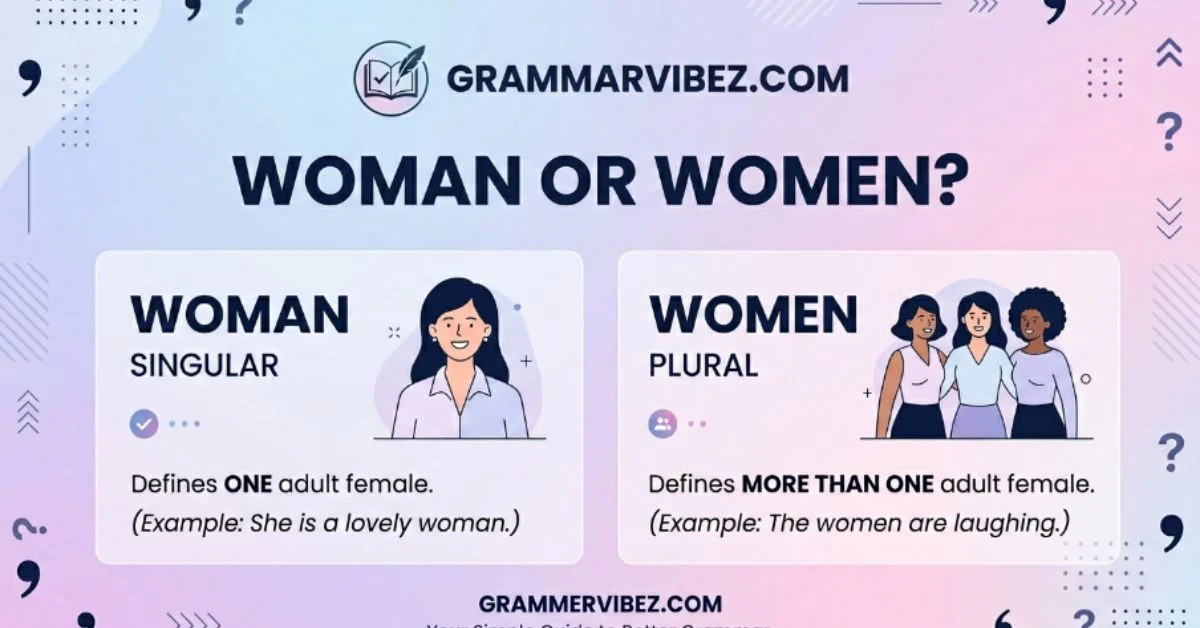
However, understanding the difference is simple once you learn the rule. “Woman” refers to one female adult, whereas “women” is the plural form.
Moreover, this small spelling change affects grammar, sentence structure, and clarity in communication.
In addition, correct usage is important for writing, speaking, and exams. Therefore, this guide will help you master both words with clear examples and easy explanations.
Quick Answer
Woman = one female adult (singular)
Women = more than one female adult (plural)
Correct Example
- The woman is reading a book.
- The women are playing football.
Incorrect Example
- The women is my teacher. ❌
- The woman are my friends. ❌
Meaning and Usage
The word woman is used when referring to a single adult female. However, women is used when talking about multiple females.
Moreover, grammar rules in English change the vowel sound and spelling in plural form, which often confuses learners.
For example:
- A strong woman can inspire change.
- Strong women can inspire society.
In addition, context always decides which word fits correctly. Therefore, paying attention to quantity is essential.
Origin and Spelling History
The word “woman” comes from Old English “wīfmann”, meaning “female human.” Over time, the spelling evolved into “woman.”
Meanwhile, the plural form “women” developed through vowel modification in Middle English.
Furthermore, this type of irregular plural is common in English. For example, “man” becomes “men.” Therefore, “woman” becomes “women” following the same pattern.
British English vs American English
There is no difference between British and American English in the usage of woman and women. However, pronunciation may slightly vary.
| Form | British English | American English |
|---|---|---|
| Woman | /ˈwʊmən/ | /ˈwʊmən/ |
| Women | /ˈwɪmɪn/ | /ˈwɪmɪn/ |
Moreover, both dialects follow the same grammar rules, so confusion is not related to region.
Spelling Comparison
Understanding spelling difference is key to avoiding mistakes.
| Singular | Plural | Meaning |
|---|---|---|
| woman | women | one vs more than one female adult |
Similarly, this pattern helps learners remember other irregular plurals in English.
Which Spelling Should You Use?
You should use “woman” when talking about one person. However, you should use “women” when referring to more than one. In addition, always check subject-verb agreement in your sentence.
For example:
- The woman is happy.
- The women are happy.
Therefore, correct usage improves clarity and professionalism in writing.
Common Mistakes
Many learners make errors because of spelling confusion. However, these mistakes are easy to fix with practice.
- Using “women” for singular ❌
- Using “woman” for plural ❌
- Wrong verb agreement (is/are) ❌
Moreover, reading and writing regularly helps avoid these issues.
Real-Life Examples
Here are practical examples for better understanding:
- The woman in the red dress is my teacher.
- The women in the office are very talented.
- A strong woman builds strong families.
- Empowered women build strong communities.
Furthermore, these examples show how context changes meaning.
Helpful Grammar Tips
First, remember that “woman = one” and “women = many.”
Next, always match verbs correctly with the subject.
Then, practice with daily sentences.
Moreover, listen carefully in spoken English to improve understanding.
Finally, consistency is key to mastering usage.
FAQs
Q1: What is the difference between woman and women?
Woman is singular, while women is plural.
Q2: Why is women spelled differently?
Because English has irregular plural forms like man/men.
Q3: Is women singular or plural?
Women is plural.
Q4: Can woman be used for multiple people?
No, it is only for one person.
Q5: What is correct: the woman is or the women is?
“The woman is” is correct for singular usage.
Conclusion
Understanding the difference between woman and women is essential for clear English communication.
However, the rule is simple: woman refers to one female, while women refers to more than one. Moreover, correct usage improves grammar accuracy and writing confidence.
In addition, learning through examples makes it easier to remember.
Therefore, by practicing regularly, you can avoid common mistakes and use both words correctly in speaking and writing.
Overall, mastering this small rule greatly improves your English fluency.

I am Mignon Fogarty, a grammar expert dedicated to making English simple, clear, and easy to learn.I write for Grammervibez, helping people improve their grammar, writing skills, and confidence in English.