Last Updated on June 7, 2026 by ramzancloudeserver@gmail.com
The words “flys” and “flies” often confuse English learners because they look similar but only one is correct in standard grammar.
In most cases, “flies” is the correct spelling and is used both as a noun and a verb form. However, “flys” appears as a common mistake or in rare brand names.
Therefore, understanding the correct usage is important for writing accuracy, exams, and professional communication.
In addition, this topic is important for learners because small spelling differences can completely change meaning and reduce clarity in English writing.
Quick Answer
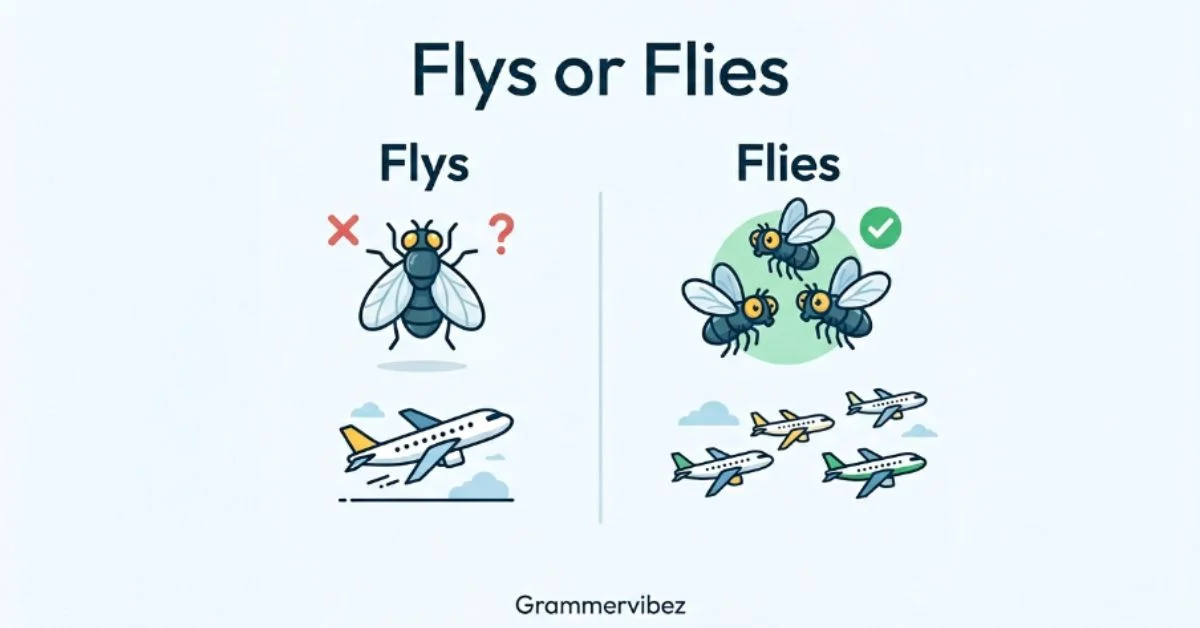
Flies = correct plural of fly + verb form (most cases)
Flys = incorrect in standard English (rare exception in names/brands)
Correct Example
- The flies are annoying in summer.
- He flies to London every month.
Incorrect Example
- The flys are everywhere ❌
- She flys to school ❌
Meaning and Usage
The word flies has two main uses in English:
- Plural noun → insects (fly → flies)
- Verb form → third person singular (he/she/it flies)
However, flys is not standard English. Therefore, it is usually considered a spelling error in academic and professional writing.
For example:
- The flies are on the food.
- She flies a plane.
Moreover, context decides whether it is noun or verb.
Origin and Spelling History
The word “fly” comes from Old English flēogan, meaning to move through the air. Over time, English developed irregular plural rules.
Similar patterns include:
- baby → babies
- city → cities
- fly → flies
Therefore, the “y → ies” rule is standard in English grammar.
British English vs American English
There is no difference between British and American English for “flies” and “flys.” However, pronunciation and usage remain the same.
| Word | Usage | Status |
|---|---|---|
| flies | correct plural + verb | standard English |
| flys | incorrect spelling | not standard |
Spelling Comparison
| Singular | Plural / Verb |
|---|---|
| fly | flies |
Moreover, this rule is consistent in all English styles.
Which One Should You Use?
You should always use flies in formal writing. However, use depends on grammar role:
- As noun (plural): The flies are in the room.
- As verb: He flies every week.
Therefore, “flys” should be avoided completely in exams and professional content.
Common Mistakes
Many learners make errors such as:
- Writing “flys” instead of “flies” ❌
- Confusing noun and verb usage ❌
- Incorrect subject-verb agreement ❌
Moreover, these mistakes usually come from fast typing or lack of grammar rules.
Real-Life Examples
- The flies are around the fruit.
- She flies to Dubai often.
- Airplanes fly across the sky.
- There are many flies in summer kitchens.
In addition, correct usage improves writing clarity and professionalism.
Helpful Grammar Tips
First, remember the rule: y changes to ies.
Next, check whether the word is noun or verb.
Then, practice daily sentences.
Moreover, read English articles to improve recognition.
Finally, avoid guessing spellings in exams or writing tasks.
FAQs
Q1: Is flys correct in English?
No, “flies” is correct in standard English.
Q2: What is the plural of fly?
Flies.
Q3: Why is flies used instead of flys?
Because English changes “y” to “ies” in plural forms.
Q4: Is flies a verb or noun?
Both, depending on context.
Conclusion
The difference between flys and flies is simple but important for correct English writing. “Flies” is the correct form used as both plural noun and verb, while “flys” is considered incorrect in standard English.
However, many learners confuse them due to spelling similarity. Therefore, understanding the “y to ies” rule helps avoid mistakes.
In addition, correct usage improves grammar accuracy, exam performance, and professional writing quality.
With regular practice and awareness of rules, learners can easily use “flies” correctly in everyday communication.