Last Updated on April 14, 2026 by ramzancloudeserver@gmail.com
Many English learners get confused when they see two different spellings: totalling and totaling. At first glance, they look like spelling mistakes, but both are actually correct.
The confusion usually happens because English is not fully standardized across countries. In British texts, you may see one form, while American content uses another.
People search this keyword when they are writing essays, emails, blogs, or exams and want to know the “correct” spelling.
The real problem is uncertainty, users don’t know if they should use one “l” or two. This often leads to overthinking and fear of making grammar mistakes.
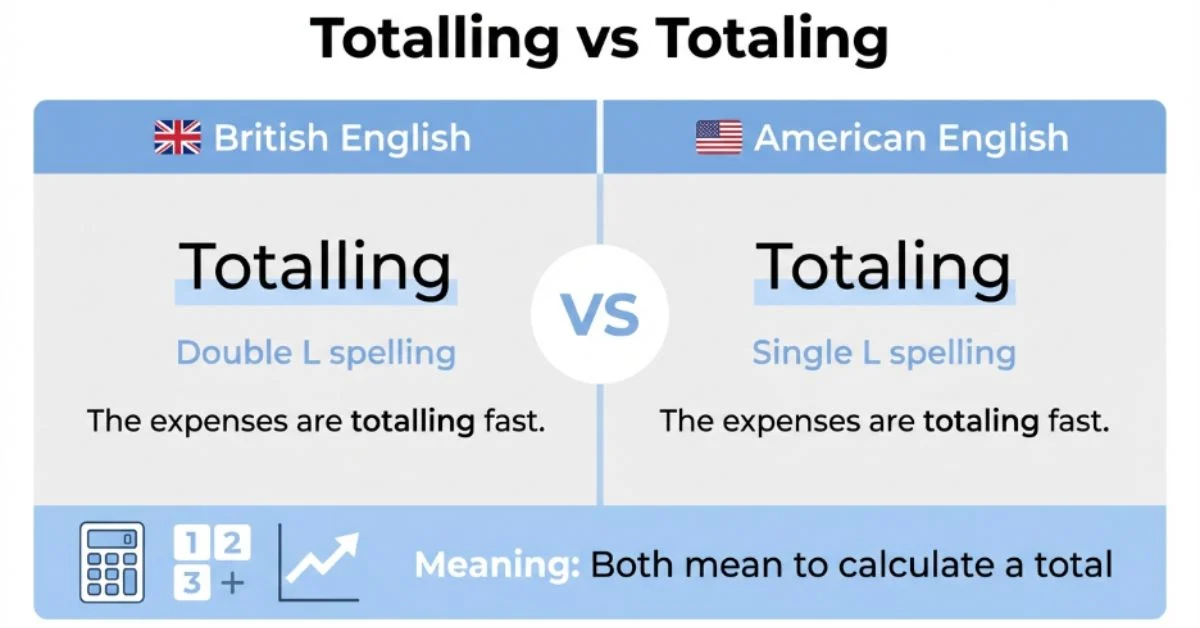
The truth is simple: both words mean the same thing, to calculate or add a total. The only difference is regional spelling rules between British and American English.
Understanding this difference helps writers sound more natural, professional, and audience-appropriate in their writing.
Quick Answer
English language
Both totalling and totaling mean:
To calculate or add up a total.
Examples:
- UK: The company is totalling its yearly expenses.
- US: The company is totaling its yearly expenses.
The Origin of Totalling / Totaling
The word comes from the root “total”, derived from Latin totalis, meaning “whole or entire.”
Over time:
- British English kept traditional spelling patterns (doubling consonants)
- American English simplified many spellings for efficiency
This is why both forms exist today.
British English vs American English Spelling
British English
American English
Rule Difference:
- British English → doubles consonant → totalling
- American English → simplified spelling → totaling
Comparison Table
| Variation | Spelling | Region |
|---|---|---|
| British English | totalling | UK, Commonwealth |
| American English | totaling | USA |
Which Spelling Should You Use?
- US audience: use totaling
- UK/Commonwealth audience: use totalling
- Global writing (blogs, SEO): choose based on target readers or stick to American English for wider reach
Common Mistakes with Totalling vs Totaling
- ❌ Mixing both spellings in one document
- ❌ Thinking one is wrong
- ❌ Using “totalling” in US academic writing
- ❌ Overcorrecting to avoid double “l” unnecessarily
Totalling / Totaling in Everyday Examples
Emails:
- “We are totaling your invoice now.”
News:
- “The damages are totalling millions of dollars.”
Social Media:
- “My steps are totaling 10k today!”
Formal Writing:
- “The audit is currently totalling all financial records.”
Totalling vs Totaling – Usage Table
| Context | British English | American English |
|---|---|---|
| Business report | totalling | totaling |
| Academic essay | totalling | totaling |
| News article | totalling | totaling |
| Casual writing | totalling | totaling |
Google Trends & Usage Insight
Globally:
- “totaling” is more searched due to higher US content volume online
- “totalling” dominates in UK-based academic and publishing content
Search behavior shows users often switch between both forms when unsure of correctness.
FAQs
1. Is “totalling” correct in English?
Yes, it is correct in British English.
2. Is “totaling” wrong?
No, it is correct in American English.
3. Why are there two spellings?
Because British and American English follow different spelling systems.
4. Which spelling is better for SEO?
American English (“totaling”) usually gets more global traffic.
5. Can I mix both spellings?
No, always stay consistent in one document.
6. Does meaning change?
No, both mean the same action: adding up totals.
7. Which dictionary should I follow?
Oxford English Dictionary for UK usage and Merriam-Webster for US usage.
Conclusion
Totalling and totaling are two spellings of the same word, and neither is incorrect. The only real difference comes from regional English standards.
British English prefers “totalling,” while American English uses “totaling.” This difference exists because English evolved differently in the UK and the US over time.
For writers, the most important rule is consistency. Choose one spelling style based on your audience and stick to it throughout your content.
Understanding this small difference can improve your writing accuracy and make your content more professional.
Instead of worrying about mistakes, focus on consistency and audience alignment. That is the real key to strong English writing.

John E. Warriner shares clear and practical grammar insights at GrammarVibez.com, helping readers understand confusing words and spelling differences with ease and confidence.