Last Updated on June 8, 2026 by ramzancloudeserver@gmail.com
Many English learners often get confused between the words “patient” and “patience” because both look similar, yet their meanings are completely different.
This confusion usually appears in speaking, writing, and exam situations, especially when someone is trying to express emotions or describe a person’s behavior.
However, using the wrong word can completely change the meaning of a sentence, which is why understanding both terms is very important.
Moreover, these words are commonly searched in grammar queries, such as “patient or patience difference,” “how to use patient in sentence,” and “meaning of patience in English.”
Therefore, this guide explains everything in a simple, clear, and practical way.
In addition, you will learn real examples, grammar rules, common mistakes, and usage tips so you can confidently use both words in everyday English.
Quick Answer
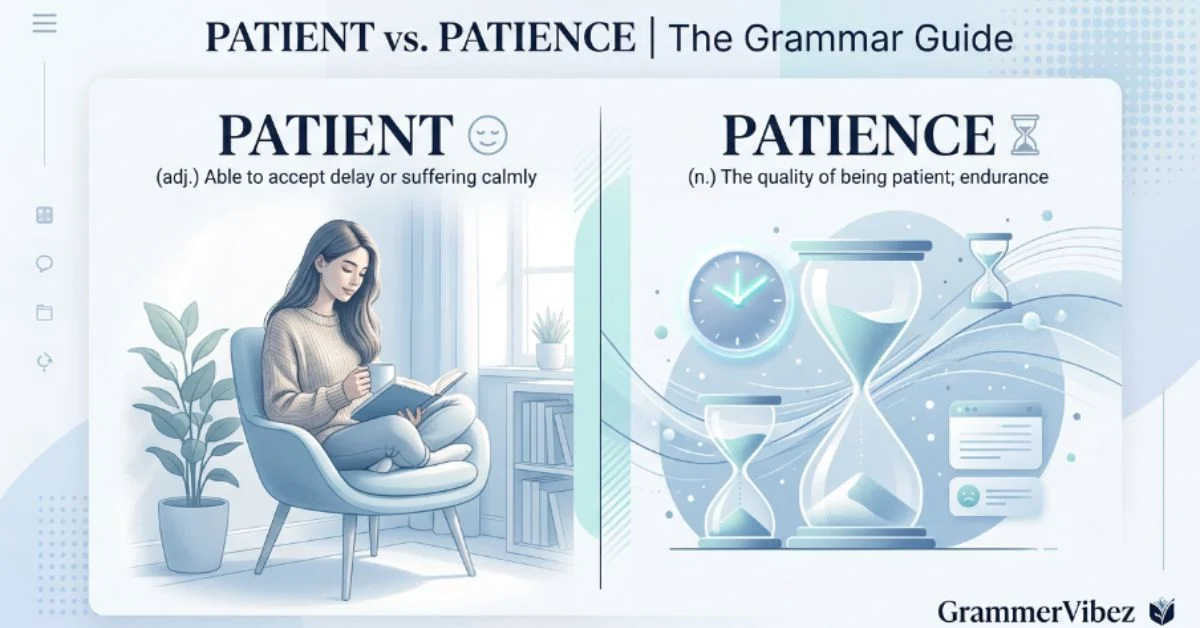
Patient is a noun or adjective used for a person or behavior.
Patience is a noun that means the ability to wait calmly.
Correct Example
- She is a very patient teacher.
- You need patience to learn English.
Incorrect Example
- She is very patience (wrong form)
- You need patient to learn English (wrong meaning)
Meaning and Usage
The word patient can be used in two main ways.
First, as an adjective, it describes a person who can wait calmly without getting angry or frustrated. For example, a patient teacher explains lessons slowly and clearly.
Second, as a noun, “patient” refers to a person receiving medical care, such as a hospital patient.
On the other hand, patience is always a noun. It describes the mental ability to stay calm while waiting or facing difficulties. For example, when you are stuck in traffic but remain calm, you are showing patience.
Moreover, these words are closely connected in meaning but are not interchangeable. Therefore, understanding context is essential for correct usage.
Origin and Spelling History
The word patient comes from the Latin word patientem, which means “suffering” or “enduring.”
Over time, it entered Old French and later Middle English, keeping a similar structure and meaning.
Similarly, the word patience also comes from Latin patientia, which means endurance or suffering.
However, as English evolved, the meanings became more refined and now represent emotional control and calmness.
Furthermore, both words developed separately in grammar roles. As a result, “patient” became used for describing people or nouns, while “patience” became an abstract quality.
British English vs American English
There is no major difference between British and American English when using these words. Both regions use:
- Patient → same spelling and meaning
- Patience → same spelling and meaning
However, pronunciation may slightly differ depending on accent. For example, British English may soften vowel sounds, while American English may pronounce them more sharply.
Moreover, grammar rules remain the same in both versions, so learners do not need to worry about regional variation.
Spelling Comparison
| Word | Type | Meaning | Usage |
|---|---|---|---|
| Patient | Adjective / Noun | Calm person / medical person | Describes behavior or hospital person |
| Patience | Noun | Ability to wait calmly | Emotional quality |
Therefore, even though both words are related, they cannot replace each other in sentences.
Which Word Should You Use?
You should use patient when describing:
- A calm person
- A medical case
You should use patience when describing:
- Emotional control
- Ability to wait
- Mental strength in difficult situations
Moreover, remembering this simple rule helps avoid most grammar mistakes in writing and speaking.
Common Mistakes
❌ You need more patient in life.
✔ You need more patience in life.
❌ She is a patience teacher.
✔ She is a patient teacher.
❌ The patient of waiting is important.
✔ The patience of waiting is important.
Furthermore, these mistakes often happen because learners confuse noun and adjective forms.
Real-Life Examples
- A doctor must be very patient with nervous patients.
- Learning a new language requires patience and practice.
- The hospital patient recovered quickly after treatment.
- Good teachers remain patient even when students struggle.
- Success in life often depends on patience and consistency.
Moreover, these examples show how context changes the meaning completely.
Helpful Grammar Tips
First, always check whether you need a noun or an adjective. If you are describing a person, use patient. If you are describing a quality or emotion, use patience.
Next, remember that “patience” cannot describe a person directly. Instead, it describes behavior or mindset.
In addition, practicing with real sentences helps build natural understanding. For example, reading daily English articles improves word recognition and reduces confusion.
Furthermore, if you are writing SEO content, using correct grammar improves readability and ranking potential.
FAQs
What is the difference between patient and patience?
“Patient” describes a person or noun, while “patience” is the ability to stay calm.
Can patient and patience be used interchangeably?
No, both have different grammar roles and meanings.
Is patience a noun or adjective?
Patience is always a noun.
What is the noun form of patient?
The noun form is also “patient” when referring to a medical person.
Why do people confuse patient and patience?
Because both words are closely related in spelling and meaning.
Conclusion
In conclusion, the difference between patient and patience is simple but very important for correct English usage.
“Patient” is used to describe a calm person or a medical individual, while “patience” refers to the ability to stay calm in difficult situations.
Therefore, using the correct word depends on context and grammar structure. Moreover, understanding this difference improves both speaking and writing skills significantly.
In addition, these words are commonly confused by learners worldwide, but with practice and examples, the mistake becomes easy to avoid.
Finally, mastering patient and patience helps you communicate more clearly, confidently, and professionally in everyday English.

Lindley Murray brings classic grammar knowledge to GrammarVibez.com, guiding readers through tricky word choices and spelling rules with simple and timeless explanations.