Last Updated on June 8, 2026 by ramzancloudeserver@gmail.com
Many English learners and writers often get confused between the words “capital” and “capitol” because they look similar, but their meanings are completely different.
This confusion is very common in exams, writing tasks, and online searches such as “capital or capitol difference” or “when to use capital vs capitol.”
However, using the wrong word can completely change the meaning of a sentence, especially in formal writing.
Moreover, both words are widely used in geography, politics, and education, which makes it even more important to understand them clearly.
Therefore, this guide explains everything in a simple, practical, and human way so you can easily remember the difference.
In addition, you will learn real examples, grammar rules, usage tips, and common mistakes to avoid confusion forever.
Quick Answer
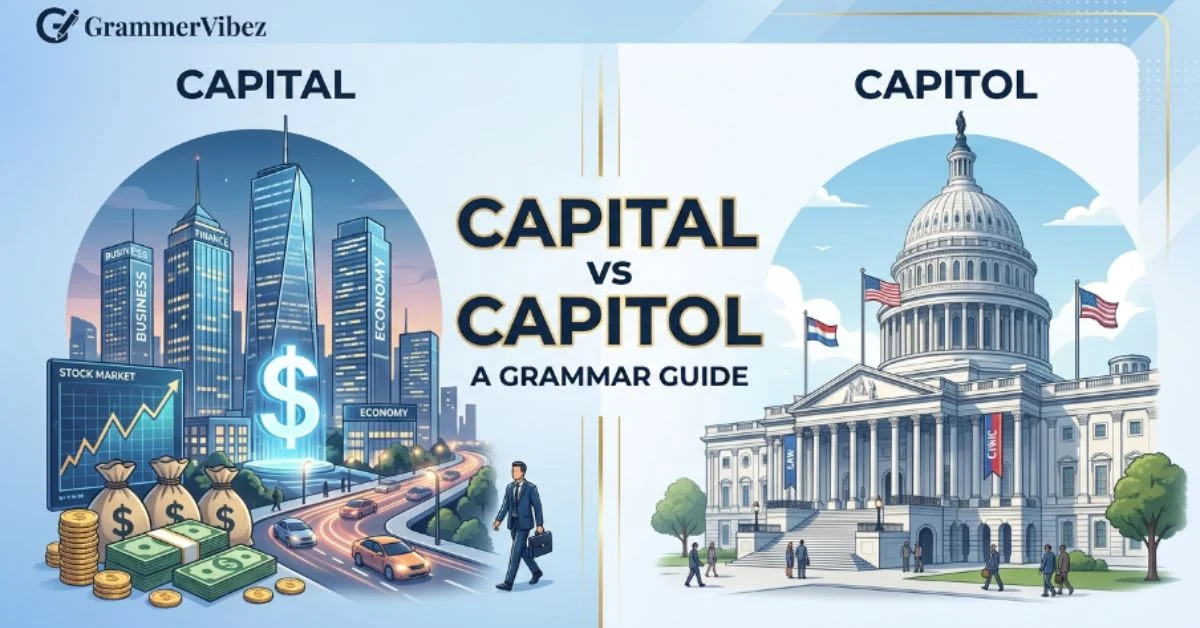
Capital has multiple meanings including city, money, and importance.
Capitol refers only to a government building where lawmakers meet.
Correct Example
- Islamabad is the capital of Pakistan.
- The Capitol building is in Washington, D.C.
Incorrect Example
- Islamabad is the capitol of Pakistan. ❌
- The capital building is in Washington, D.C. ❌ (wrong in this context)
Meaning and Usage
The word capital has several meanings depending on context.
First, it refers to the main city of a country or state, such as Islamabad, London, or Paris.
Next, it can mean money or financial assets, especially in business and economics.
Moreover, it is also used to describe something important or major, such as “capital punishment.”
On the other hand, capitol is much more specific. It refers to a building where a legislative body meets, such as a parliament or congress building.
For example, the United States Capitol is where lawmakers meet in Washington, D.C. Therefore, while both words sound similar, their usage is completely different.
Origin and Spelling History
The word capital comes from the Latin word capitalis, meaning “chief” or “head.” Over time, it evolved into English with multiple meanings related to importance, finance, and geography.
Meanwhile, capitol comes from the Latin word Capitolium, which referred to a temple in ancient Rome. This historical origin is why it is specifically connected to government buildings today.
Moreover, English separated these two spellings over time to avoid confusion. However, many learners still mix them due to similar pronunciation.
British English vs American English
Interestingly, both British and American English use capital and capitol in the same way.
| Type | Capital | Capitol |
|---|---|---|
| British English | Main city, money, importance | Government building |
| American English | Same meanings | Same meanings |
| Academic Writing | Standard usage | Standard usage |
| News Media | Common usage | Rare but correct |
Furthermore, there is no spelling difference between regions, which makes the distinction purely based on meaning, not geography.
Spelling Comparison
| Word | Meaning | Usage |
|---|---|---|
| Capital | City, money, importance | Broad usage |
| Capitol | Government building | Specific usage |
Therefore, understanding context is the key factor in choosing the correct word.
Which Word Should You Use?
You should use capital when referring to:
- Countries or cities
- Money or investment
- Importance or major things
However, you should use capitol only when referring to:
- Government buildings
- Legislative assembly locations
- Political institutions
Moreover, remembering this simple rule helps avoid most writing mistakes.
Common Mistakes
❌ Washington is the capital building of USA.
✔ Washington is the Capitol building of the USA.
❌ Islamabad is the capitol of Pakistan.
✔ Islamabad is the capital of Pakistan.
❌ The capital holds parliament meetings. (wrong meaning)
✔ The Capitol holds parliament meetings.
Furthermore, these mistakes often happen due to pronunciation similarity and lack of context understanding.
Real-Life Examples
- Islamabad is the capital city of Pakistan.
- The United States Capitol is located in Washington, D.C.
- London is the capital of the United Kingdom.
- The state capitol building is open to visitors.
- Capitals are important centers of government and administration.
Moreover, these examples show how context changes the meaning completely.
Helpful Grammar Tips
First, always ask yourself: am I talking about a city or a building? If it is a city, use capital. If it is a government building, use capitol.
Next, remember that “capitol” always relates to politics and buildings, not geography or money.
In addition, practicing with real sentences helps improve memory and reduces confusion.
Furthermore, reading news articles about government systems helps you naturally understand usage patterns.
FAQs
What is the difference between capital and capitol?
Capital refers to a city or money, while capitol refers to a government building.
Is capitol used in British English?
Yes, but it is rarely used except in political contexts.
Can capital and capitol be used interchangeably?
No, both have completely different meanings.
What is the capital of a country?
It is the main city where government offices are located.
Why do people confuse capital and capitol?
Because both words sound similar but have different meanings.
Conclusion
In conclusion, the difference between capital and capitol is simple but very important for correct English usage.
Capital refers to cities, money, or importance, while capitol is used only for government buildings where legislative work takes place.
Therefore, understanding context is the key to choosing the right word. Moreover, this confusion is very common among learners because both words sound similar but serve completely different purposes.
In addition, using them correctly improves writing accuracy, clarity, and professionalism.
Finally, with practice and real examples, you can easily master this difference and avoid one of the most common English grammar mistakes in everyday writing.

I am Mignon Fogarty, a grammar expert dedicated to making English simple, clear, and easy to learn.I write for Grammervibez, helping people improve their grammar, writing skills, and confidence in English.