Last Updated on April 1, 2026 by ramzancloudeserver@gmail.com
Many English learners feel confused when choosing between nauseous or nauseated. Both words are used when talking about sickness, so they often seem interchangeable.
This is why people search for terms like “nauseous meaning,” “nauseated vs nauseous pronunciation,” and “is nauseous a word.”
The confusion comes from a shift in modern English usage. Traditionally, the two words had different meanings.
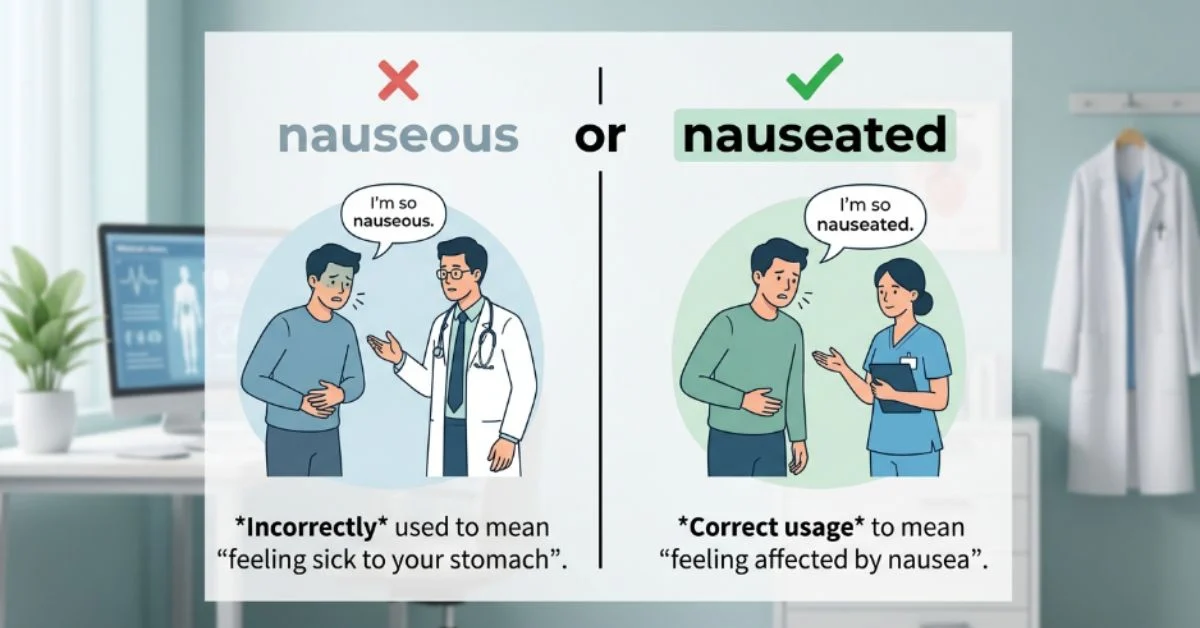
Nauseous described something that causes sickness, while nauseated described the feeling of being sick. But in everyday speech, especially online and in conversation, people often mix them.
This guide clears that confusion in a simple way. You will learn the correct meanings, origins, grammar rules, pronunciation, and real-life examples.
We will also explain how dictionaries and modern usage treat both words today.
By the end, you will clearly understand when to use Nauseous or Nauseated without hesitation in writing or speech.
Quick Answer
Nauseated = feeling sick 🤢
Nauseous = something that causes sickness (traditional rule)
Examples:
- I feel nauseated after the long trip.
- The smell is nauseous.
👉 In modern English, both are often used for “feeling sick,” but nauseated is more correct in formal writing.
The Origin of Nauseous or Nauseated
The word comes from Latin “nausea,” meaning seasickness or discomfort.
- Nausea → sickness feeling
- Nauseous → causing nausea
- Nauseated → experiencing nausea
Over time, English usage changed, and people began using nauseous for both meanings. This shift created today’s confusion in grammar and everyday speech.
British English vs American English Usage
There is no strict spelling difference between British English and American English for these words.
However, usage style differs:
- British English → prefers nauseated for feeling sick
- American English → often uses nauseous for feeling sick in casual speech
Comparison Table
| Usage Type | Nauseous | Nauseated |
|---|---|---|
| British English | causing sickness | feeling sick |
| American English | both meanings used | feeling sick (formal) |
| Formal writing | less preferred | preferred |
Which Spelling Should You Use?
Use depends on your audience:
- 🇬🇧 UK / Commonwealth → use nauseated (clear and formal)
- 🇺🇸 US audience → both accepted, but nauseated is safer in writing
- 🌍 Global SEO / blogging → prefer nauseated for clarity
👉 Rule: When in doubt, choose nauseated.
Common Mistakes with Nauseous or Nauseated
❌ Wrong:
- I feel nauseous (formal writing misuse)
- The patient is nauseous (incorrect traditional meaning)
✅ Correct:
- I feel nauseated
- The smell is nauseous
Common confusion:
- Mixing both words in the same sentence incorrectly
- Using “nauseous” for personal feelings in formal documents
Nauseous or Nauseated in Everyday Examples
📧 Email:
- I felt nauseated during the meeting and had to step out.
📰 News:
- Several passengers reported feeling nauseated after turbulence.
📱 Social Media:
- That ride made me so nauseated 🤢
📄 Formal writing:
- The patient experienced nausea and felt nauseated.
Nauseous or Nauseated – Google Trends & Usage Data
Search trends show:
- “nauseous” is searched more in casual queries
- “nauseated” appears more in grammar and academic searches
- Most confusion comes from learners and non-native speakers
👉 Overall, usage is mixed, but nauseated is preferred in formal writing standards.
Comparison Table – Keyword Variations
| Term | Meaning | Correct Usage | Formal Level |
|---|---|---|---|
| nauseous | causes sickness / sometimes feeling sick | informal use | low-medium |
| nauseated | feeling sick | correct standard use | high |
| nausea | sickness feeling | noun form | neutral |
FAQs
1. What does nauseous or nauseated mean?
Nauseous means causing sickness, while nauseated means feeling sick.
2. Is nauseous a correct word?
Yes, but its traditional meaning is “causing nausea.”
3. Can I say “I feel nauseous”?
Yes in casual English, but “I feel nauseated” is more correct in formal writing.
4. What is the difference between nauseous vs nauseated pronunciation?
Nauseous = NAW-shus, Nauseated = NAW-zee-ay-ted.
5. Why do people confuse these words?
Because modern usage has changed the original grammar rule.
6. Which word should I use in exams?
Use nauseated for clear and correct grammar.
7. Are both words accepted globally?
Yes, but usage style depends on context and formality.
Conclusion
The confusion between nauseous or nauseated is very common in English. Traditionally, “nauseous” describes something that causes sickness, while “nauseated” describes the feeling of being sick.
Over time, everyday usage has blurred this rule, especially in spoken American English.
For safe and correct writing, especially in exams, blogs, or professional content, nauseated is the best choice. It clearly describes the feeling without confusion.
“Nauseous” is still correct but is better used for things that cause sickness rather than the feeling itself.
Understanding this small difference helps improve your grammar, writing clarity, and confidence.
Once you learn the rule, you will easily avoid this common mistake in both speaking and writing.

Lindley Murray brings classic grammar knowledge to GrammarVibez.com, guiding readers through tricky word choices and spelling rules with simple and timeless explanations.