Last Updated on July 12, 2026 by ramzancloudeserver@gmail.com
Have you ever written a sentence and stopped because you weren’t sure whether to use “loss” or “lost”?
These two words are closely related, but they are not the same. Many English learners and even native speakers confuse them because they come from the same root word “lose.”
The problem is that they look similar and are often used in emotional, financial, and everyday situations.
But in grammar, they play completely different roles. One is a noun, and the other is a verb or adjective.
If you use them incorrectly, your sentence may still be understood, but it will not be grammatically correct.
This is especially important in formal writing, exams, emails, and business communication.
In this guide, you will learn:
- The exact meaning of loss and lost
- How they are different
- When to use each one
- Real-life examples
- Common mistakes people make
Let’s break it down in a simple way.
Quick Answer
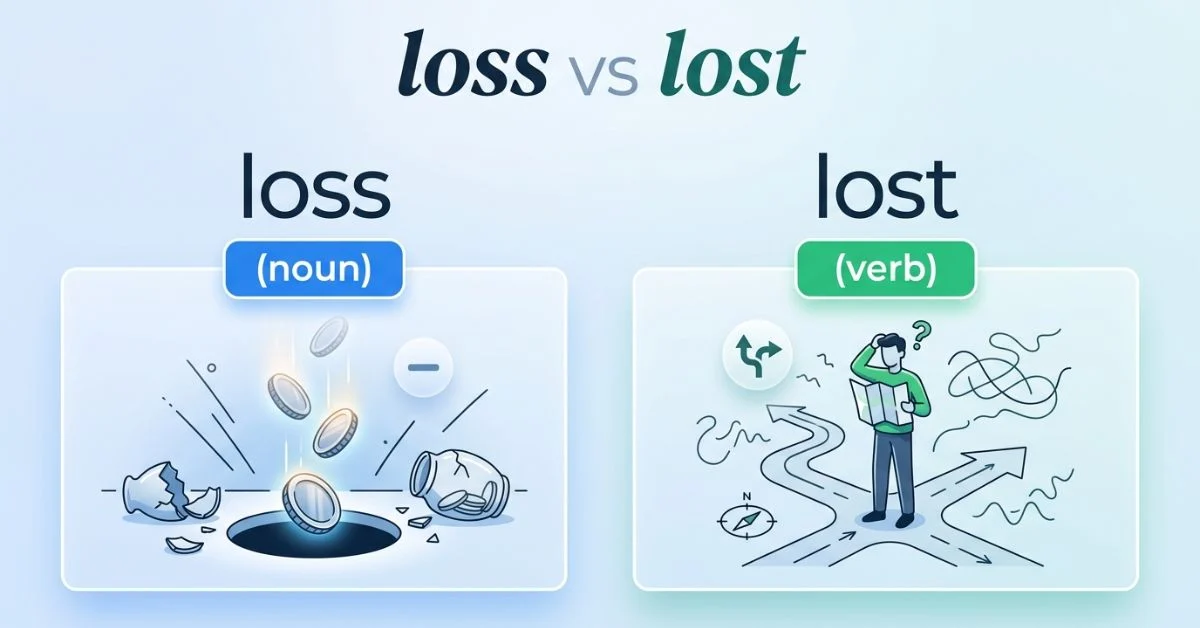
👉 Loss = noun (something that is gone or taken away)
👉 Lost = past tense of “lose” or adjective (unable to find or missing)
Examples:
- ✔️ I felt a great loss after the incident
- ✔️ I lost my wallet yesterday
👉 Simple rule:
- Loss = thing (noun)
- Lost = action or state (verb/adjective)
The Origin of Loss or Lost
Both words come from the Old English verb “losian”, which means to be destroyed or disappear.
Over time, English developed three related forms:
- Lose → base verb
- Lost → past tense
- Loss → noun form
Why the change happened:
English creates different word forms to show:
- action (lose)
- completed action (lost)
- result or thing (loss)
👉 That’s why loss or lost are connected but not interchangeable.
Loss or Lost – Grammar Breakdown
Understanding grammar helps avoid confusion.
🔹 Loss (Noun)
- Refers to something you no longer have
- It is a thing or situation
Examples:
- Financial loss
- Emotional loss
- Data loss
🔹 Lost (Verb / Adjective)
- Past tense of “lose”
- Also describes something missing
Examples:
- I lost my phone
- He feels lost in the city
👉 So:
- loss = result
- lost = action or condition
Loss or Lost in British vs American English
There is no difference in meaning between British and American English.
👉 Both use:
- loss (noun)
- lost (verb/adjective)
Comparison Table
| Feature | Loss | Lost |
|---|---|---|
| Word type | Noun | Verb / Adjective |
| Meaning | Something gone | Past action / missing |
| Used in UK | Yes | Yes |
| Used in USA | Yes | Yes |
| Formal writing | Yes | Yes |
👉 The rule is universal
When to Use Loss or Lost
This is where most confusion happens.
✔️ Use loss when:
- Talking about a thing or result
- Referring to damage or absence
Examples:
- The company suffered a huge loss
- There was data loss after the crash
✔️ Use lost when:
- Talking about something that happened
- Describing missing items or feelings
Examples:
- I lost my keys
- She feels lost after moving
👉 Remember:
- loss = noun (what happened)
- lost = verb/adjective (what you did or feel)
Common Mistakes with Loss or Lost
Here are frequent errors learners make:
❌ Mistake 1: Using “loss” instead of “lost”
❌ I loss my phone
✔️ I lost my phone
❌ Mistake 2: Using “lost” as a noun
❌ There was a big lost
✔️ There was a big loss
❌ Mistake 3: Confusing emotional usage
- Loss = sadness about something gone
- Lost = feeling confused or missing
Loss or Lost in Everyday Examples
📧 Email:
- We regret the loss of important files
- I lost access to my account
🏢 Business:
- The company reported a financial loss
- They lost the contract
📱 Social Media:
- I feel a loss of motivation
- I lost my streak on the app
📰 News:
- The country suffered heavy loss
- Several players lost the match
👉 Notice how loss or lost change meaning completely depending on usage.
Loss or Lost – Google Trends & Usage Data
- Both words are highly used worldwide:
- USA
- UK
- Pakistan
- India
- Loss is common in:
- business
- finance
- news
- Lost is common in:
- daily conversation
- storytelling
- emotions
👉 Both are important in English communication
Comparison Table (All Forms of “Lose”)
| Word | Type | Meaning | Example |
|---|---|---|---|
| Lose | Verb | To not keep something | I lose my phone often |
| Lost | Verb / Adjective | Past / missing | I lost my phone |
| Loss | Noun | Result of losing | Financial loss |
FAQs
1. What is the difference between loss and lost?
Loss is a noun. Lost is a verb or adjective.
2. Can I say “I loss my phone”?
No. The correct form is I lost my phone.
3. What does loss mean?
It means something that is gone or taken away.
4. What does lost mean?
It means something is missing or not found.
5. Is loss and lost the same?
No, they are different grammar forms.
6. Can lost be used as an adjective?
Yes. Example: I feel lost.
7. Is loss used in daily English?
Yes, especially in formal writing.
Conclusion
The difference between loss or lost is simple once you understand their roles in grammar.
👉 Loss is a noun. It refers to something that has been gone or taken away.
👉 Lost is a verb or adjective. It describes an action or a condition of missing something.
Many learners confuse these words because they come from the same root, but their usage is different in sentences. One talks about the result, and the other talks about the action or feeling.
In formal writing, exams, emails, and business communication, using the correct form is very important. It shows clarity and strong grammar understanding.
To remember easily:
👉 Loss = thing (result)
👉 Lost = action or state
Once you keep this rule in mind, you will never mix them up again.

John E. Warriner shares clear and practical grammar insights at GrammarVibez.com, helping readers understand confusing words and spelling differences with ease and confidence.