Many writers and English learners feel confused when choosing between immigrate and emigrate.
At first, both words seem similar because they relate to moving from one country to another. However, they do not mean the same thing.
This confusion often appears in essays, news writing, and everyday communication.
People search for “immigrate or emigrate” because they want a clear and simple explanation. They want to know which word fits their sentence and how to use it correctly.
Moreover, using the wrong term can change the meaning of your sentence and cause misunderstanding.
Therefore, learning the difference is important for accurate and professional writing.
In this guide, you will learn the exact meanings, origins, and correct usage of both words.
You will also see real-life examples, common mistakes, and helpful tips. By the end, you will confidently use immigrate and emigrate without confusion.
Quick Answer
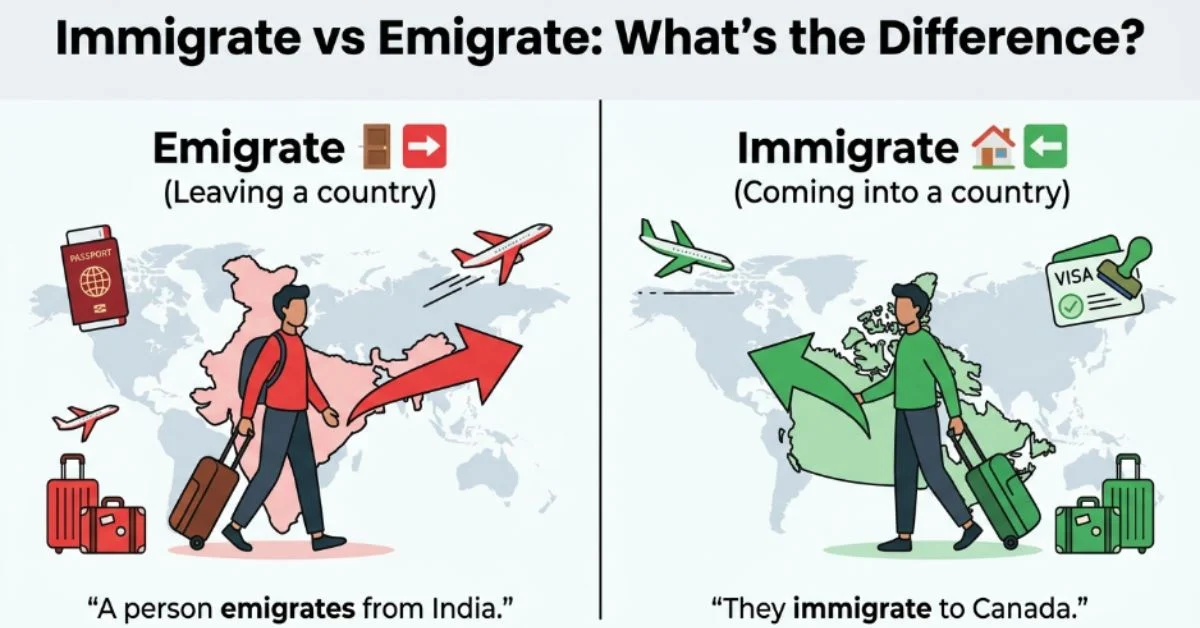
- Emigrate → To leave your country
- Immigrate → To enter a new country
Examples:
- He emigrated from Pakistan.
- He immigrated to Canada.
👉 Simple rule:
E = Exit (leave)
I = In (enter)
The Origin of Immigrate or Emigrate
Both words come from Latin roots.
- Emigrate comes from emigrare, meaning “to move out.”
- Immigrate comes from immigrare, meaning “to move into.”
Over time, English kept both words to describe two sides of the same action. One focuses on leaving a place, while the other focuses on entering a new one. Therefore, both words describe the same movement but from different perspectives.
British English vs American English Spelling
There is no spelling difference between British and American English for these words.
Comparison Table
| Region | Leaving a Country | Entering a Country |
|---|---|---|
| UK | Emigrate | Immigrate |
| US | Emigrate | Immigrate |
| Global | Emigrate | Immigrate |
Both regions use the same spelling and meaning.
Which Spelling Should You Use?
You should choose based on the direction of movement.
- Use emigrate when talking about leaving a country.
- Use immigrate when talking about entering a country.
Example:
- She emigrated from India.
- She immigrated to the UK.
Always think about the point of view in your sentence.
Common Mistakes with Immigrate or Emigrate
Many writers confuse these words. However, you can avoid mistakes with simple rules.
❌ Mistake 1: Using them as the same word
- Incorrect: He immigrated from France.
- Correct: He emigrated from France.
❌ Mistake 2: Ignoring direction
Always check if the action is leaving or entering.
❌ Mistake 3: Using wrong prepositions
- Emigrate from a country
- Immigrate to a country
Immigrate or Emigrate in Everyday Examples
You can use both words in daily situations.
Emails:
- She plans to emigrate from her home country.
- He wants to immigrate to Australia.
News:
- Thousands of people emigrate every year.
- Many families immigrate for better opportunities.
Social Media:
- I want to immigrate to a new country someday!
Formal Writing:
- Economic conditions influence people to emigrate.
Immigrate or Emigrate – Google Trends & Usage Data
Search trends show that:
- “Immigrate” appears more in discussions about destination countries.
- “Emigrate” appears in discussions about origin countries.
- Many users search both terms together to understand the difference.
Moreover, educational websites and news platforms use both words correctly, depending on context.
Comparison Table – Immigrate vs Emigrate
| Feature | Immigrate | Emigrate |
|---|---|---|
| Meaning | Enter a country | Leave a country |
| Direction | In | Out |
| Preposition | To | From |
| Example | Immigrate to Canada | Emigrate from Pakistan |
| Common Use | Destination focus | Origin focus |
FAQs
1. What is the difference between immigrate and emigrate?
Immigrate means entering a country, while emigrate means leaving a country.
2. Which word should I use?
Use emigrate for leaving and immigrate for entering.
3. Is there a spelling difference in the UK and US?
No. Both regions use the same spelling.
4. Can both words be used in one sentence?
Yes. Example: He emigrated from India and immigrated to Canada.
5. Why do people confuse these words?
Because they describe the same action from different perspectives.
6. What prepositions are used?
Use from with emigrate and to with immigrate.
7. Are these words formal?
Yes. They are commonly used in formal and official contexts.
Conclusion
Understanding the difference between immigrate and emigrate is simple once you focus on direction. Emigrate means leaving a country, while immigrate means entering a new one.
Although both words describe the same movement, they highlight different points of view.
Moreover, using the correct word improves clarity and prevents confusion in your writing.
Whether you write emails, essays, or professional content, choosing the right term makes your message more accurate and effective.
Therefore, always think about whether the person is leaving or arriving before selecting the word.
In conclusion, mastering immigrate and emigrate will strengthen your English skills. With practice, this rule becomes natural, and your writing becomes clearer, more confident, and more professional.

Lindley Murray brings classic grammar knowledge to GrammarVibez.com, guiding readers through tricky word choices and spelling rules with simple and timeless explanations.