Last Updated on May 28, 2026 by ramzancloudeserver@gmail.com
Many English learners get confused between “ate” and “eaten” because both words come from the verb “eat,” but they are used in different grammar situations.
However, the difference is actually simple once you understand past tense and past participle rules.
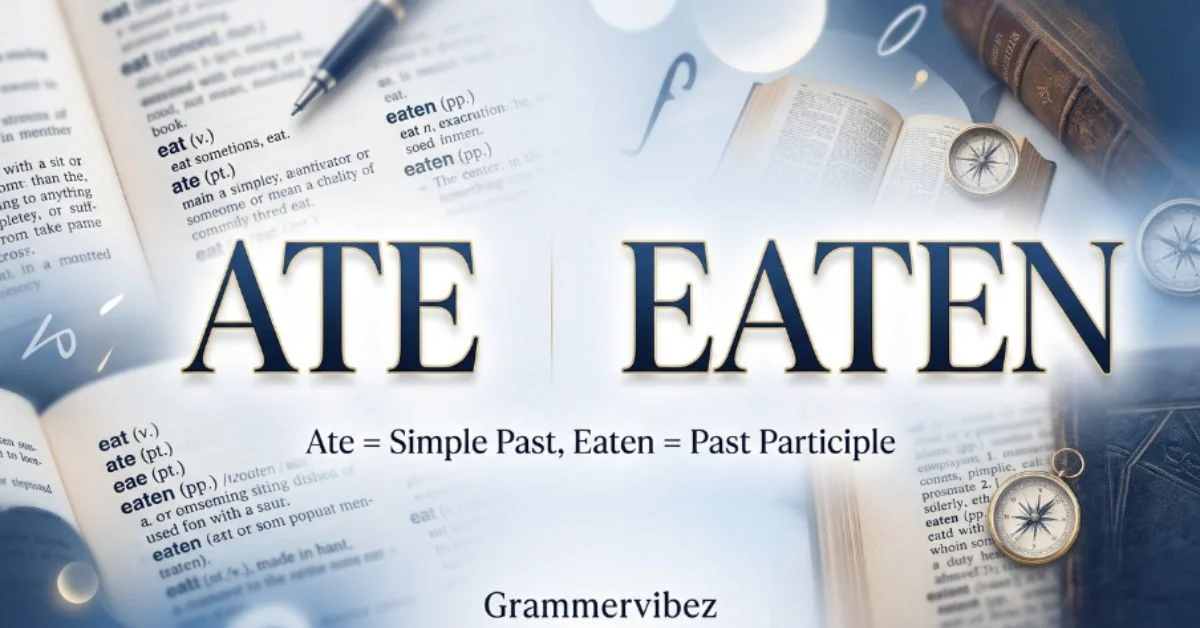
“Ate” is the simple past form, while “eaten” is the past participle used with helping verbs like “has,” “have,” or “had.”
Therefore, using the correct form is important for clear and accurate English.
Moreover, these forms appear frequently in daily conversation, writing, exams, and professional communication.
Quick Answer
“Ate” is simple past tense, while “eaten” is the past participle of “eat.”
- Ate = completed action in the past
- Eaten = used with helping verbs (has/have/had)
Correct Example
- I ate breakfast early today.
- She has eaten already.
Incorrect Example
- I eaten breakfast today. ❌
- She has ate already. ❌
Meaning and Usage
The word “ate” is used when you talk about something that happened and finished in the past. Meanwhile, “eaten” is used in perfect tenses where the action connects to another time using helping verbs.
For example:
- Yesterday, I ate pizza.
- I have eaten pizza before.
Moreover, “eaten” often appears in present perfect, past perfect, and passive structures. On the other hand, “ate” is more direct and simple.
Origin and Spelling History
Both “ate” and “eaten” come from the Old English verb “etan,” meaning “to consume food.” Over time, English developed different verb forms to show time clearly.
- “Ate” became the simple past form.
- “Eaten” became the past participle form.
In addition, English irregular verbs like “eat” do not follow regular -ed patterns, which is why learners often find them confusing.
British English vs American English
Both British and American English use “ate” and “eaten” in the same grammatical way. However, pronunciation of “ate” may differ slightly.
| Form | British English | American English | Usage |
|---|---|---|---|
| Ate | Often pronounced “et” | Often pronounced “ayt” | Simple past |
| Eaten | Same usage | Same usage | Past participle |
Moreover, grammar rules remain identical in both versions of English.
Spelling Comparison
| Word | Tense | Function | Example Sentence |
|---|---|---|---|
| Ate | Simple Past | Completed action | I ate dinner at 8 PM. |
| Eaten | Past Participle | Used with helping verbs | I have eaten dinner already. |
Which Spelling Should You Use?
You should use “ate” when talking about a finished action in the past. However, use “eaten” when the sentence includes helping verbs like “has,” “have,” or “had.”
A simple rule:
- Ate = Past action alone
- Eaten = Perfect tense action
For example:
- I ate lunch. ✔
- I have eaten lunch. ✔
Therefore, checking the sentence structure helps you choose correctly.
Common Mistakes
Many learners confuse these two forms because they both relate to the same verb “eat.” However, the grammar role is different.
| Incorrect Usage | Correct Usage | Reason |
|---|---|---|
| I have ate breakfast. | I have eaten breakfast. | Needs past participle |
| She eaten food yesterday. | She ate food yesterday. | Simple past required |
| They have ate already. | They have eaten already. | Correct form is “eaten” |
Moreover, irregular verbs require practice because they do not follow simple rules.
Real-Life Examples
Here are natural examples of how native speakers use these forms:
- I ate pasta last night at a restaurant.
- She has eaten at that café many times.
- Meanwhile, they had eaten before the meeting started.
- We ate together as a family.
- Furthermore, he has never eaten sushi before.
These examples clearly show how context changes the verb form.
Helpful Grammar Tips
First, remember that “ate” is always simple past. Therefore, it never uses helping verbs like “has” or “have.”
Meanwhile, “eaten” must always appear with helping verbs or in perfect tense.
Examples:
- I ate ✔
- I have eaten ✔
- I eaten ❌
In addition, practice irregular verbs regularly because they are commonly used in English.
Finally, reading and listening to English content can help you naturally understand correct usage.
FAQs
What is the difference between ate and eaten?
“Ate” is simple past, while “eaten” is the past participle of “eat.”
Is it correct to say “I have ate”?
No, the correct form is “I have eaten.”
When should I use eaten?
Use “eaten” with has, have, or had.
Is ate past tense or present tense?
“Ate” is the simple past tense.
Why do people confuse ate and eaten?
Because both come from the same verb but are used in different grammar structures.
Conclusion
Understanding the difference between “ate” and “eaten” is essential for speaking and writing correct English.
Although both come from the verb “eat,” they serve different grammatical purposes. “Ate” is used for simple past actions, while “eaten” is used with helping verbs in perfect tenses.
Therefore, recognizing sentence structure is the key to choosing the correct form.
Moreover, these verbs are very common in everyday English, so mastering them improves both fluency and confidence.
Once you practice regularly, using “ate” and “eaten” correctly becomes completely natural.