Last Updated on June 11, 2026 by ramzancloudeserver@gmail.com
Many English learners get confused between “anyway” and “anyways” because both words are commonly used in spoken English, informal texting, and social media communication.
However, in formal English grammar, these two forms are not equal, which often leads to mistakes in exams, emails, academic writing, and professional content.
Moreover, since both words sound natural in conversation, people assume they are interchangeable, but that is not correct in standard English usage.
This confusion becomes even more important when learners start writing professional emails, job applications, or academic essays where grammar accuracy matters.
Therefore, understanding the difference between “anyway or anyways” is essential for improving communication skills, sentence flow, and writing confidence.
In this guide, you will learn the meaning, correct usage rules, examples, mistakes, and real-life applications in a very simple way.
Additionally, you will understand related grammar concepts such as discourse markers, transition words, formal vs informal English, and sentence connectors.
This will help you use the correct form naturally in any situation.
Quick Answer
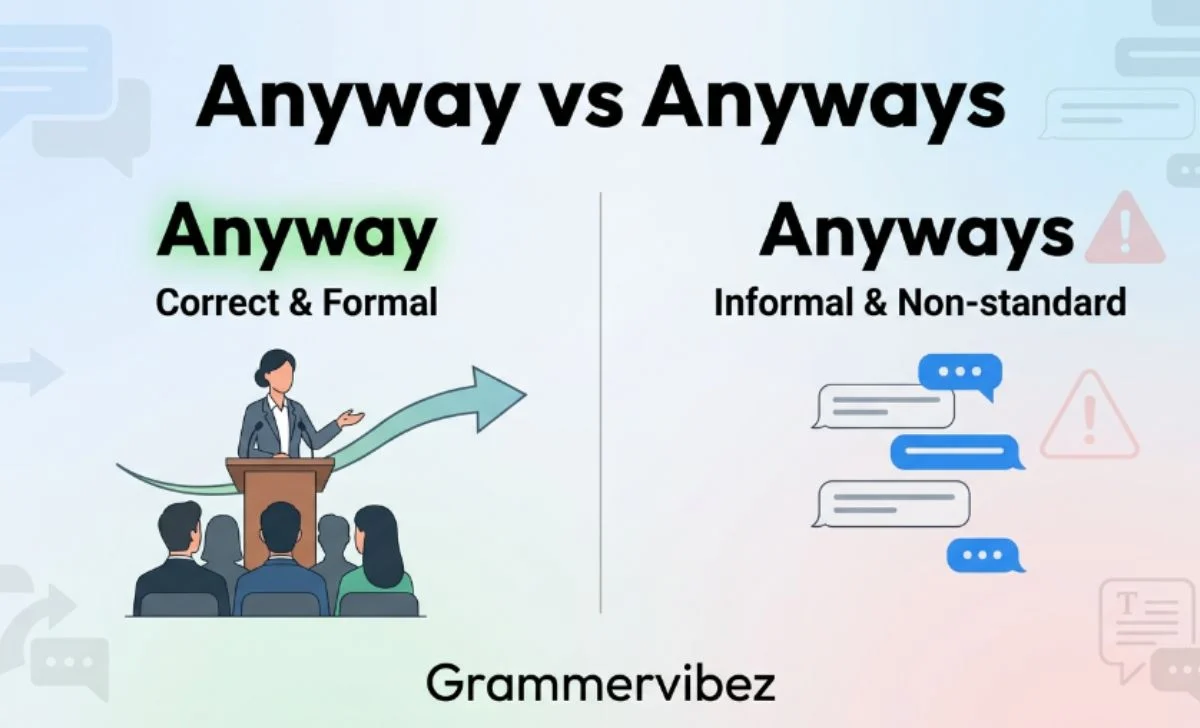
The correct standard English form is “anyway.”
“Anyways” is informal and not recommended in formal writing.
Correct Example
- Anyway, I will see you tomorrow.
Incorrect Example
- Anyways, I will see you tomorrow. (informal / non-standard)
Meaning and Usage
“Anyway” is a discourse marker (transition word) used in English to shift topics, continue a thought, or return to the main idea of a conversation. It plays an important role in maintaining natural sentence flow in both spoken and written English.
In addition, “anyway” can also mean:
- “in any case”
- “regardless”
- “however” (in some conversational contexts)
Example:
- I was tired. Anyway, I finished my work.
Moreover, “anyway” is widely used in:
- Academic writing
- Business communication
- Formal emails
- Everyday conversation
On the other hand, “anyways” is an informal variation mainly used in casual American English speech. However, it is not considered grammatically standard in formal writing or academic contexts.
Origin and Spelling History
The word “anyway” comes from Old English structure combining “any” + “way,” meaning “in any manner” or “regardless of the situation.”
Over time, it became a standard English adverb and discourse marker used in both formal and informal writing.
The form “anyways” developed later as a spoken variation, mostly in American English dialects.
It emerged naturally in speech where speakers sometimes add “-s” endings for emphasis. However, this form was never fully accepted in formal grammar rules.
Therefore:
- “Anyway” = standard English form
- “Anyways” = informal spoken variation
British English vs American English
Both British and American English prefer “anyway” in formal writing. However, spoken English shows slight variation.
- British English → strictly uses “anyway”
- American English → “anyways” appears in casual speech but not in formal writing
| Feature | Anyway | Anyways |
|---|---|---|
| Formal writing | ✔ Yes | ❌ No |
| Academic use | ✔ Yes | ❌ No |
| Spoken English | ✔ Yes | ✔ Informal |
| Standard grammar | ✔ Yes | ❌ Non-standard |
| Regional usage | Global | Mostly US informal |
Spelling Comparison
| Word | Type | Usage | Formal Status | Correctness |
|---|---|---|---|---|
| anyway | adverb / transition word | formal + informal | standard | correct |
| anyways | informal variant | casual speech only | non-standard | incorrect in writing |
👉 Therefore, “anyway” is always the safest and most correct option.
Which Spelling Should You Use?
You should always use “anyway” in:
- Exams
- Academic essays
- Business emails
- Professional communication
- Formal writing
You may hear “anyways” in:
- Casual conversations
- Social media posts
- Informal storytelling
- Friendly texting
👉 Rule of thumb: If you are unsure, always choose “anyway.”
Common Mistakes
Many learners mistakenly treat both words as interchangeable. This leads to grammar errors.
❌ Incorrect Usage
- Anyways, I will go now.
- I was late, anyways I joined the meeting.
- She was tired, anyways she continued working.
✔ Correct Usage
- Anyway, I will go now.
- I was late, anyway I joined the meeting.
- She was tired, anyway she continued working.
Another mistake is overusing “anyway” repeatedly, which can make writing repetitive and less natural.
Real-Life Examples
📧 Email Example
- Anyway, please let me know your availability for the meeting.
🏢 Business Communication
- The project was delayed; anyway, we completed it successfully.
💬 Daily Conversation
- I didn’t like the weather. Anyway, we enjoyed the trip.
📱 Social Media
- It didn’t go as planned, but anyway, it turned out fine.
🎓 Academic Writing
- The experiment had errors; anyway, the final results were consistent.
Helpful Tips
First, remember that “anyway” is a discourse marker, not just a simple word. It helps connect ideas smoothly in sentences.
Moreover, it improves flow and clarity when changing topics or continuing thoughts.
In addition, avoid using “anyways” in formal writing because it is considered non-standard. However, in spoken English, especially informal American speech, it may still appear naturally.
Furthermore, think of “anyway” as a bridge between two ideas. It helps guide the reader from one thought to another without confusion.
Therefore, correct usage improves both fluency and professionalism in writing.
Finally, practice reading and writing sentences daily to build natural understanding of transition words like “however,” “therefore,” “meanwhile,” and “anyway.”
FAQs
Is “anyways” correct English?
No, it is informal and not recommended in formal writing.
What is correct: anyway or anyways?
“Anyway” is the correct standard English form.
Can I use anyways in exams?
No, always use “anyway.”
Why do people say anyways?
Because it is common in casual spoken English.
Is anyway formal or informal?
It is acceptable in both formal and informal writing.
Do British people use anyways?
No, British English prefers “anyway.”
Is anyway a transition word?
Yes, it is a discourse marker used to connect ideas.
Conclusion
Understanding the difference between anyway and anyways is important for improving English grammar, writing clarity, and communication skills.
While both words are commonly heard in spoken language, only “anyway” is considered correct in standard English writing.
It is widely accepted in both British and American English and is suitable for academic, professional, and formal contexts.
On the other hand, “anyways” remains an informal variation mainly used in casual speech and should be avoided in serious writing.
Therefore, using “anyway” ensures correctness, clarity, and professionalism in all types of communication.
By mastering this small but important difference, learners can significantly improve their grammar accuracy, sentence flow, and overall confidence in English writing.

John E. Warriner shares clear and practical grammar insights at GrammarVibez.com, helping readers understand confusing words and spelling differences with ease and confidence.