Last Updated on June 6, 2026 by ramzancloudeserver@gmail.com
In modern English writing, small spelling variations often create confusion, especially when both forms are correct but used in different regions.
One such common confusion is “afterward or afterwards.” Moreover, both words are widely used in academic writing, business communication, and SEO content.
However, writers still struggle to choose the right version for British English or American English.
Therefore, understanding their correct usage improves clarity, professionalism, and search engine optimization.
In addition, this guide explains meaning, grammar rules, real examples, and modern usage trends in 2026.
Quick Answer
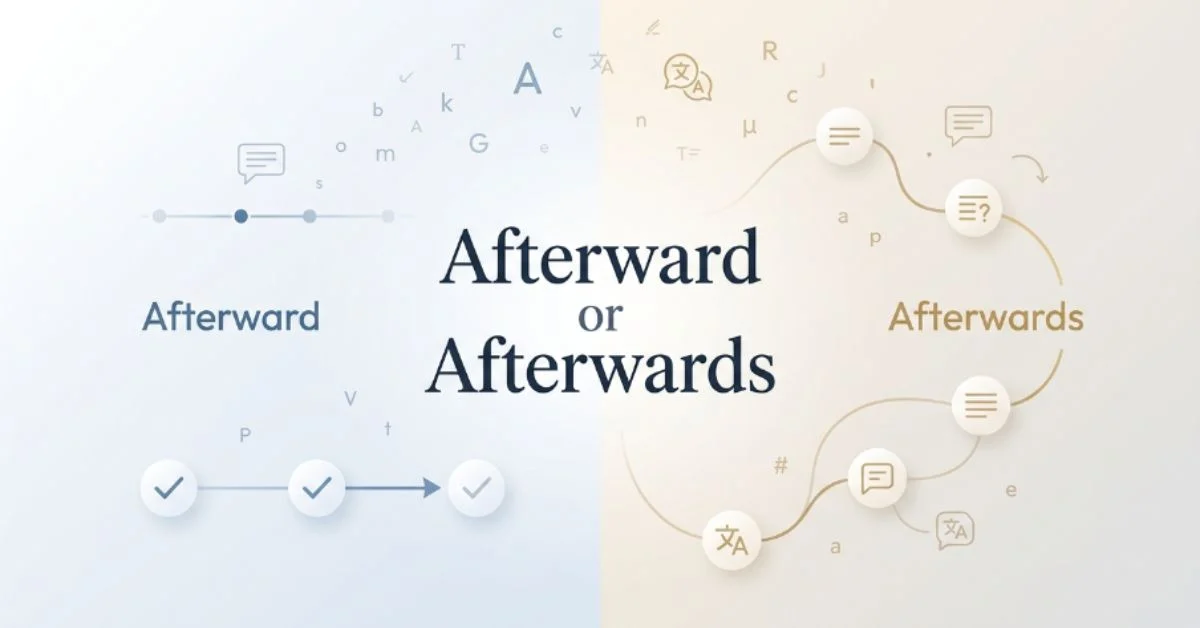
“Afterward” and “afterwards” both mean “later in time,” however usage depends on regional English style.
Correct Example
She finished the report and afterward joined the meeting.
Correct Example
She finished the report and afterwards joined the meeting.
Incorrect Example
She finished the report and afterwords joined the meeting.
Meaning and Usage
The words “afterward” and “afterwards” are adverbs of time, therefore they show that one action happens after another. Moreover, both are grammatically correct and interchangeable in meaning.
For example, in professional writing:
“We completed the audit and afterward updated the financial records.”
Similarly, in British-style communication:
“The team finalized the proposal and afterwards submitted it to management.”
Furthermore, these words help improve sentence flow, especially in storytelling, reporting, and step-by-step explanations. As a result, they are widely used in blogs, journalism, and academic essays.
Origin and Languages Background
The origin of both forms comes from Old English structure combining “after” with directional suffixes “-ward” and “-wards.” Moreover, language evolution created regional differences over time.
The American spelling system was simplified through reforms introduced by Noah Webster, who promoted shorter and more phonetic spellings.
Therefore, “afterward” became the standard in American English, while “afterwards” remained dominant in British English.
In addition, both forms are now globally accepted in modern English usage.
British English vs American English Usage
Although both forms mean the same thing, usage differs based on region and writing style.
| Feature | British English | American English |
|---|---|---|
| Preferred Form | Afterwards | Afterward |
| Writing Style | Formal, traditional | Modern, simplified |
| Common Usage | UK media, academic writing | US blogs, digital content |
| SEO Preference | UK keyword targeting | US keyword targeting |
Moreover, consistency matters more than preference in SEO writing.
Which One Should You Use?
The choice depends on your audience and content strategy. Therefore:
- Use afterward for American readers
- Use afterwards for British readers
- For global content, pick one and stay consistent
In addition, search engines like Google understand both variations, however consistent usage improves topical clarity and ranking performance.
Common Mistakes
Many writers lose quality by making simple errors. Therefore, avoid:
- Mixing both spellings in one article
- Confusing “afterword” (book section) with adverb usage
- Using incorrect spelling like “afterwords”
- Overusing the word unnecessarily in every paragraph
Moreover, inconsistent spelling can reduce readability score in SEO tools like Yoast.
Real-Life Examples
In real-world usage, both forms are common in professional communication.
- “The company launched the update and afterward monitored system performance.”
- “The committee reviewed the policy and afterwards published the final report.”
Similarly, in journalism and storytelling, these adverbs help maintain timeline clarity. Furthermore, in business writing, they improve process explanation and reporting structure.
Helpful Grammar Tips
These adverbs are flexible in sentence structure. Therefore, they can appear at the beginning or end of a sentence.
- Afterward, we conducted the final review.
- We conducted the final review afterward.
However, overuse should be avoided in SEO writing. In addition, maintaining sentence variety improves readability and engagement.
FAQs
What is the difference between afterward and afterwards?
Both mean “later,” however “afterward” is American English and “afterwards” is British English.
Which is correct grammar?
Both are correct, but usage depends on region.
Can I use both in one article?
No, consistency is recommended for SEO and readability.
Is afterward formal or informal?
It is neutral and suitable for both formal and informal writing.
Why do Americans drop the “s”?
Because of spelling simplification reforms introduced in American English.
Conclusion
“Afterward” and “afterwards” are two correct forms of the same adverb that indicate time progression. Moreover, their difference lies only in regional usage, not in meaning.
Therefore, choosing the correct form depends on your audience and writing style. In addition, maintaining consistency is crucial for SEO performance and readability.
Overall, understanding this difference helps writers produce clearer, more professional, and search-friendly content in modern English.

Lindley Murray brings classic grammar knowledge to GrammarVibez.com, guiding readers through tricky word choices and spelling rules with simple and timeless explanations.