Last Updated on June 3, 2026 by ramzancloudeserver@gmail.com
If you’ve searched for “camouflage or camoflauge,” you’re not alone. Many English speakers accidentally misspell this word because its letter pattern can be tricky to remember.
Whether you’re writing about military camouflage, wildlife adaptation, hunting gear, tactical clothing, or fashion trends, using the correct spelling is important.
Moreover, spelling errors can affect professional writing, academic work, and online content.
In this guide, you’ll learn the correct spelling, its meaning, usage, history, and practical tips to avoid common mistakes.
By the end, you’ll know exactly when and how to use the word correctly.
Quick Answer
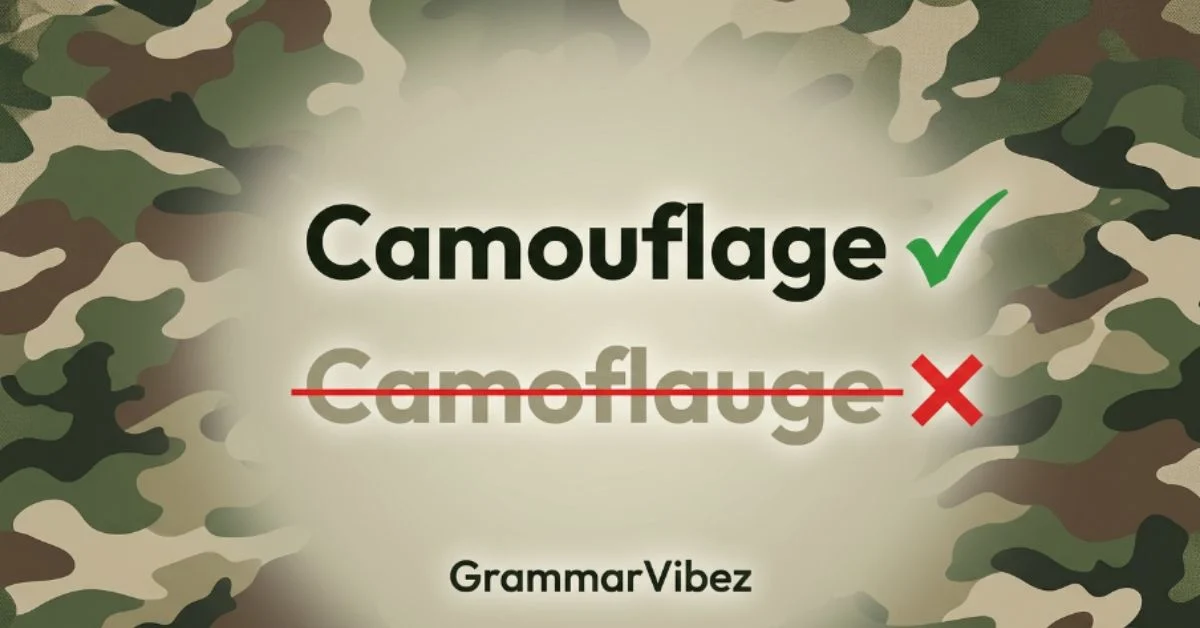
The correct spelling is camouflage.
Camoflauge is a common misspelling and is not recognized as a standard English word.
Correct Example
- The soldier wore camouflage clothing to blend into the forest.
- Many animals use camouflage to avoid predators.
- The hunter selected camouflage gear for the outdoor trip.
Incorrect Example
- The soldier wore camoflauge clothing. ❌
- The animal relied on camoflauge for protection. ❌
- The store sells camoflauge jackets. ❌
Meaning and Usage
The word camouflage refers to concealment or disguise that helps a person, animal, vehicle, or object blend into its surroundings. It can function as both a noun and a verb.
As a noun, camouflage describes a pattern or method of concealment.
- The tank’s camouflage made it difficult to spot.
As a verb, it means to hide or disguise something.
- Trees helped camouflage the military vehicle.
Camouflage is commonly associated with military operations, wildlife survival, hunting equipment, tactical apparel, outdoor recreation, and fashion. Moreover, the term is widely used in photography, environmental science, and zoology.
Because camouflage helps objects remain less visible, it plays an important role in both nature and human activities.
Origin and Spelling History
The word camouflage entered English from French during the early twentieth century. It comes from the French verb camoufler, meaning “to disguise” or “to conceal.”
Initially, the term gained popularity during military operations in major conflicts where soldiers and equipment needed protection from enemy observation.
Consequently, camouflage became a widely recognized concept in military strategy.
Over time, the word expanded beyond warfare. Today, it is frequently used when discussing animal adaptations, hunting techniques, outdoor gear, and even fashion trends.
Meanwhile, the spelling camoflauge developed as a phonetic mistake. Since the letter sequence in camouflage is unusual, many people accidentally transpose letters while typing or writing.
British English vs American English
Unlike many English words, there is no spelling difference between British English and American English.
| Usage | British English | American English |
|---|---|---|
| Correct Spelling | Camouflage | Camouflage |
| Common Misspelling | Camoflauge | Camoflauge |
Therefore, writers in the United Kingdom, the United States, Canada, Australia, and other English-speaking countries use the same standard spelling.
Spelling Comparison
| Feature | Camouflage | Camoflauge |
|---|---|---|
| Standard English Word | Yes | No |
| Dictionary Approved | Yes | No |
| Used in Professional Writing | Yes | No |
| Accepted in Academic Writing | Yes | No |
| Search Engine Recommendation | Yes | No |
| Correct Spelling | Yes | No |
The comparison is simple: camouflage is correct, while camoflauge is incorrect.
Which Spelling Should You Use?
You should always use camouflage.
Whether you’re discussing military uniforms, animal coloration, hunting accessories, tactical equipment, outdoor clothing, or fashion patterns, camouflage is the accepted spelling.
Moreover, dictionaries, educational institutions, publishers, and style guides consistently recognize camouflage as the correct form.
If you write camoflauge, spell-check tools will typically suggest camouflage as the correction.
Therefore, there is never a situation where camoflauge is considered the preferred spelling.
Common Mistakes
Many people make spelling errors because the word contains an uncommon letter arrangement.
Switching the Letters
A frequent mistake is writing:
- Camoflauge ❌
Instead of:
- Camouflage ✅
Writing by Sound Alone
Because English spelling often differs from pronunciation, some writers spell the word exactly as they hear it. As a result, letters become misplaced.
Typing Too Quickly
Fast typing often causes transposed letters. Therefore, proofreading is important, especially in professional documents.
Ignoring Spell Check
Modern writing tools usually identify camoflauge as an error. However, some people overlook correction suggestions and publish the mistake.
Real-Life Examples
Here are practical examples showing correct usage.
Military Context
The soldiers wore camouflage uniforms during training exercises.
Wildlife Context
A chameleon uses camouflage to blend into its environment.
Hunting Context
The hunter selected camouflage clothing to remain less visible.
Fashion Context
Camouflage jackets continue to appear in seasonal fashion collections.
Photography Context
Photographers often wear camouflage gear when photographing wildlife.
These examples demonstrate how widely the word is used across different fields.
Helpful Grammar Tips
Remember these simple tricks to avoid mistakes.
Think of the Ending
The correct word ends with:
-flage
Not:
-flauge
Use a Memory Trick
Think:
CAMOU + FLAGE = CAMOUFLAGE
This helps you remember the proper letter sequence.
Read the Word Slowly
Breaking the word into parts makes it easier to spell correctly:
Cam-ou-flage
Let Technology Help
Spell-check tools, grammar software, and writing assistants can quickly catch errors before publication.
Finally, proofreading remains one of the most effective ways to eliminate spelling mistakes.
FAQs
Is camouflage or camoflauge correct?
Camouflage is correct. Camoflauge is a misspelling.
Why do people misspell camouflage?
People often transpose letters because the word contains an unusual spelling pattern.
Is camoflauge in the dictionary?
No. Major English dictionaries recognize camouflage, not camoflauge.
Is camouflage the same in British and American English?
Yes. Both varieties use camouflage.
Can camouflage be a noun and a verb?
Yes. It can refer to concealment as a noun and the act of disguising as a verb.
What industries commonly use the word camouflage?
Military, wildlife biology, hunting, outdoor recreation, fashion, photography, and environmental science frequently use the term.
Conclusion
The debate between camouflage or camoflauge has a simple answer: camouflage is the only correct spelling.
Although camoflauge appears frequently in online searches and typing errors, it is not accepted in standard English.
Moreover, both British and American English use the same spelling, making the choice straightforward.
Whether you’re discussing military tactics, animal adaptations, hunting apparel, or fashion trends, camouflage is the word you should use.
By remembering the correct letter sequence and proofreading your writing, you can avoid one of the most common spelling mistakes associated with this word.

John E. Warriner shares clear and practical grammar insights at GrammarVibez.com, helping readers understand confusing words and spelling differences with ease and confidence.