Many English learners search for “you’re or your” because these two words are often confused in writing and communication.
They sound exactly the same, but their meanings are completely different. This leads to common mistakes in emails, exams, social media posts, and professional writing.
Even fluent speakers of the English language sometimes write incorrect phrases like “your welcome,” which creates confusion in communication.
The main reason for this confusion is that these words are homophones in Homophone. They sound identical but have different grammar roles.
One is a contraction of “you are,” and the other is a **possessive determiner” in Grammar.
This article will clearly explain the meaning, origin, correct usage, examples, and common mistakes.
You will also learn how to quickly identify the correct word in any sentence. By the end, you will never confuse you’re and your again.
Quick Answer
✔ Simple Rule:
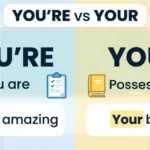
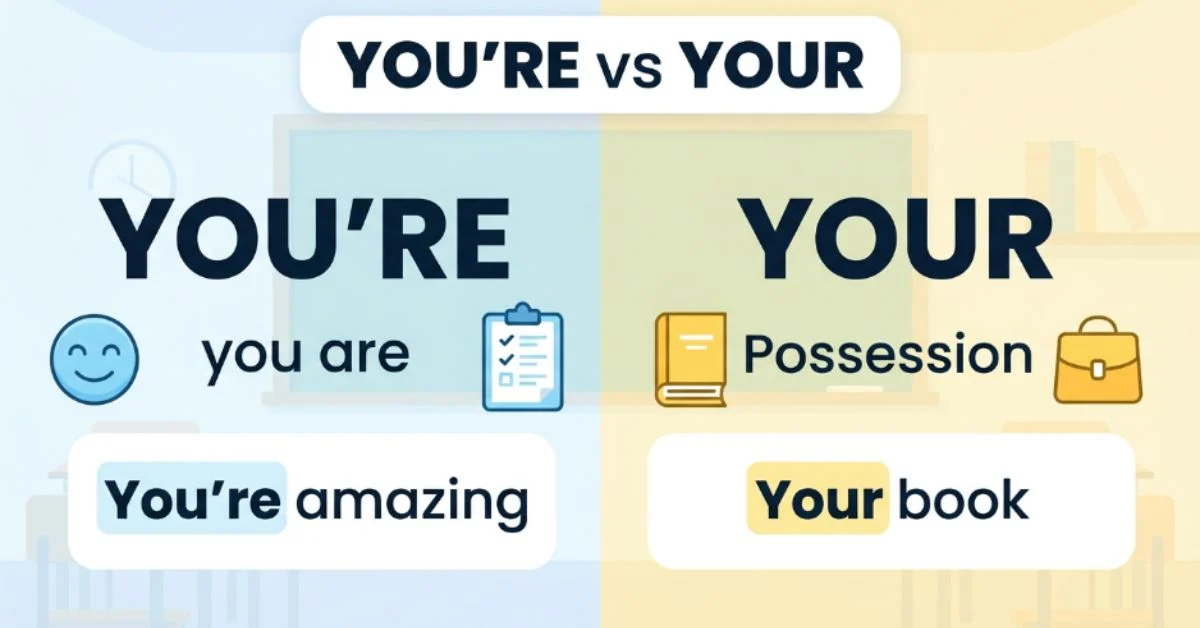
- You’re = You are
- Your = Shows possession (belonging to you)
✔ Examples:
- You’re late → You are late
- Your phone is ringing → The phone belongs to you
👉 Quick test: If “you are” fits, use you’re.
The Origin of You’re or Your
- You’re comes from “you + are” and is called a contraction in Contraction
- Your comes from Old English and has always been used for possession
English developed contractions to make speech faster and easier in everyday communication.
British English vs American English Spelling
There is no difference in spelling between British and American English for you’re and your.
| Word | Meaning | Example |
|---|---|---|
| You’re | You are | You’re happy |
| Your | Possession | Your bag is heavy |
👉 This confusion is grammatical, not regional.
Which Spelling Should You Use?
Use depends on meaning, not country:
- Use you’re when meaning “you are”
- Use your when showing ownership
Audience Guide:
- Global writing → focus on grammar accuracy
- Academic writing → strict correctness required
- Social media → mistakes are common but avoidable
Common Mistakes with You’re or Your
Your welcome
You’re welcome
Your going to school
You’re going to school
I like you’re idea
I like your idea
👉 These errors happen because pronunciation is the same.
You’re or Your in Everyday Examples
📧 Emails
- You’re invited to the meeting
- Please submit your report
📰 News
- You’re watching live coverage
- Your city will experience changes
💬 Social Media
- You’re amazing
- Love your style
🏫 Formal Writing
- You’re required to complete the task
- Your answer is correct
You’re or Your – Google Trends & Usage Data
Search behavior shows:
- “Your” is used more frequently because it appears in ownership sentences
- “You’re” is searched mainly for grammar correction
- High confusion searches:
- you’re or your meaning
- your vs you’re examples
- your welcome correction
Top Countries Searching:
- United States
- United Kingdom
- India
- Pakistan
👉 This shows global confusion among learners of the English language.
Comparison Table (Keyword Variations)
| Phrase | Correct Form | Meaning |
|---|---|---|
| your welcome | you’re welcome | you are welcome |
| your going | you’re going | you are going |
| your idea | your idea | possession |
| you’re idea | incorrect | grammar mistake |
FAQs
1. What is the difference between you’re and your?
You’re means “you are,” while your shows possession.
2. Is “your welcome” correct?
No, correct form is “you’re welcome.”
3. How can I remember easily?
Replace with “you are.” If it fits, use you’re.
4. Are you’re and your homophones?
Yes, they sound the same but have different meanings.
5. Why do people confuse them?
Because they sound identical in speech.
6. Can I use your instead of you’re?
No, both are different grammar forms.
7. Is this mistake common worldwide?
Yes, it is one of the most common English mistakes.
Conclusion
The difference between you’re and your is simple but very important in English grammar. You’re always means “you are,” while your shows possession.
The confusion happens because both words sound the same when spoken, but their meanings are completely different.
Once you understand the simple rule of replacing the word with “you are,” you can easily avoid mistakes in exams, emails, and daily communication.
This small grammar skill improves your writing clarity and makes your English more professional.
With regular practice and awareness, you can completely eliminate this common error and communicate more confidently in both academic and professional settings.