I often see people search “savy or savvy” because both look correct at first glance. But only one spelling is right in English.
This confusion is common for students, writers, and even professionals who want clear and correct communication.
Many people also search for savvy meaning, pronunciation, synonyms, and slang usage.
Some even wonder if “savy” is acceptable in modern English. The truth is simple, but important for writing, SEO, and daily communication.
Trusted sources like the Oxford English Dictionary and Merriam-Webster confirm only one correct form.
In this guide, I will explain the correct spelling, meaning, origin, and real-life examples. By the end, you will confidently use savvy and avoid common mistakes.
Quick Answer
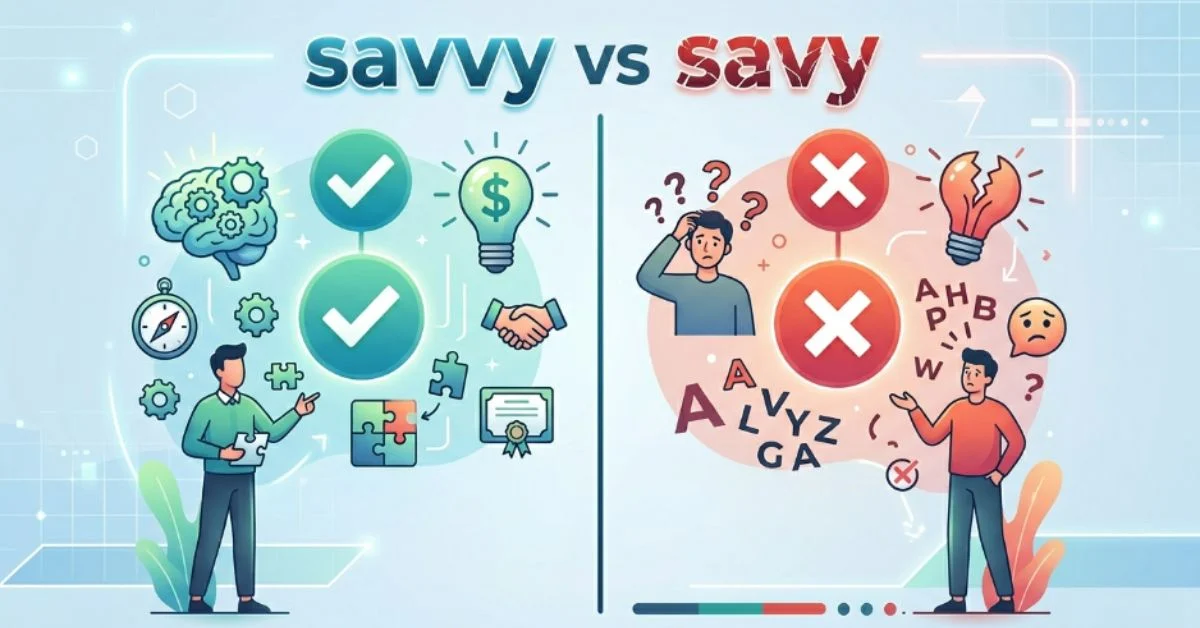
- ❌ Savy = Incorrect spelling
- ✅ Savvy = Correct spelling
Meaning of savvy:
A person who is smart, practical, and knowledgeable.
Examples:
- She is tech-savvy.
- He is business-savvy.
👉 Simple rule: Always use savvy (double “v”)
The Origin of Savy or Savvy
The word savvy comes from French “savez-vous?” meaning “do you know?” Over time, it entered English and became a common word for intelligence and practical knowledge.
This origin is studied in Etymology. The incorrect form “savy” appears because people try to simplify the spelling by removing one “v.”
British English vs American English Spelling
There is no difference between UK and US English.
| Region | Correct Spelling |
|---|---|
| US English | Savvy |
| UK English | Savvy |
| Incorrect | Savy |
👉 Both Cambridge Dictionary and Merriam-Webster use savvy.
Which Spelling Should You Use?
- Students → Savvy
- Business writing → Savvy
- Social media → Savvy
- Global English → Savvy
❌ Never use “savy” in professional or academic writing.
Common Mistakes with Savy or Savvy
❌ Writing “savy” with one “v”
❌ Thinking both spellings are correct
❌ Ignoring double-letter rule
✔ Correct forms:
- tech-savvy
- business-savvy
- media-savvy
👉 Tip: Remember → sav + vy = savvy
Savy or Savvy in Everyday Examples
Emails
- We need a tech-savvy candidate.
News
- Young consumers are more digital-savvy.
Social Media
- Be savvy with your money 💡
Daily Life
- She is very savvy in business decisions.
Savy or Savvy – Google Trends & Usage Data
- Savvy → High global usage (business, tech, marketing)
- Savy → Common typo, searched by learners
👉 Popular contexts:
- Tech-savvy users
- Business-savvy professionals
- Social media captions
Comparison Table: Savy vs Savvy
| Feature | Savvy | Savy |
|---|---|---|
| Correct spelling | ✅ Yes | ❌ No |
| Dictionary word | ✅ Yes | ❌ No |
| Used in English | ✅ Yes | ❌ No |
| Common mistake | ❌ No | ✅ Yes |
| Used in professional writing | ✅ Yes | ❌ No |
FAQs
1. Is savy a correct word?
No, it is a spelling mistake.
2. What does savvy mean?
It means smart, practical, and knowledgeable.
3. Why is savvy spelled with double “v”?
Because of its historical origin and English spelling rules.
4. Is there a UK vs US difference?
No, both use savvy.
5. What is tech-savvy?
It means someone skilled with technology.
6. Is savvy a slang word?
It can be informal, but it is widely accepted in standard English.
7. How do you pronounce savvy?
It is pronounced as “sav-ee”.
Conclusion
Understanding savy or savvy is simple once you know the rule. The correct spelling is savvy, and it is used worldwide in both British and American English.
The incorrect form “savy” is just a common mistake caused by dropping one “v.”
The word savvy has a rich history linked to French and is now widely used in business, technology, and daily communication.
Whether you are writing emails, creating content, or improving your English, using the correct spelling helps you look more professional and confident.
Trusted dictionaries like the Oxford English Dictionary and Merriam-Webster clearly support this.
👉 Final tip:
Always write savvy, never “savy,” and use it in phrases like tech-savvy or business-savvy for strong, clear communication.